How does a cartel determine the price to maximize the joint profit? Evaluate the advantages and disadvantages of cartel for consumers and producers.
How does a cartel determine the price to maximize the joint profit? Evaluate the advantages and disadvantages of cartel for consumers and producers.
(संयुक्त नाफा अधिकतम गर्नका लागि कार्टेलले कसरी मूल्य निर्धारण गर्दछ ? उपभोक्ताहरू र उत्पादकहरूको लागि कार्टेलका फाइदाहरू र बेफाइदाहरू मूल्याङ्कन गर्नुहोस् ।)
Question from
Tribhuvan University MGT 207 · Microeconomics for Business 1 paper
Solution
A cartel is a direct, often secret, agreement among competing oligopolists to promote their common interests, such as maximizing joint profit, reducing uncertainty and avoiding price wars. Agreements may be formal or informal, and both are illegal in most countries. OPEC in the oil market is the best-known example. There are two types of cartel: one aiming at joint profit maximization and one aiming at market sharing.
How a cartel determines price for joint profit maximization:
- Central agency: the member firms set up a central agency and give it the power to decide price, output, quotas and the distribution of profit. The cartel then behaves like a single multi-plant monopolist.
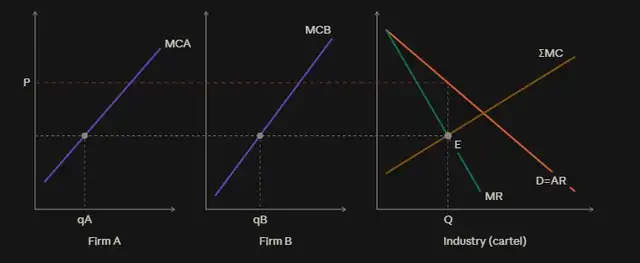
- Industry MC curve: the agency adds up the marginal cost curves of all members horizontally to get the industry marginal cost curve, ΣMC = MCA + MCB + …
- Industry demand and MR: the agency estimates the market demand curve (AR) for the industry and its MR curve.
- Total output and price: joint profit is at its maximum where industry MR = ΣMC. This gives the total industry output OQ. The price OP is read from the demand (AR) curve at that output, and all members must sell at this price.
- Allocation of output (quotas): total output is divided among members so that the MC of each firm equals the common industry MC at equilibrium: MCA = MCB = MR. Low-cost firms produce more and high-cost firms produce less.
- Distribution of profit: the joint profit is shared according to the agreed formula, which need not match each firm’s own output.
The diagram below shows this:
Advantages for producers:
- Higher joint profit: acting like a monopolist, the cartel restricts output and raises the price, so members earn supernormal profit.
- Less uncertainty and no price wars: because interdependence is managed by agreement, firms avoid costly price-cutting and the risks of rivals’ reactions.
- Lower selling costs and stability: less need for competitive advertising, plus stable prices and market shares that make planning easier.
Disadvantages for producers:
- Instability and cheating: each member has an incentive to secretly produce more than its quota or cut prices, so cartels often break down. Disagreements over quotas and profit-sharing are common, especially when costs differ.
- Legal risk: cartels are illegal in most countries, so members face fines and penalties. High profits may also attract new rivals and substitutes.
Effects on consumers:
- Disadvantages: consumers pay higher prices for a smaller output, lose consumer surplus, and have less choice. Without competition, firms have weak incentives to improve quality or innovate, so resources are misallocated, as under monopoly.
- Possible advantages: stable prices and steady supply, with no sudden shortages from price wars. A cartel may also avoid wasteful advertising and allow rationalization of production in low-cost plants.
- Overall evaluation: a cartel benefits producers in the short run but harms consumers and economic efficiency. It is also unstable because of cheating and legal action. This is why most governments ban cartels and promote competition.
A cartel maximizes joint profit by fixing output where industry MR equals ΣMC, charging the price from the demand curve, and allocating quotas so that each firm’s MC is equal. Its gains go mainly to producers, while consumers bear the cost of higher prices and lower output.
Explore more questions
-
1.
Asked in 2082 (15 marks)
Critically analyze the Loanable Fund Theory of interest.
(ब्याजको ऋण योग्य कोषको सिद्धान्तको आलोचनात्मक विश्लेषण गर्नुहोस् ।)
-
2.
Long question Asked in 2082 (15 marks)
The production function of Langtang Cheese Pvt. Ltd. is \( Q = 4L + 11L^2 - L^3 \). Complete the following table.
(लाङटाङ चिज प्रा.लि.को उत्पादन फलन \( Q = 4L + 11L^2 - L^3 \) छ । दिइएको तालिका पूरा गर्नुहोस् ।)
No. of Labor Total Production Average Production Marginal Production 0 1 2 3 4 5 6 7 8 9 a) Analyze the three stages of the Law of Variable proportion for Langtang Cheese Pvt. Ltd. by using above data.
(माथिको तथ्याङ्क प्रयोग गरी लाङटाङ चिज प्रा.लि.का लागि परिवर्तनशील अनुपातको नियमका तीनवटा चरणहरुको विश्लेषण गर्नुहोस् ।)
b) Market price of cheese is Rs.1000 per kg. and the wage rate is Rs 34,000 per month. Using data of the second stage of the Law of Variable proportion, find the equilibrium level of labour and output of the cheese.
(चिजको बजार मूल्य प्रति केजी रु.१००० छ, र ज्याला दर प्रति महिना रु.३४००० छ । परिवर्तनशील अनुपातको नियमको दोस्रो चरणको तथ्याङ्क प्रयोगगरी, श्रम र चिजको उत्पादनको सन्तुलनस्तर पत्ता लगाउनुहोस् ।)
-
3.
Long question Asked in 2082 (10 marks)
Complete the following table. Graph total revenue, average revenue and marginal revenue curves. Explain the relation of total revenue and marginal revenue with price elasticity of demand.
(दिइएको तालिका पूरा गर्नुहोस् । कुलआय, औसतआय र सिमान्त आय वक्रहरूको ग्राफ बनाउनुहोस् । मागको मूल्यलोचसँग कुल आय र सिमान्त आयको सम्बन्ध व्याख्या गर्नुहोस् ।)
Quantity 0 10 20 30 40 50 60 70 Total revenue 0 60 100 120 120 100 60 0 Average revenue marginal revenue -
4.
Asked in 2082 (10 marks)
Why do some long run average cost curves are U-shaped but some are L-shaped? Differentiate with the reasons.
(किनकुनै दीर्घकालिन औसत लागतवक्र U आकारका हुन्छन् तरकुनै दीर्घकालिनऔसत लागतबक्र L आकारका हुन्छन् ? कारणहरु सहित छुट्ट्याउनुहोस् ।)
-
5.
Long question Asked in 2082 (10 marks)
Explain the consumer's equilibrium in cardinal approach. Price apple is Rs.20, price of banana is Rs. 10 and the consumer spends whole income Rs.110 on apple and banana. Find the consumer's equilibrium when the marginal utilities (MU) of apple and banana are as follows:
(संख्यात्मक उपयोगिता विश्लेषण विधिमा उपभोक्ता सन्तुलनको व्याख्या गर्नुहोस् । स्याउको मूल्य रु.२० छ, केराको मूल्य रु. १० छ र उपभोक्ताले आफ्नो सबै आम्दानी रु.११० स्याउ र केरामा खर्च गर्दछ । स्याउ र केराको सिमान्त उपयोगिताहरु निम्नानुसार भएको अवस्थामा उपभोक्ताको सन्तुलन पत्ता लगाउनुहोस् ।)
Units of consumption 1 2 3 4 5 6 7 MU of apple 800 700 600 500 400 300 200 MU of banana 500 450 400 350 300 250 200 -
6.
Asked in 2082 (10 marks)
Explain the degrees of elasticity of supply.
(पूर्तिलोचका श्रेणीहरुको व्याख्या गर्नुहोस् ।)
Question
Open in new tabCouldn't load this question. Open it instead.