This chapter explains how firms and industries decide price and output under perfect competition and monopoly, using equilibrium concepts and the TR–TC and MR–MC approaches.
Concept of Firm and Industry

Introduction:-
In economics, market refers to a mechanism for determining the price of the goods and services and their transaction. The price determination is the most important part of the production.
Microeconomics also focuses on the determination of price. Therefore, it is also known as price theory. A firm produces the output with the purpose of selling in the market. But it has to decide what price to charge on the per unit output and how much to sell at that price. Therefore, the study of the equilibrium of a firm using TR-TC approach and MR-MC approach helps to determine price and output under perfect competition and monopoly.
Concept of firm and industry:-
1. Concept of the firm :-
A firm is an independent unit producing goods and services for sale. It is also defined as a single unit of an industry.
According to P.A. Samuelson and W. D. Nordhaus, “ A firm is a basic private producing unit in an economy. It hires labor, rents or owns capital and land and share goods and services. ” Thus, a firm is a single unit of an industry producing goods and services with the objective of maximizing the profit.
2. Concept of an industry:-
In general sense, industry means the economic activity concerned with the processing of raw materials and manufacturing of goods. But in economics, it is defined as a group of firms producing homogeneous goods or services.
According to P. A. Samuelson and W. D. Nordhaus, “ Industry is a group of firms producing similar or identical products. ” Thus, an industry is a group of manufacturers that produce a particular kind of goods or services.
Concept of Equilibrium

According to Hansen, “A firm will be in equilibrium when it has no advantage to increase or decrease the output." Thus, we can conclude that when a firm is earning a maximum profit or minimizing the loss, it is said to be in equilibrium. There are two methods or approaches for the determination of equilibrium of a firm which is as follows:-
1. Total revenue and the total cost approach (TR-TC approach) 2. Marginal revenue and Marginal cost approach (MR-MC approach)
Equilibrium of an Industry under Perfect Competition
Determination of price and output in the market or industry:-
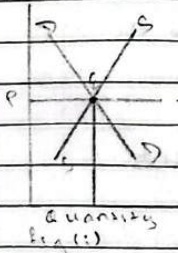
In perfect competition, the equilibrium price and output are determined from the interaction between two market forces: demand and supply. At different prices, different quantities of a commodity are demanded and supplied. The competition between buyers and sellers move the price up and down and finally settle at that point where the quantity demanded becomes equal to the quantity supplied. This is called price determination through interaction between demand and supply.
The process of price determination can be explained by the help of following schedule and diagram:-
| Price per unit (Rs) | Quantity demanded (in Kg) | Quantity supplied (in Kg) | Remarks |
| 5 | 30 | 10 | Excess demand |
| 10 | 20 | 20 | Equilibrium |
| 15 | 10 | 30 | Excess supply |
In the above table, we can see the inverse relationship between price and quantity demanded and a positive relationship between price and quantity supplied. This relation can also be explained by the help of the following diagram:-

Equilibrium of a Firm using TR-TC Approach
1. Total revenue and Total cost approach:-
According to TR-TC approach, a firm gains equilibrium position at that output at which the difference between total revenue and the total cost is maximum. Every rational firm aims to maximize profit. π = TR-TC where; π = profit, TR = Total Revenue and TC = Total Cost
A. Equilibrium of a firm under perfect competition:-
Perfect competition is the market structure in which there are a large number of buyers and sellers selling homogeneous products. A firm is a small part of the whole industry. Price is fixed by the industry. The firm can sell as much as it wants only at the price fixed by the industry. The total revenue curve is an upward sloping line which increases at the same rate in this market. It is generally assumed that Total Cost Curve is inversely ‘S’ shaped. A firm attains equilibrium at that point at which the difference between TR and TC is maximum. It can be presented with the help of the following diagram:-

B. Equilibrium of a firm under monopoly:-
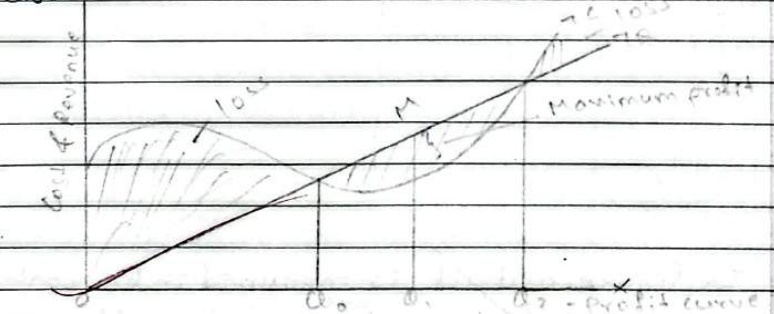
Under monopoly, a firm determines the price of its product itself. The monopoly firm increases its price to increase the revenue or may decrease the price to increase its sales. Therefore, TR curve is inverse ‘S’ shaped. The firm chooses that level of output at which the profit is maximum. The profit is maximized when there is a greater vertical distance between TR and TC curves. It can be explained by the help of the following diagram:-

In the above figure, TR and TC represent Total Revenue and Total Cost Curve. π curve represents the profit curve. Before OQ1 and after OQ3 level of output, the firm bears loss because the total cost is higher than total revenue. From OQ1 to OQ3 level of output, the firm enjoys profit because TR is higher than TC. The maximum profit is the vertical gap MN which is also represented in the π curve as Q2E. The firm is equilibrium at this level of output and does not want to deviate from this point.
Equilibrium of a Firm using MR-MC Approach
MR-MC approach is a very important and useful method for determining the equilibrium of the firm. Under this approach, the following conditions must be fulfilled to attain equilibrium by the firm.
i. Necessary condition:- Marginal revenue should be equal to Marginal Cost i.e. MR=MC.
ii. Sufficient condition:- Marginal Cost curve must intersect the Marginal Revenue curve from below.
The MR-MC approach of determining equilibrium under the perfect competition and monopoly is explained as follows:-
A. Equilibrium of a firm under perfect competition:-
Perfect competition is characterized by a large number of buyers and sellers. Firms produce homogeneous goods and they are taken as the price takers. In this market, the firm has no control over the price. It must sell the products at that price which is determined by the industry. So, the price remains uniform. Therefore, the AR curve and MR curve are the same and parallel to X-axis. MC curve is U-shaped. The determination of equilibrium of a firm under perfect competition using this approach can be shown graphically as follows:-

B. Equilibrium of a firm under monopoly or imperfect competition:-
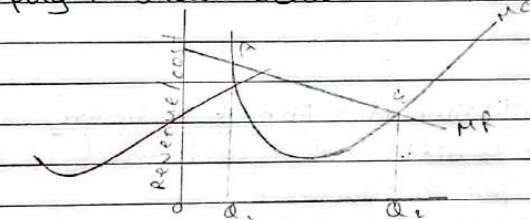
In the monopoly market, the firm is the price maker. It can sell less output at a high price and more output at a low price. So, AR and MR curves slope downward. The MC curve is U-shaped. The equilibrium of the firm under monopoly using MR-MC approach can be explained by the help of the following diagram:-

Price and Output Determination under Perfect Competition (Short Run)
Short-run refers to that time period in which a firm can not change the fixed factors of production. Therefore, a firm cannot change its production process and there may be abnormal profit, normal profit or even loss depending on the firm's revenue and cost. The profit and loss also depends upon the nature of AC and AR, which can be presented as follows:-
- If AR=AC, the firm receives a normal profit.
- If AR> AC, the firm receives abnormal profit.
- If AR< AC, the firm bears the loss.
The profit and loss depend also on the nature of MR and MC and the following conditions must be fulfilled in order to obtain equilibrium in the perfect competition market:
- Market supply must be equal to market demand.
- MC must be equal to MR.
- MC must cut MR from below.
The short-run equilibrium of the firm and industry under perfect competition can be explained by the help of the following diagrams:-

In the above figures, we can see the equilibrium price determination in the industry in the first figure. In the second, third, and fourth figures, the conditions of equilibrium in three different firms are shown under perfect competition, in the short run. There are three possibilities which are as follows:-
1. Abnormal profit (supernormal or excess profit):-
The second figure shows the abnormal profit earned by the firm. The firm earns an abnormal profit when AR is greater than AC. In this figure, E is the equilibrium point because here MR and MC are equal and MC is intersecting MR from below. So, OQ is the equilibrium quantity. The firm is earning abnormal profit equal to the shaded rectangular area. The firm's average cost of production is ‘OC’.
2. Normal profit:-
In the third figure, the firm is in equilibrium at point E. Because at this point MC is intersecting MR from below. The equilibrium output is OQ. The firm is earning just a normal profit because AR and AC are equal at this level of output. It is that profit which is just sufficient to run the business.
3. Loss:-
In the fourth figure, the firm is in equilibrium at point E because, at this point, both necessary and sufficient conditions are fulfilled. The equilibrium output determined by the firm is OQ. At this output, AC is greater than AR. So, the firm is bearing loss equal to the shaded area.
Price and Output Determination under Perfect Competition (Long Run)
In the long run, the firm can enter or exit from the industry depending on profit or loss situation. If profits are high, new firms enter into the industry and if the firms are in loss, they exit from the industry in the long run. Due to this, abnormal profit and loss situations are ruled out in the long-run and the firms will earn just the normal profit.
The following conditions must be fulfilled in order to attain equilibrium in long-run under perfect competition market:-
- The quantity demanded and the quantity supplied must intersect at an equilibrium price.
- LMC must be equal to MR.
- LMC must intersect MR from below.
It can be shown by the following diagram:-

Price and Output Determination under Monopoly (Short Run)
Price and output determination under monopoly in Short-run:
Short-run refers to that period in which a monopolist cannot change the fixed factors. However, the monopolist is free in determining price due to lack of competition. A monopolist has control over the market supply. So, he/ she is the price maker. His/ her price and output determination is motivated by profit as well as sales maximization. Therefore, he/ she will adjust the output in such a way that the marginal cost and marginal revenue are equal.
In short run equilibrium whether the firm makes an abnormal profit, normal profit or loss, it depends on the level of AC and AR which can be shown as follows:-
- If AR=AC, the firm receives a normal profit.
- If AR> AC, the firm receives abnormal profit.
- If AR< AC, the firm bears the loss.
The following conditions must be fulfilled in order to attain equilibrium under monopoly:-
- MR must be equal to MC
- MC must intersect MR from below.
The equilibrium position of a monopoly firm can be graphically presented as follows:-

1. Abnormal profit:-
In the first figure, we see that the equilibrium point is 'E' when MC cuts MR from below. The equilibrium level of output is determined at OQ. The level of revenue earned is OP and the cost incurred is OC. Since Revenue is greater than cost, the firm earns abnormal profit equal to the shaded area (ABPC).
2. Loss:-
In the second figure, point E is the equilibrium point where MC intersects MR from below. The equilibrium level of output is OQ. The cost incurred is OC and the revenue earned is OP. Since cost is higher than revenue, the firm bears loss equal to the shaded area (ABCP).
3. Normal profit:-
In the third figure, we can see that the equilibrium point is at 'E' where the conditions for equilibrium are fulfilled. The equilibrium level of output is OQ. The revenue and cost are at the same level (OP). The firm earns just a normal profit to sustain its business in this case.
Price and Output Determination under Monopoly (Long Run)
Long-run is that time period in which all the fixed and variable factors of production can be altered. The firm can change the size of plant and machinery and can determine the level of output to maximize its profit. Because of this, the firm does not suffer loss. Likewise, the entry of new firms is restricted somehow and the monopolist earns abnormal profit in the long run due to lack of competition.
The following conditions must be fulfilled to attain equilibrium under monopoly in the long run:
i) MR must be equal to LMC. ii) LMC must intersect MR from below. The equilibrium of a monopoly, in the long run, can be graphically presented as follows:-

Similarities between Perfect Competition and Monopoly


1. Objective: Under both market structure, the objective of the firm is to maximize the profit.
2. Equilibrium condition: Under both market structure, the condition of equilibrium is the same. In both markets, MR and MC should be equal and MC must intersect MR from below.
3. The shape of AC and MC: Due to the operation of the law of variable proportion, AC and MC curves under both market structures are ‘U’ shaped.
4. State of profit in the short run: In the short run, under both market structures, there are possibilities of earning an abnormal profit, normal profit and bearing loss as well.
5. The number of buyers: In both markets, there are a large number of buyers.
Differences between Perfect Competition and Monopoly

Differences between perfect competition and monopoly
Basis |
Perfect competition |
Monopoly |
|---|---|---|
| 1. Number of firms | There is a large number of firms in an industry under perfect competition. | In the case of a monopoly, there is only one firm under the industry. |
| 2. Objective | The objective is sales maximization. | The objective is profit maximization. |
| 3. Entry and exit condition | Firms are free to enter and exit from the industry under this market. | In the case of monopoly, there is a strict barrier in the entry and exit of the firm . |
| 4. State of profit | In the long run, a firm earns only a nominal profit in perfect competition | In the case of monopoly, the firm can enjoy supernormal profit in the long run. |
| 5. Nature of AR and MR curves | Under perfect competition, both AR and MR curves are equal and parallel to the x-axis. | Under monopoly, both AR and MR curves are downward sloping. |
| 6. Price | The price is uniform and stable. | The price may change. |
| 7. Buyers and sellers | There are large numbers of buyers and sellers. | There is a single seller and multiple buyers. |
| 8. Price making | They are price takers. | They are price makers. |
| 9. Nature of production | Under perfect competition, the products are homogeneous. | Under monopoly, products are unique. |