Explain the consumer's equilibrium in indifference curve analysis approach.
Explain the consumer's equilibrium in indifference curve analysis approach.
(तटस्थ वक्ररेखा विश्लेषण विधिमा उपभोक्ताको सन्तुलन व्याख्या गर्नुहोस् ।)
Question from
Tribhuvan University MGT 207 · Microeconomics for Business 1 paper
Solution
The indifference curve (ordinal) approach, developed by Hicks and Allen, treats utility as something that can only be ranked, not measured in numbers. Consumer’s equilibrium is the point where a consumer, with a given income and given prices, reaches the highest possible indifference curve and so gets maximum satisfaction. It is found by combining the consumer’s indifference map (what the consumer wants) with the budget line (what the consumer can afford).
The assumptions are:
- Rationality: the consumer aims to maximize satisfaction.
- Ordinal utility: preferences can be ranked but not measured.
- Fixed income and prices: money income and the prices of X and Y are given.
- Non-satiety and transitivity: more is preferred to less, and choices are consistent.
- Diminishing MRS: indifference curves are convex to the origin.
The two tools used are:
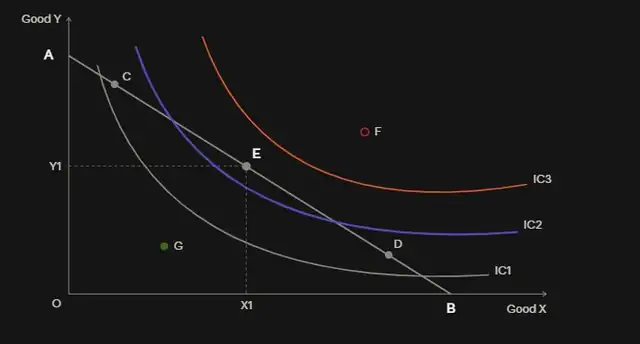
- Indifference map: a set of indifference curves (IC1, IC2, IC3). A higher curve represents higher satisfaction.
- Budget line (AB): this shows all combinations of X and Y the consumer can buy with the whole income, Px·X + Py·Y = B. Its slope is Px / Py.
- Point of equilibrium (E): the budget line AB touches (is tangent to) the indifference curve IC2 at point E. Here the consumer buys OX1 of X and OY1 of Y and gets the maximum possible satisfaction. IC2 is the highest curve the consumer can reach with this income.
- Why other points are not equilibrium:
a. C and D lie on the budget line and are affordable, but they are on the lower curve IC1. By moving along AB toward E, the consumer reaches IC2 at the same cost.
b. G lies inside the budget line, so it is affordable but leaves part of the income unspent.
c. F, and any point on IC3, gives higher satisfaction but lies outside the budget line, so the consumer cannot afford it. - Conditions for equilibrium:
a. Necessary (first-order) condition: the budget line must be tangent to the indifference curve, so the slope of the IC equals the slope of the budget line:
MRSxy = Px / Py = MUx / MUy
The rate at which the consumer is willing to exchange the goods equals the rate at which the market exchanges them.
b. Sufficient (second-order) condition: the indifference curve must be convex to the origin at the point of tangency, meaning the MRS is diminishing there. If the curve were concave, the point of tangency would give minimum, not maximum, satisfaction.
The equilibrium is shown in the figure below:
Explore more questions
-
1.
Asked in 2083 (15 marks)
How do the tax policy, subsidy policy and price control policy of the government affect the market equilibrium?
(सरकारको कर नीति, अनुदान नीति र मूल्य नियन्त्रण नीतिले बजार सन्तुलनलाई कसरी प्रभाव पार्दछन् ।)
-
2.
Asked in 2083 (15 marks)
Critically analyze the Marginal Productivity Theory of Wages.
(ज्यालाको सीमान्त उत्पादकत्वको सिद्धान्तको आलोचनात्मक विश्लेषण गर्नुहोस् ।)
-
3.
Long question Asked in 2083 (15 marks)
Complete the following schedule if the market demand function is D = 1000 - 10P and the market supply function is S = 100 + 20P. (4+3+4+4).
(यदि बजार मागफलन D = 1000 - 10P छ र बजार पूर्ति फलन S = 100 + 20P छ भने, दिइएको सूची पूरा गर्नुहोस्।)
Price Market demand Market supply Shortage/ Surplus Pressure in price 10 20 30 40 50 a) Plot the market demand curve and the market supply curve in a figure. Show the equilibrium price and quantity both in schedule and figure.
(एउटा चित्रमा बजार मागवक्र र बजार पूर्तिवक्र खिच्नुहोस् । सूची र चित्र दुवैमा सन्तुलन मूल्य र परिमाण देखाउनुहोस् ।)
b) Calculate price elasticity of demand
(i) when price increases from 10 to 20 and,
(ii) when price decreases from 20 to 10.
(मागको मूल्यलोच गणना गर्नुहोस् (अ) जब मूल्य रु. १० बाट बढेर रु. २० हुन्छ र (आ) जब मूल्य रु. २० बाट घटेर रु. १० हुन्छ ।)
c) Calculate price elasticity of supply
(i) when price increases from 10 to 20 and,
(ii) when price decreases from 20 to 10.
(पूर्ति लोच गणना गर्नुहोस्
(अ) जब मूल्य रु. १० बाट बढेर रु. २० हुन्छ र,
(आ) जब मूल्य रु. २० बाट घटेर रु. १० हुन्छ ।)
-
4.
Long question Asked in 2083 (10 marks)
Complete the following table and explain the relation between average cost and marginal cost.
(दिइएको तालिका पूरा गर्नुहोस् तथा औसत लागत र सिमान्त लागत बिचको सम्बन्ध व्याख्या गर्नुहोस् ।)
Output TFC TC TVC AVC AC MC 0 24 24 - - - - 1 - 30 - - - - 2 - 32 - - - - 3 - 36 - - - - 4 - 48 - - - - 5 - 74 - - - - 6 - 120 - - - - -
5.
Long question Asked in 2083 (10 marks)
Consider the following two production preference schedules of a producer:
(उत्पादकका निम्न दूईवटा उत्पादन प्राथमिकता सूचीहरुमा ध्यान दिनुहोस् :)
Schedule 1 Schedule 2 Combination K L Output Combinations K L Output A1 10 60 1000 A2 10 75 1500 B1 20 25 1000 B2 20 40 1500 C1 30 10 1000 C2 30 25 1500 D1 40 5 1000 D2 40 15 1500 a. Compute total cost for each combination of capital and labor if price of use of capital is Rs.10, price of labor is Rs.5 and the producer has total cost outlay Rs.400 and identify the least cost combination.
(यदि पूँजीको प्रयोगको मूल्य रु. १० श्रमको मूल्य रु. ५ छ र उत्पादकसँग कूल लागत खर्च रु. ४०० छ भने पूँजी र श्रमको हरेक संयोगको कूल लागत गणना गर्नुहोस् र न्यूनतम लागत संयोग पत्ता लगाउनुहोस्।)
b. Sketch the isoquants \( \text{IQ}_1 and \text{IQ}_2 \) by using schedule 1 and schedule 2 respectively and sketch the isocost line also. Identify the optimal combination of capital and labor in figure.
(सूचि १ र सूचि २ प्रयोग गरेर सम उत्पादन रेखाहरू क्रमशः \( \text{IQ}_1 र \text{IQ}_2 \) खिच्नुहोस् तथा सम लागत रेखा समेत खिच्नुहोस् । चित्रमा पूँजी र श्रमको अधिकतम संयोग पत्ता लगाउनुहोस् ।)
-
6.
Asked in 2083 (10 marks)
How does a monopoly firm determine price in short run? Explain.
(अल्पकालमा एउटा एकाधिकार फर्मले मूल्य निर्धारण कसरी गर्दछ ? व्याख्या गर्नुहोस् ।)
Question
Open in new tabCouldn't load this question. Open it instead.