How do the tax policy, subsidy policy and price control policy of the government affect the market equilibrium?
How do the tax policy, subsidy policy and price control policy of the government affect the market equilibrium?
(सरकारको कर नीति, अनुदान नीति र मूल्य नियन्त्रण नीतिले बजार सन्तुलनलाई कसरी प्रभाव पार्दछन् ।)
Question from
Tribhuvan University MGT 207 · Microeconomics for Business 1 paper
Solution
Market equilibrium is the point where quantity demanded equals quantity supplied, which fixes the equilibrium price and quantity. Marshall compared demand and supply to the two blades of a pair of scissors. The government often intervenes in this equilibrium through taxes, subsidies and price controls to raise revenue, support producers or protect consumers. These policies either shift the supply curve or fix the price directly, so they change the equilibrium.
A. Effect of tax policy
- Meaning: the main purpose of a tax is to raise government revenue. An indirect tax such as VAT, excise duty or sales tax also raises the cost of production.
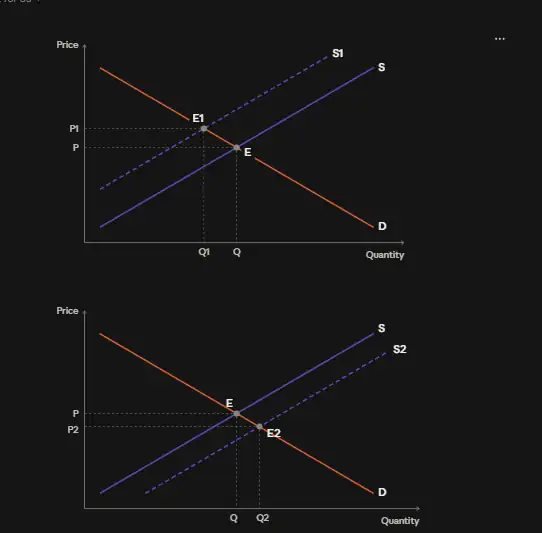
- Shift in supply: because costs rise, the supply curve shifts to the left (upward), from S to S1, by the amount of the tax per unit.
- New equilibrium: equilibrium moves from E to E1. The price rises from P to P1 and the quantity falls from Q to Q1.
- Example: a higher excise duty on imported cars in Nepal raises their price and reduces the number of cars sold.
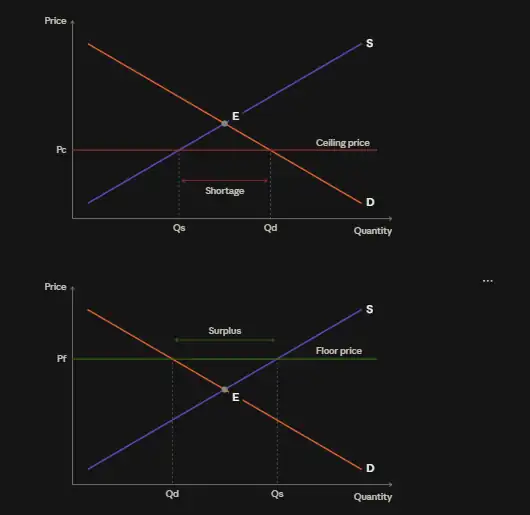
Effect on efficiency: taxes, ceilings and floors move the market away from the competitive equilibrium, where MB equals MC, so total surplus falls. A subsidy raises output above the efficient level and costs the government money.
Explore more questions
-
1.
Asked in 2083 (15 marks)
Critically analyze the Marginal Productivity Theory of Wages.
(ज्यालाको सीमान्त उत्पादकत्वको सिद्धान्तको आलोचनात्मक विश्लेषण गर्नुहोस् ।)
-
2.
Long question Asked in 2083 (15 marks)
Complete the following schedule if the market demand function is D = 1000 - 10P and the market supply function is S = 100 + 20P. (4+3+4+4).
(यदि बजार मागफलन D = 1000 - 10P छ र बजार पूर्ति फलन S = 100 + 20P छ भने, दिइएको सूची पूरा गर्नुहोस्।)
Price Market demand Market supply Shortage/ Surplus Pressure in price 10 20 30 40 50 a) Plot the market demand curve and the market supply curve in a figure. Show the equilibrium price and quantity both in schedule and figure.
(एउटा चित्रमा बजार मागवक्र र बजार पूर्तिवक्र खिच्नुहोस् । सूची र चित्र दुवैमा सन्तुलन मूल्य र परिमाण देखाउनुहोस् ।)
b) Calculate price elasticity of demand
(i) when price increases from 10 to 20 and,
(ii) when price decreases from 20 to 10.
(मागको मूल्यलोच गणना गर्नुहोस् (अ) जब मूल्य रु. १० बाट बढेर रु. २० हुन्छ र (आ) जब मूल्य रु. २० बाट घटेर रु. १० हुन्छ ।)
c) Calculate price elasticity of supply
(i) when price increases from 10 to 20 and,
(ii) when price decreases from 20 to 10.
(पूर्ति लोच गणना गर्नुहोस्
(अ) जब मूल्य रु. १० बाट बढेर रु. २० हुन्छ र,
(आ) जब मूल्य रु. २० बाट घटेर रु. १० हुन्छ ।)
-
3.
Long question Asked in 2083 (10 marks)
Complete the following table and explain the relation between average cost and marginal cost.
(दिइएको तालिका पूरा गर्नुहोस् तथा औसत लागत र सिमान्त लागत बिचको सम्बन्ध व्याख्या गर्नुहोस् ।)
Output TFC TC TVC AVC AC MC 0 24 24 - - - - 1 - 30 - - - - 2 - 32 - - - - 3 - 36 - - - - 4 - 48 - - - - 5 - 74 - - - - 6 - 120 - - - - -
4.
Long question Asked in 2083 (10 marks)
Consider the following two production preference schedules of a producer:
(उत्पादकका निम्न दूईवटा उत्पादन प्राथमिकता सूचीहरुमा ध्यान दिनुहोस् :)
Schedule 1 Schedule 2 Combination K L Output Combinations K L Output A1 10 60 1000 A2 10 75 1500 B1 20 25 1000 B2 20 40 1500 C1 30 10 1000 C2 30 25 1500 D1 40 5 1000 D2 40 15 1500 a. Compute total cost for each combination of capital and labor if price of use of capital is Rs.10, price of labor is Rs.5 and the producer has total cost outlay Rs.400 and identify the least cost combination.
(यदि पूँजीको प्रयोगको मूल्य रु. १० श्रमको मूल्य रु. ५ छ र उत्पादकसँग कूल लागत खर्च रु. ४०० छ भने पूँजी र श्रमको हरेक संयोगको कूल लागत गणना गर्नुहोस् र न्यूनतम लागत संयोग पत्ता लगाउनुहोस्।)
b. Sketch the isoquants \( \text{IQ}_1 and \text{IQ}_2 \) by using schedule 1 and schedule 2 respectively and sketch the isocost line also. Identify the optimal combination of capital and labor in figure.
(सूचि १ र सूचि २ प्रयोग गरेर सम उत्पादन रेखाहरू क्रमशः \( \text{IQ}_1 र \text{IQ}_2 \) खिच्नुहोस् तथा सम लागत रेखा समेत खिच्नुहोस् । चित्रमा पूँजी र श्रमको अधिकतम संयोग पत्ता लगाउनुहोस् ।)
-
5.
Asked in 2083 (10 marks)
How does a monopoly firm determine price in short run? Explain.
(अल्पकालमा एउटा एकाधिकार फर्मले मूल्य निर्धारण कसरी गर्दछ ? व्याख्या गर्नुहोस् ।)
-
6.
Asked in 2083 (10 marks)
Explain the consumer's equilibrium in indifference curve analysis approach.
(तटस्थ वक्ररेखा विश्लेषण विधिमा उपभोक्ताको सन्तुलन व्याख्या गर्नुहोस् ।)
Question
Open in new tabCouldn't load this question. Open it instead.