Algae
The term algae have been derived from a Latin word alga meaning seaweed. The study of algae is known as phycology or algology. There are about 1560 genera with 17535 species of algae (Smith 1955). Some of the general characteristics of algae are as following:
- They are autotrophic thallophytes
- Cell wall is made up of cellulose
- The reserve food is stored in the form of starch
- The photosynthetic pigments are chlorophylls, carotenoids, xanthophylls and phycobilins
- Reproduction takes place by vegetative, asexual and sexual methods.
- Asexual reproduction takes place by motile and non-motile spores.
Eg: Spirogyra, Laminaria, Zygnema etc.
Types of algae
- Chlorophyceae
- Phaeophyceae
- Rhodophyceae
Chlorophyceae
- They are known as green algae.
- They comprise 425 genera and 7000 species.
- They are mostly grown in fresh water.
- Cell wall is outer pectic & inner cellulosic layer.
- The reserve foods are stored in the form of starch.
- They range from microscopic unicellular to multicellular.
- Reproduction takes place by vegetative, asexual & sexual methods.
- Asexual reproduction takes place by the formation of motile zoospore & aplanospores.
- Sexual reproduction is isogamous, anisogamous & oogamous.
Phaeophyceae
- They are known as brown algae.
- They comprise 240 genera and 2000 species.
- They are mostly grown in marine water.
- Cell wall is outer phycolloids & inner cellulosic layer. They are multi-cellular.
- The reserve foods are stored in the form of mannitol, fat.
- Reproduction takes place by vegetative, asexual & sexual methods.
- Asexual reproduction takes place by the formation of zoospore.
- Sexual reproduction is isogamous, anisogamous & oogamous.
Rhodophyceae
- They are known as red algae.
- They comprise 400 genera and 5000 species.
- They are mostly grown marine water & few.
- The reserve foods are stored in the form of floridean starch; cell wall is outer pectic & inner cellulosic layer.
- They are usually multicellular & few are unicellular.
- Reproduction takes place by vegetative, asexual & sexual methods.
- Asexual reproduction takes place by the formation of non-motile spores.
- Sexual reproduction is only oogamous.
Spirogyra
Kingdom: Plantae
Division: Chlorophyta
Class: Chlorophyceae
Order: Conjugales
Family: Zygnemaceae
Genus: Spirogyra
Species: zonata
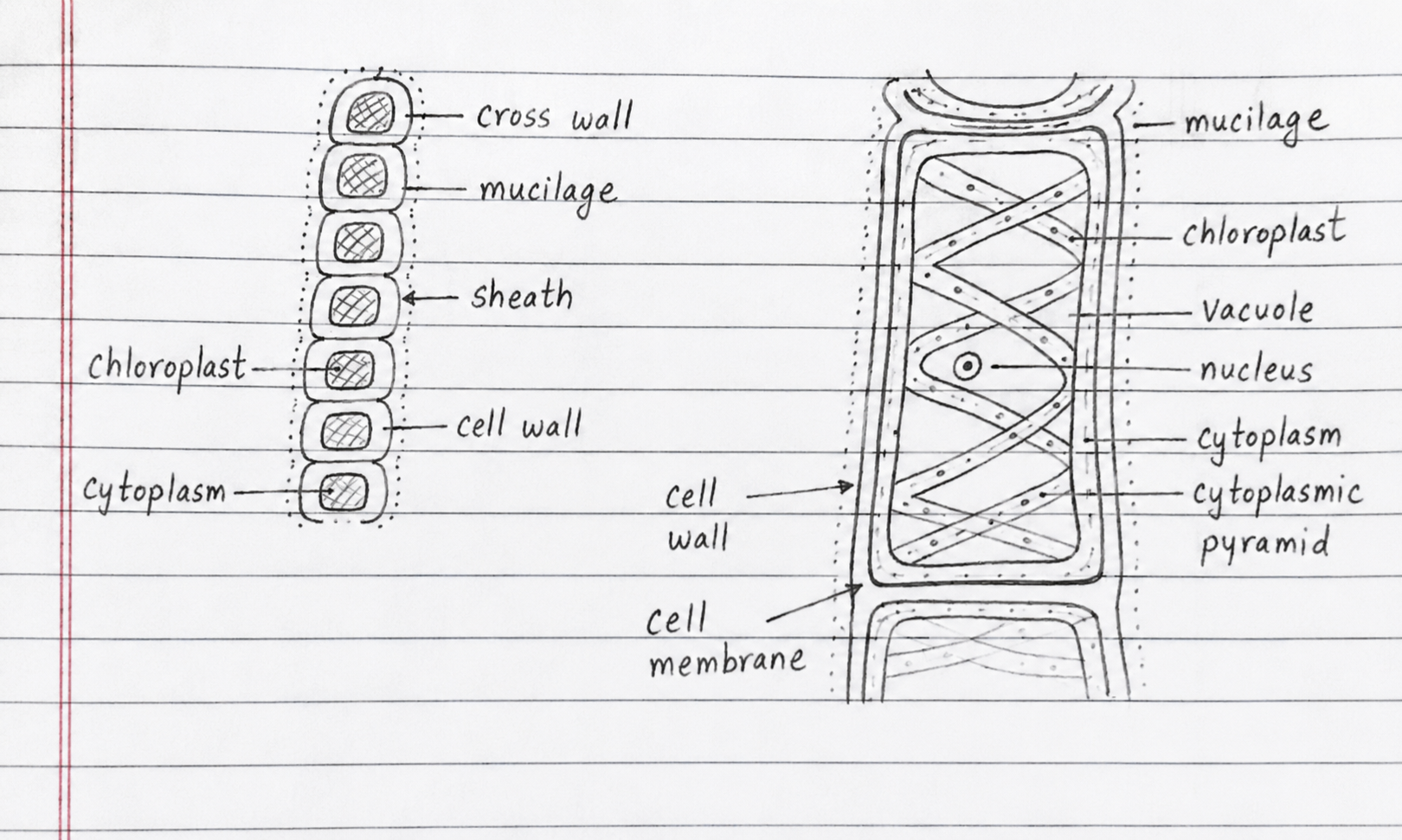
Spirogyra is green algae found in fresh water like ponds, rivers, lakes, streams etc. It is commonly known as pond silk or water silk or pond scum. It remains attached on the substratum by means of holdfast. It is slippery in touch due to presence of mucilaginous sheath. The filament is a long-hair or thread like structure where cells are placed one above another in a single row. The body is thallus. The cell is rectangular in shape surrounded by cell wall made up of cellulose. There is presence of large central vacuoles. There are presence of ribbon shaped spirally coiled chloroplast. Reserve food material is stored in the starch which is found in the pyrenoids.
Spirogyra reproduce by vegetative, asexual and sexual methods.
1) Vegetative reproduction
It takes place by fragmentation. It takes place during favorable conditions. The filament breaks up into smaller fragments due to mechanical injury or decay of intercalary regions. Each fragment develops into new filaments.
2) Asexual reproduction
It takes place by akinete, aplanospores and parthenospores formation.
- a) Akinete: During unfavourable condition, the entire protoplast of the vegetative cell loses water, becomes contract spore like structure and secrete thick wall around them is known as akinete. On the return of favourable condition the akinete develops into new filaments.
- b) Aplanospores: They are the thin walled non-motile spores which develop singly inside the vegetative cell due to the loss of water from the protoplast. On the return of favourable condition the aplanospores develops into new filaments.
- c) Parthenospores: When the gametes fail to fused together during sudden changes in the environment the gametes become round off and secrete a thick walled around and behave as zygospore. Such zygospores are called azygospores or parthenospores.
3) Sexual reproduction
It is isogamous since there is no difference in the shape of gametes. It takes place by conjugation. The conjugation occurs in the following methods:
a) Lateral conjugation: It is also known as homothallic mode of sexual reproduction. The entire contents of the cells of the filaments round off to form male and female gametes. The wall of the filament in between the two cells develops a small outgrowth called papillae. The common wall gets partially dissolved and forms a minute pore called conjugation tube. The male gamete migrates through the conjugation tube and gets fused with female gamete and forms zygote. The zygote secrets thick wall around it and form spore like structure called zygospore. The zygospore undergoes resting period during unfavorable condition into new filaments on the return of favourable condition.
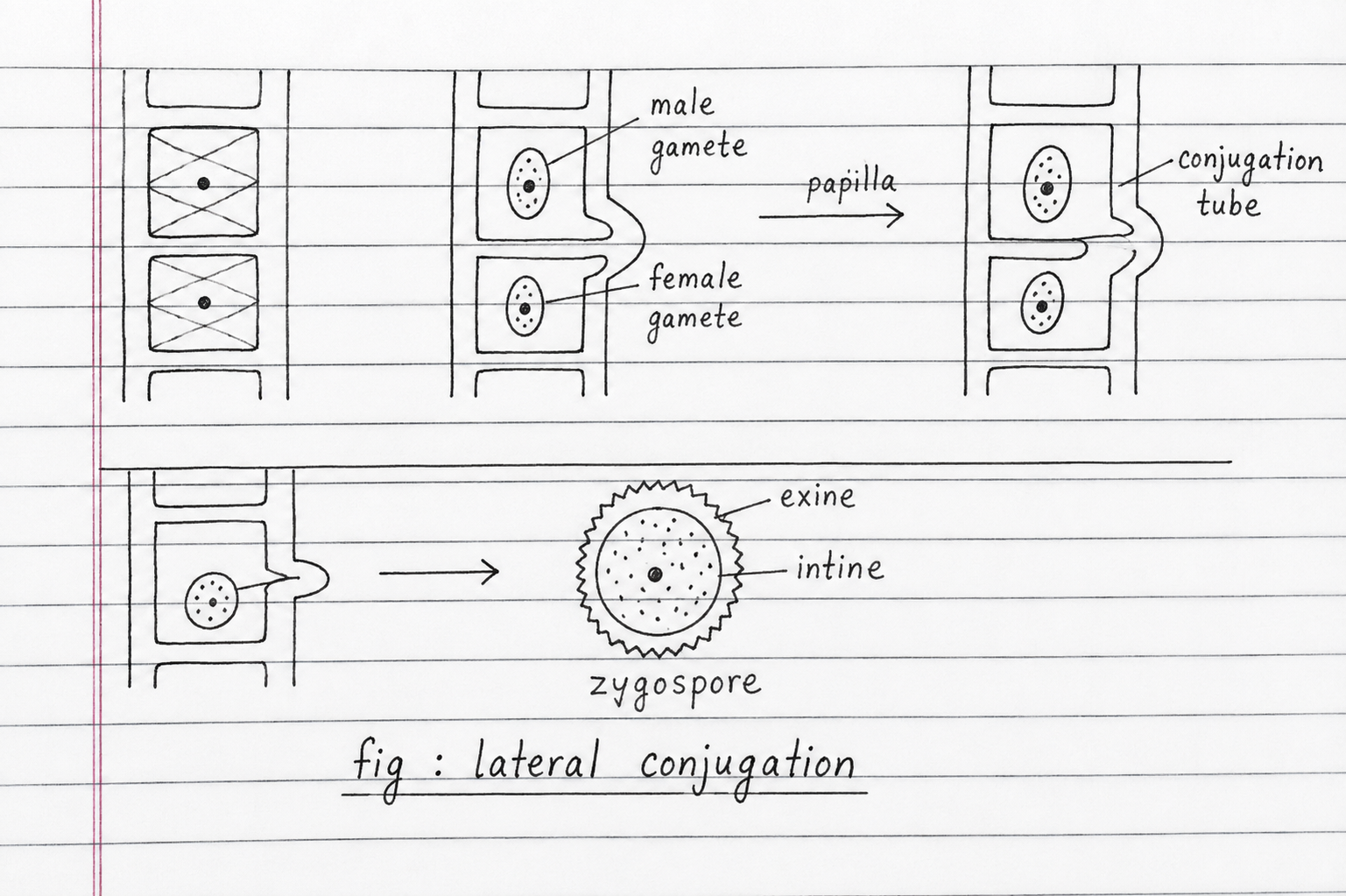
Fig: lateral conjugation
b) Scalariform conjugation: It is also known as heterothallic mode of sexual reproduction. It occurs among the two filaments. The two filaments of opposite strains come closer to each other and hold together by mucilaginous substances secreted by both the filament. The entire content of the cells of the filament round off to form gametes. Small protuberance develops from each cell of both the filaments facing opposite to each other. The protuberance meet at the center and the wall of contact get dissolves by secretion of enzymes. As a result minute pore is formed called conjugation tube. The male gamete of the conjugating cells migrate towards the another filament's conjugating cells through the conjugation tube and get fused with the female gamete to form a zygote. The zygote secrets thick wall around it and form spore like structure called zygospore. The zygospore undergoes resting period during unfavorable condition and develops into new filament on the return of favourable condition.
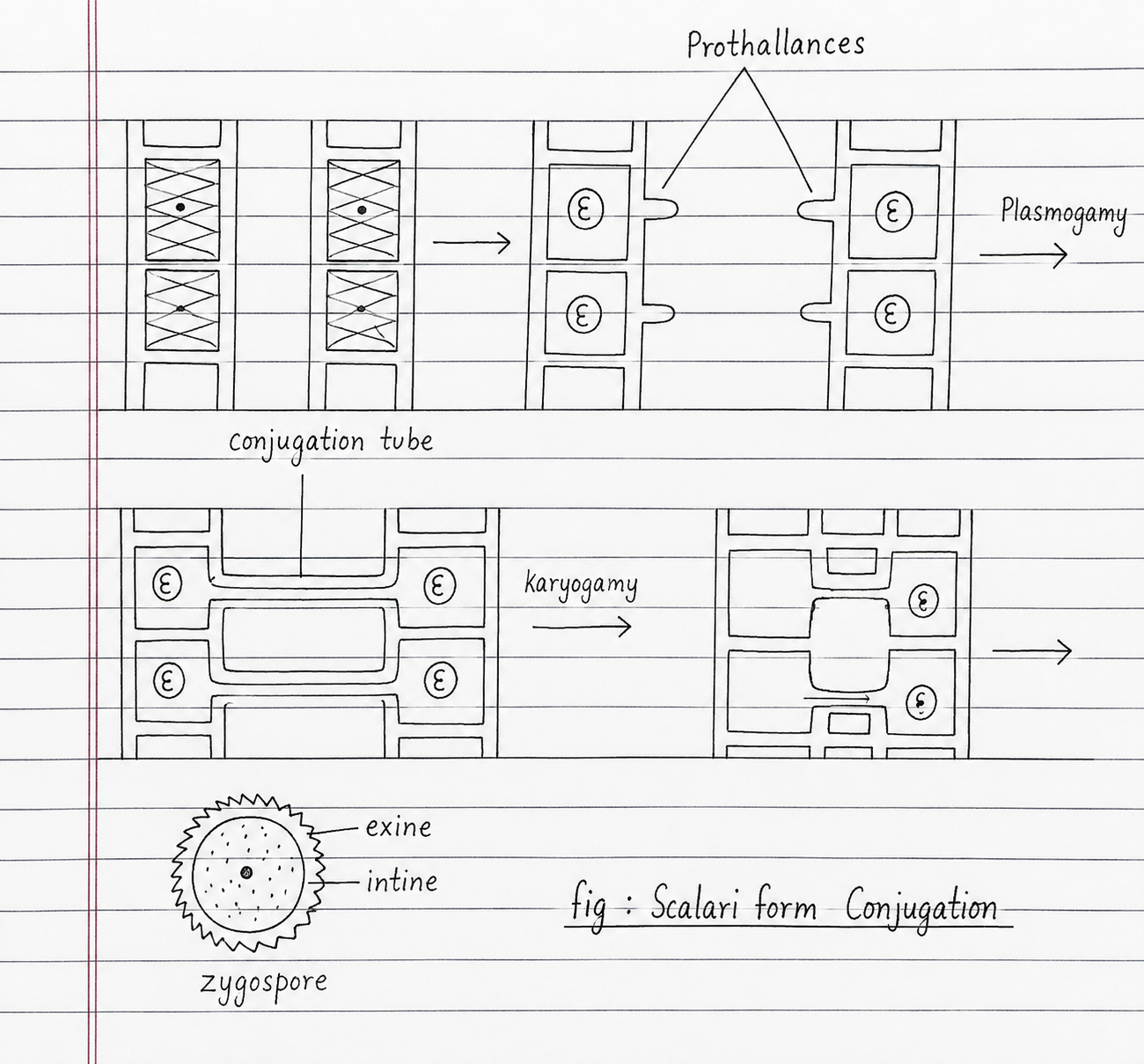
Fig: Scalariform conjugation
Germination of zygospore
The zygospore is a thick wall resting spore. It is surrounded by two walls — outer exine and inner intine. The zygospore undergoes rest during unfavourable condition. On the return of favorable condition, the zygospore germinates. Before germination, it under goes meiosis and four haploid nuclei are formed. Out of four, three nuclei get degenerate and one becomes functional. The zygospore absorbs water and swells. The exine gets rupture and intine comes out in the form of germ tube. It undergoes repetitive mitotic division and new filaments are formed.
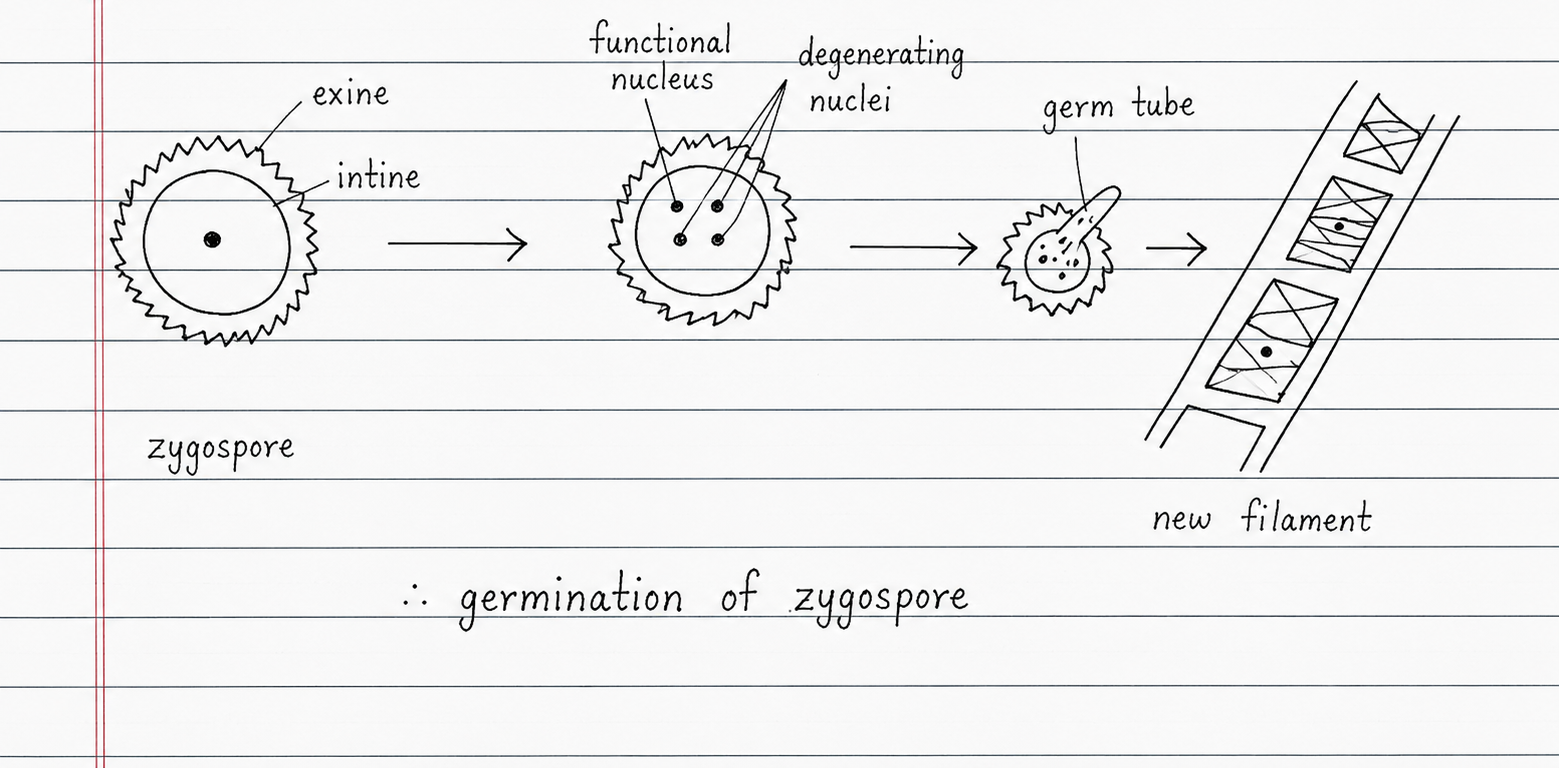
Fig: germination of zygospore