Pteridophyta
The pteridophyte means plant with feather like fronds. They are also called vascular cryptogams because they are the non-flowering plants having vascular tissues i.e. xylem and phloem. In Nepal, 31 families, 103 genera and 383 species of ferns have been reported so far. They are truly land plants that grow well in moist, shady and cool places. Some species are aquatic and few of them are epiphytes.
General characteristics of pteridophytes
- The plant body is sporophyte, usually differentiated into roots, stem and leaves.
- They are non-flowering plants.
- They possess vascular tissues i.e. xylem and phloem.
- Reproduction takes place by spores produced inside the sporangia.
- The plants show clear alternation of generation.
Dryopteris
Kingdom — Plantae
Division — Tracheophyta
Sub-division — Pteridophyta
Class — Pteropsida
Order — Filicales
Family — Polypodiaceae
Genus — Dryopteris
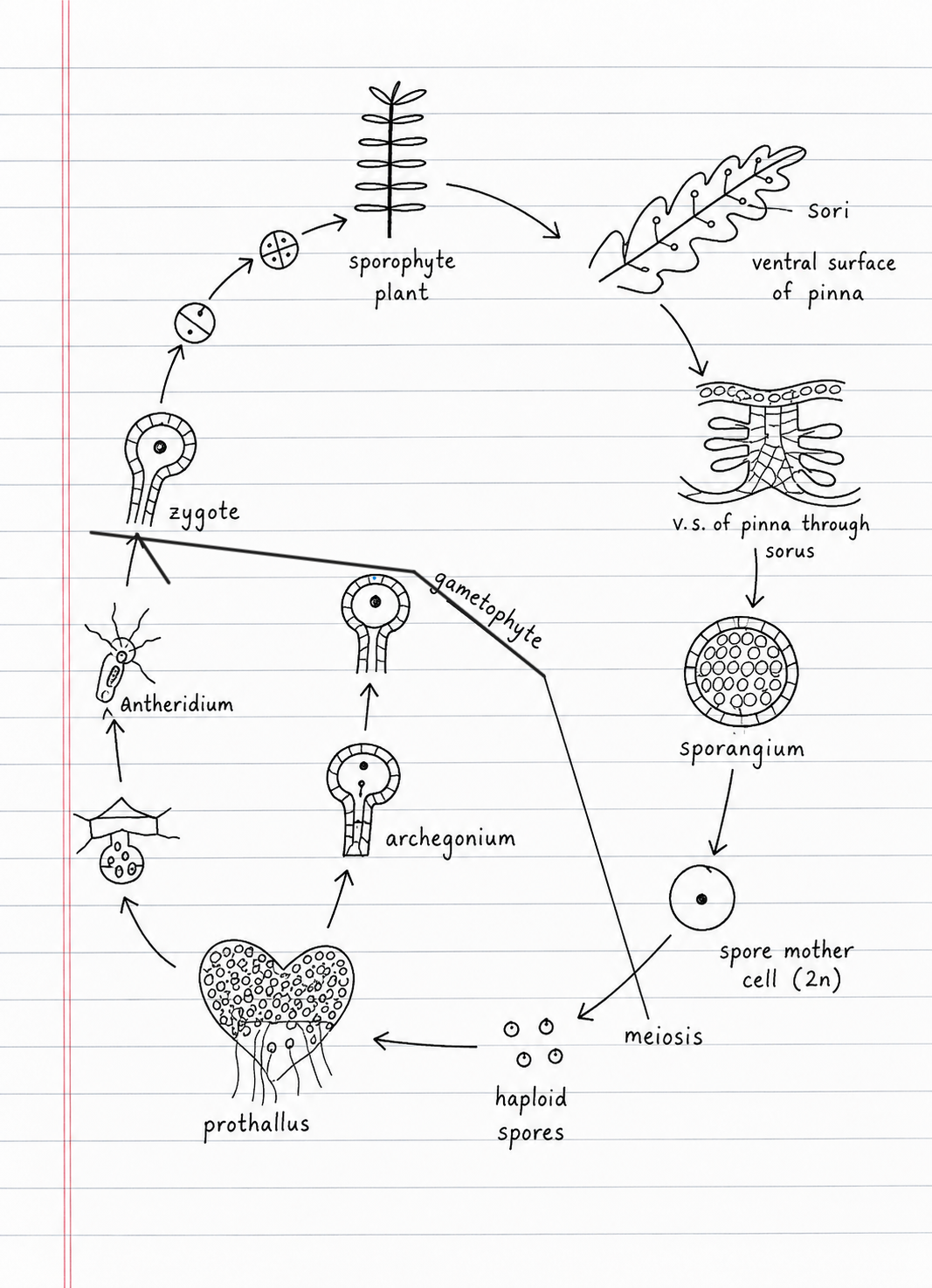
The fern is commonly found growing on moist and shady places. They are cosmopolitan in distribution. The plant body is sporophyte which produces spores. The sporophyte is differentiated into root, stem and leaves. The root is true root and the stem is highly reduced and underground called rhizome. The leaf is called sporophyll as it produces spores. The young leaves are highly coiled in structure; such structure are called circinate and are covered with brownish coloured hair or scale like structure called ramenta. The stalk of the leaf is called petiole. The main axis of the leaf is called rachis. The leaf bears leaflets called pinnae. The pinnae are made up of pinnules. The entire leaf is also called frond.
Reproduction
In fern, reproduction takes place by vegetative, asexual and sexual methods.
1) Vegetative reproduction
It takes place by the fragmentation of rhizomes and development of adventitious buds.
- a) Fragmentation: The rhizome is dichotomously branched. The rhizomes are separated into two fragments by the progressive death and decay of the older parts of rhizome up to dichotomy. Each of the fragments grows and develops into new independent plant.
- b) Adventitious buds: Adventitious buds arise in the axil of leaves and are detached from the plant and form new plant.
2) Asexual reproduction
The asexual reproduction takes place by spores. The spores are produced on sporangia. The sporangia are found on sori. The sori are kidney shaped brown coloured structure found on the ventral surface of pinnae. Thus the leaves are also called sporophyll as they produce spores. Each sorus consists of parenchymatous cells called placenta. The number of sporangia are developed on both side of the placenta. Each sporangium has a biconvex capsule and a long stalk. The capsule is surrounded by a thick layer called jacket. The jacket has thickening called annulus. The annulus is discontinued in certain region called stomium. The capsule of sporangia consists of sporogenous cells called spore mother cells. Spore mother cell undergoes meiosis and haploid spores are formed. On each sporangium about 32-64 spores are produced. At maturity, the wall of the sporangium ruptures along the stomium and spores are released. The spores on getting suitable substratum develop into heart shaped gametophyte called prothallus.
3) Sexual reproduction
The sexual reproduction is highly advanced oogamous type. The spores are the beginning of gametophyte. The spores on germination give rise to minute, green and heart shaped structure called prothallus. All cells of the prothallus contain chloroplast and can prepare their food by the photosynthesis process. The prothallus develops rhizoids from the posterior end of the prothallus and survive independently. The male sex organs called antheridia are found on the posterior end of the prothallus. The female sex organs called archegonia are found on the anterior end of the prothallus near the apical notch.
Antheridium: Each antheridium is multicellular structure. The antheridium consists of mass of androgonal cells called androcytes. At maturity, the androcytes are released and metamorphosed into multi-flagellated antherozoids which are the male gametes.
Archegonium: Each archegonium is flask-shaped in structure. It consists of venter and a neck. The venter consists of a large egg cell and a smaller ventral canal cell. The neck consists of 4-6 rows of neck canal cells.
Fertilization: It takes place in the presence of water. The multi-flagellated antherozoids are released. The ventral canal cell and neck canal cells of archegonium disintegrate and the tip of the neck ruptures. The antherozoids swims in water, reaches to the venter and fused with egg to form zygote.
Sporophyte: The zygote mitotically divides into 2-celled embryos. The embryo undergoes repeated mitotic division and young sporophyte is formed. The sporophyte is differentiated into roots, stems and leaves.