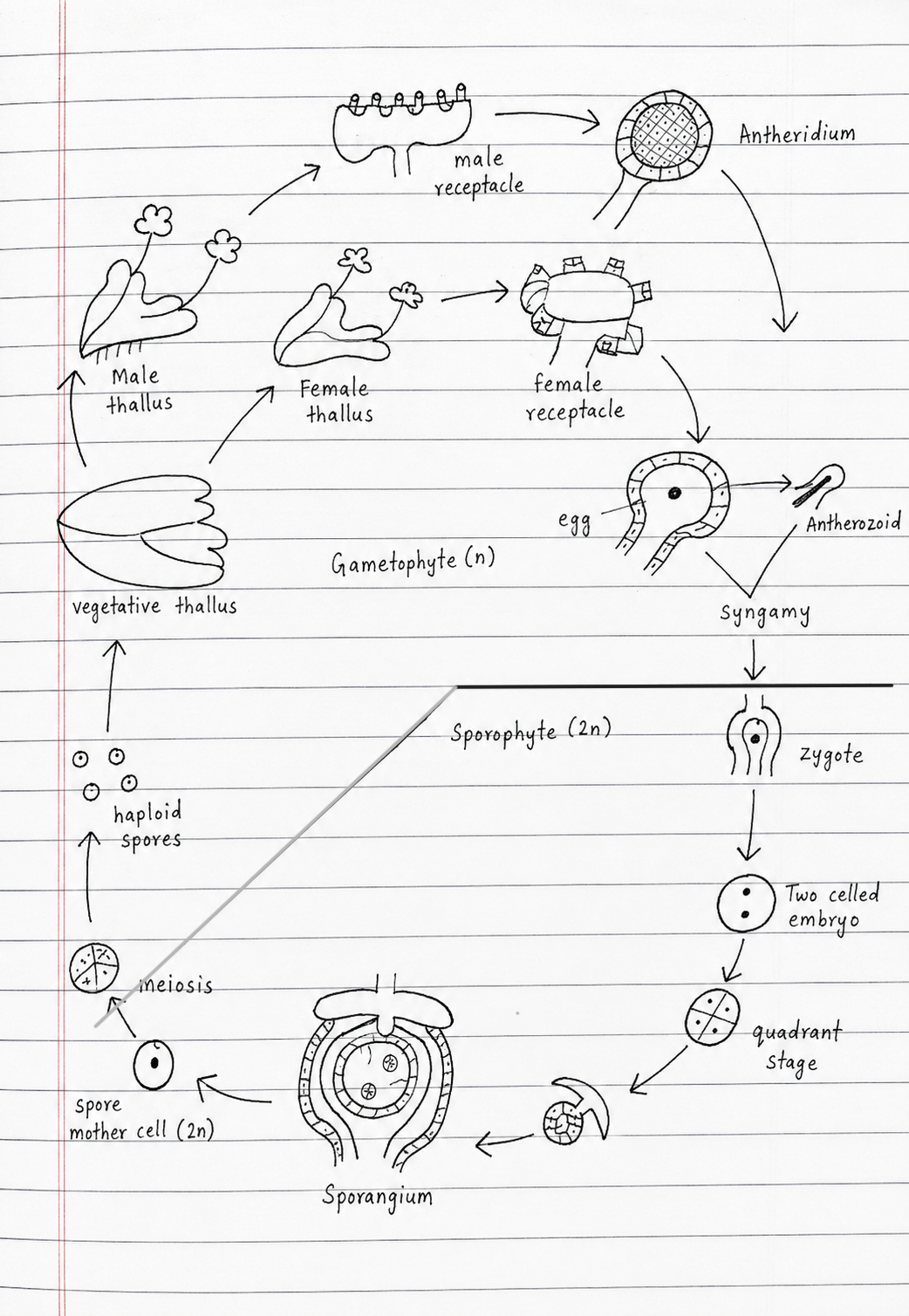
Bryophyta
The term bryophyta is used as a collective name to represent a group of plants that includes liverworts, hornworts and mosses growing predominantly in amphibious environment. In Nepal about 180 genera and 853 species of bryophytes are reported. Its types:
- Hepaticopsida (Liverworts)
- Anthocerotopsida (Hornworts)
- Bryopsida (Mosses)
General characteristics of Bryophyta
- They are generally grown in moist and shady places.
- The vascular tissues (xylem & phloem) are absent.
- They are called amphibian plants because they need water during fertilization to complete their life cycle.
- The haploid gametophytic generation is dominant in the entire life cycle.
- The sexual reproduction is highly advanced oogamous type.
- They show distinct alternation of haploid gametophytic and diploid sporophytic generation.
Marchantia
Kingdom: Plantae
Division: Bryophyta
Class: Hepaticopsida
Order: Marchantiales
Family: Marchantiaceae
Genus: Marchantia
Occurrence
Marchantia includes about 65 species distributed all over the world. It is commonly known as liverworts. They grow in moist and shady places such as on the rock, soils, logs of wood, bank of stream, on the walls etc. Three species of Marchantia are reported in Nepal: Marchantia polymorpha, Marchantia nepalensis.
Structure
Plant body is thallus. The thallus is not differentiated into root, stem and leaves. The thallus is dorso-ventrally flattened and dichotomous branched. At the tip of each branch there is presence of a growing apex called apical notch. Along the line of mid vein there are presence of cup like structure called gemma cup. On the ventral surface there are presence of rhizoid and scales. The rhizoids are two types: smooth walled and tuberculated. The scales are also two types: ligulate and appendiculate.
male receptacles
Reproduction
1) Vegetative reproduction
a) Fragmentation
The thallus of the Marchantia breaks up into smaller fragments. During fragmentation, the thallus starts to decay from the posterior end. The decomposition reaches up to the dichotomy and thallus breaks up into two segments.
b) Adventitious branches
Small branches develop on both the lateral sides of the thallus such branches are called adventitious branches. Each adventitious branch develops into new thallus.
c) Gemmae
The gemmae are produced in the gemma cup. They are found on the dorsal surface of the thallus, along the midrib. Each gemma is multicellular, bilaterally symmetrical discoid body supported by single stalks. It is a multicellular structure having notches on the lateral sides. The majority of cells of it contain chlorophylls except rhizoidal cells and oil cells. At maturity, the gemma breaks its connection from the stalk cell and carried out by various agencies like water current, wind and animals.
2) Sexual reproduction
The sexual reproduction is highly advanced oogamous types. Marchantia plants are dioecious i.e. male and female sex organs develop in separate thalli.
Alternation of generation
The sequential alternation of haploid gametophyte and diploid sporophyte generation is called alternation of generation. The haploid gametophyte generation begins with meiosis by the formation of spores and ends with fertilization by the formation of zygote. Similarly diploid sporophyte generation begins with fertilization by the formation of zygote and ends with meiosis by the formation of spores.
Female thallus
The female sex organ is called archegonia. It is found on the aerial out growth called archegoniophore. The archegoniophore bears female receptacle which is umbrella shaped or fingers like in structure. On the ventral surface of female receptacle, the number of archegonia are developed which are enclosed in a membrane called perichaetium. The archegonium has a venter and neck. The venter consist a large egg cell and a smaller ventral canal cell. The neck consists of 4-6 neck canal cells.
Fertilization
Water is essential for fertilization. The ventral canal cells and neck canal cells of archegonia disintegrate to form mucilage. The mucilage absorbs water and the neck rupture through cover cells. The antherozoid gets fused with egg to form zygote. Thus the zygote is the beginning of sporophyte.
Male thallus
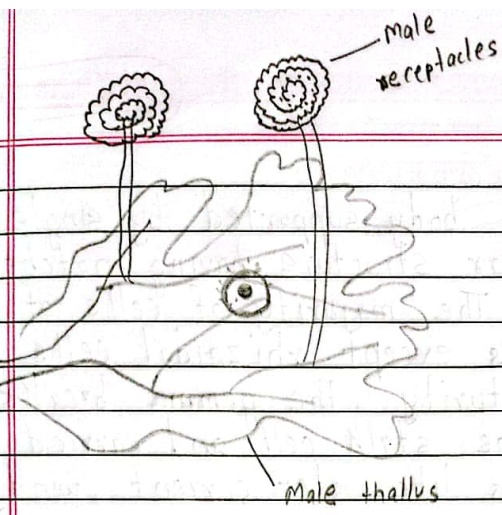
Male sex organs are called antheridium. It is found on the male thallus. An aerial out growth develops called antheridiophore. At the tip of the antheridiophore, there is presence of male receptacles which is star or disc-shaped in structure. On the dorsal surface of the male receptacles there are presence of an antheridium. The antheridium consists of mass of androgonal cells called androcytes.
Sporophyte
The zygote is the beginning of the sporophyte. It mitotically divides to form 2-celled, 4-celled and 8-celled embryo. The embryo develops into sporophyte. The sporophyte is completely depended on gametophyte, thus called sporogonia. It is differentiated into foot, seta & capsule. The foot absorbs food and minerals nutrients from the gametophytic tissues. The seta is a short connection between foot and capsule. The capsule consists of mass of sporogenous cells and surrounded by single layer jacket. The sporophyte is also surrounded by two layers — inner calyptra and outer perigynium. The sporogenous cells differentiated into fertile spore mother cells and sterile elater mother cells.