3.1 Monera
Characteristics of Monera
- It includes all the simple, primitive organisms which lack a well-developed nucleus and membrane-bound organelles. They contain circular double stranded naked DNA as the nuclear body in the cytoplasm.
- They are microscopic and made up of prokaryotic cells. They are cosmopolitan in distribution and found in all the types of habitats.
- Most of them have rigid wall.
- They have autotrophic and heterotrophic mode of nutrition. They are known as decomposers and mineralisers in the biosphere.
- Reproduction is primarily asexual.
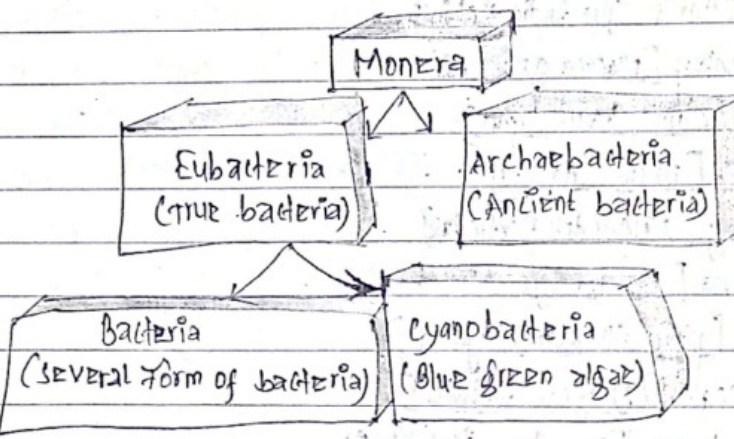
Monera includes:
- Eubacteria (true bacteria)
- Archaebacteria (ancient bacteria)
- Cyanobacteria (blue green algae)
Bacteria
Bacteria are tiny, unicellular microscopic organisms which are identified by their specific activities. Bacteria were discovered by Anton van Leeuwenhoek. The study of bacteria is known as bacteriology.
Characteristics of bacteria
- Bacteria are unicellular and prokaryotic organisms.
- They contain circular double stranded naked DNA in the primitive nucleus in the cytoplasm.
- They are cosmopolitan in distribution.
- Most of them have a solid cell wall which is composed of glycolosamine and acetyl glutamic acid with diaminopimelic acid.
- They have autotrophic and heterotrophic mode of nutrition. They are known as decomposers and mineralizers in the biosphere. Flagella if present are single stranded. Ribosomes are present (70S type). The common mode of reproduction is by binary fission.
Types on the basis of shape
[1] Bacillus: The bacteria which are cylindrical and rod-like in structure are called bacillus. They occur in the following forms:
- Diplobacillus: In this form, bacilli occur in pairs. e.g. Corynebacterium diphtheriae
- Streptobacillus: Many bacilli occur in chain. e.g. Bacillus tuberculosis
[2] Coccus: These bacteria are oval or spherical in shape and are smallest amongst all known bacteria. They occur in following forms:
- Micrococcus: Each coccus is a free individual. e.g. Micrococcus luteus
- Diplococcus: Cocci are found in pairs. e.g. Diplococcus pneumoniae
- Streptococcus: Cocci form a chain. e.g. Streptococcus lactis
- Staphylococcus: Cocci form irregular groups or grape-like bunches. e.g. Staphylococcus aureus
[3] Spiral or helical: They are helical or cork-screw shaped or coiled. They are of two types:
- Comma shaped: They look like small curved rods or they have a single curve in their body. e.g. Vibrio cholerae
- Spiral: The body is twisted spirally. e.g. Spirillum volutans
Structure of bacteria
The ultra structure of bacteria reveals the following cell structures: cell wall, plasma membrane, cytoplasm, nucleoid (DNA), free ribosomes, flagellum, fimbriae, polysome, mRNA, etc.
%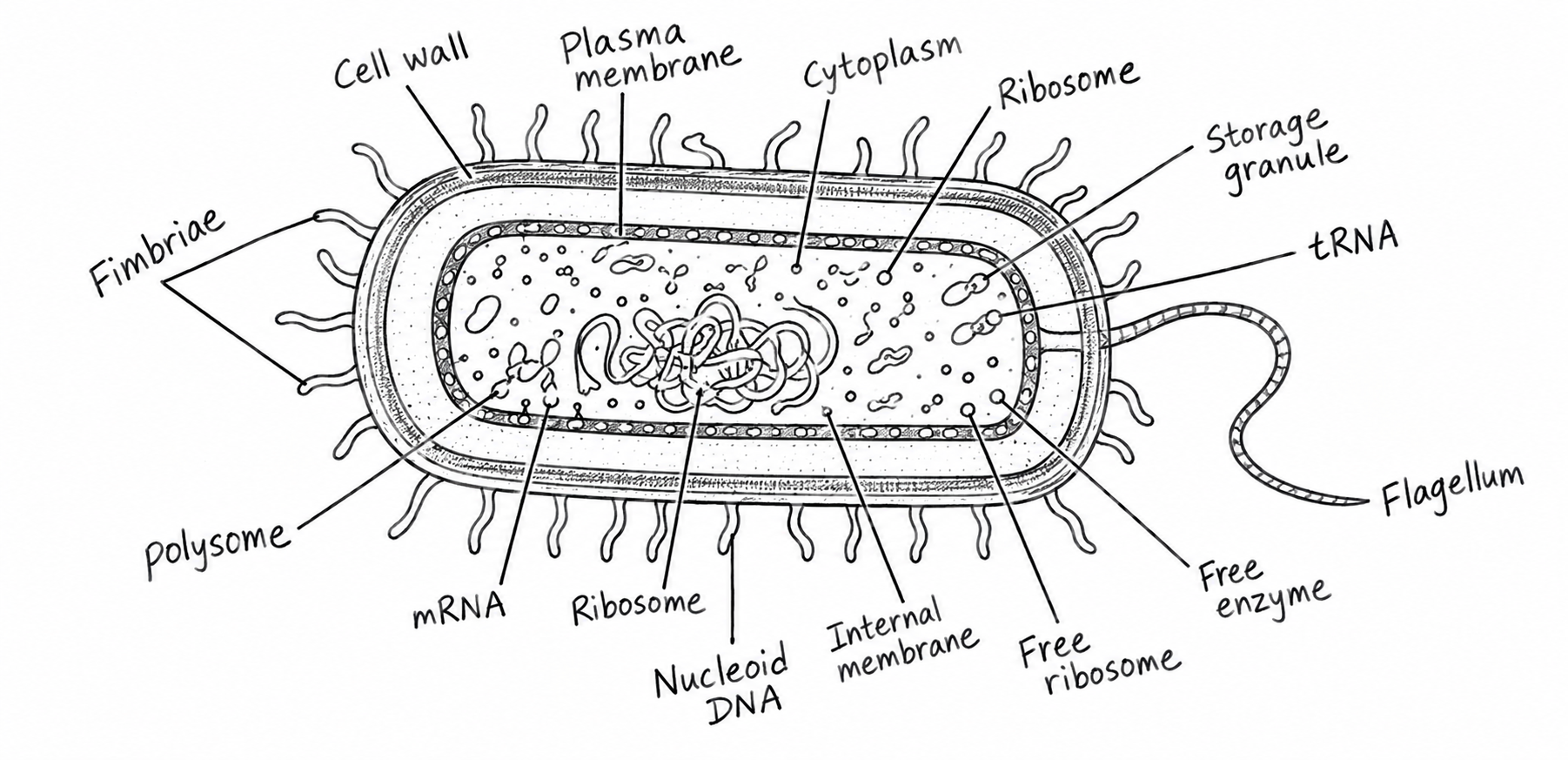
I. Cell wall: The cell wall is the outermost protective covering of the bacterial cell. It is made up of mucopeptide or peptidoglycan or murein. It protects inner content of the cells.
Capsule or slime layer: The bacterial cell secretes mucilaginous substances which are deposited around the cell wall called slime layers. If the slime layer is compactly arranged it is called capsule and the bacteria are known as capsulated bacteria. If the slime layer is loosely arranged, then the bacteria are known as non-capsulated bacteria. It is made up of polysaccharides and proteins.
III) Cell membrane: Lies inner to the cell wall; it is made up of lipids and proteins i.e., lipoproteinous in nature. In some regions, the cell membrane has finger-like unfoldings called mesosomes. The respiratory enzymes are situated on it, thus it takes part in respiration. It also helps in DNA replication.
IV) Cytoplasm: The cytoplasm lies inner to the cell membrane; thus there is lack of membrane-bound cell organelles. Ribosomes are found in cytoplasm which are 70S type. Reserve food materials are also stored in cytoplasm.
Nucleoid: There is lack of well organized nucleus; the nucleus is represented by single circular DNA called nucleoid. The DNA is naked type without histone protein.
VI) Fimbriae / pili: On the surface of the bacterial cell wall there are present minute hair-like structures called fimbriae or pili. They help the bacterial cell to attach on the host. They also take part in sexual reproduction during conjugation.
VII) Flagella: The flagella are the hair-like locomotory organs found on the bacterial cell. They are single stranded structures. On the basis of flagellation the bacteria are known as:
- Atrichous: Bacteria without flagella.
- Monotrichous: Bacteria with only one flagellum.
- Amphitrichous: Bacteria with one flagellum at both the ends.
- Cephalotrichous: Bacteria with bunch of flagella at one end.
- Lophotrichous: Bacteria with bunch of flagella at both ends.
- Peritrichous: Bacteria with flagella all over the body.
Bacterial lifestyle
On the basis of mode of nutrition, the bacteria show following lifestyles.
[A] Autotrophic bacteria: The bacteria which can prepare their own food as green plants are called autotrophic bacteria. They are of following types.
Photoautotrophic bacteria: The bacteria which can synthesize their organic food from inorganic raw materials with the help of energy obtained through light are called photoautotrophic bacteria. Contain photosynthetic pigments like bacteriochlorophyll or Chlorobium chlorophyll as like green plants. They use CO₂ for the synthesis of C₆H₁₂O₆. They do not use water as a source of hydrogen and use various other compounds of hydrogen as the source of hydrogen. Thus there is no evolution of oxygen. Such type of photosynthesis is known as anoxygenic photosynthesis.
Chemoautotrophic bacteria: The bacteria which can prepare their own food with the help of energy obtained through chemicals are known as chemoautotrophic bacteria. Thus the process of synthesis of food with the help of energy obtained through chemicals is known as chemosynthesis.
[B] Heterotrophic bacteria: The bacteria which cannot prepare their own food and obtain their food or nutrition from other various sources are called heterotrophic bacteria. They are of following types:
- Saprophytic bacteria: The bacteria which cannot prepare their own food and obtain their food from dead and decayed organic matters are called saprophytic bacteria. They secrete some enzymes which can decompose the complex organic compounds into simple forms with the release of energy during the process. e.g. Pseudomonas.
- Symbiotic bacteria: Some bacteria live in close association with organisms where both the organisms are mutually benefited. Such bacteria are called symbiotic bacteria. They obtain their food from their symbiotic partners. e.g. Rhizobium.
- Parasitic bacteria: The bacteria which cannot prepare their own food and obtain their food from the living tissues of plants and animals where they grow are called parasitic bacteria. The organisms in which they grow are called host and the bacteria are called parasites. e.g. Salmonella typhi.
Economic importance of bacteria
[A] Beneficial impacts or positive importance
- Role of bacteria in agriculture: Bacteria act on dead bodies and convert organic compounds into simple forms such as nitrates, sulphates, phosphates etc. Some bacteria help in fixation of atmospheric nitrogen in symbiotic association with the roots of legumes.
- Role of bacteria in sanitation: Bacteria check the accumulation of waste by feeding on decaying organic matter.
- Role of bacteria in industries: Bacteria are used in different industries like dairies for ripening milk and producing flavours in butter; vinegar making industries; fermentation of sugary substances; tanning of hides (crude skin); fibre retting in the process of separating fibres from the plant tissues.
- Role of bacteria in medicines: A number of medicines, antibiotics, antiserum and vaccines are produced by various types of bacteria.
- Role of bacteria in the production of enzymes: Enzymes amylase and protease are manufactured from Bacillus subtilis.
- Role of bacteria in production of vitamin: Bacteria like Clostridium butylicum has been used in the synthesis of riboflavin.
[B] Harmful impacts
- Disease: Bacteria cause many serious diseases in human beings, animals and plants. Such as pneumonia, Asiatic cholera, diphtheria in human beings; tuberculosis, anthrax in animals.
- Food spoilage: Some saprophytic bacteria spoil the foodstuffs by causing decay, putrefaction, and loss of food value.
- Cotton deterioration: Spirochaeta, Cytophaga destroy cotton and articles made from it.
Cyanobacteria
Cyanobacteria are commonly known as blue green algae. The following are the characteristic features:
- They are prokaryotic organisms.
- They are mostly unicellular and they are bacteria or prokaryotes.
- They are mostly aquatic. Some of them occur in fresh water and they are marine.
- There is lack of the nucleus and membrane-bound cell organelles.
- Photosynthetic pigments are C-phycocyanin, C-phycoerythrin in addition to chlorophylls.
- Reserve food is stored in the form of cyanophycean starch. Sexual reproduction is absent.
- They reproduce by vegetative and asexual methods. e.g. Nostoc, Anabaena, Oscillatoria etc.
Nostoc
Occurrence: Nostoc is a filamentous blue green alga, occurs in colonies. They are found in aquatic habitats like ponds, lakes, ditches, agriculture fields etc.
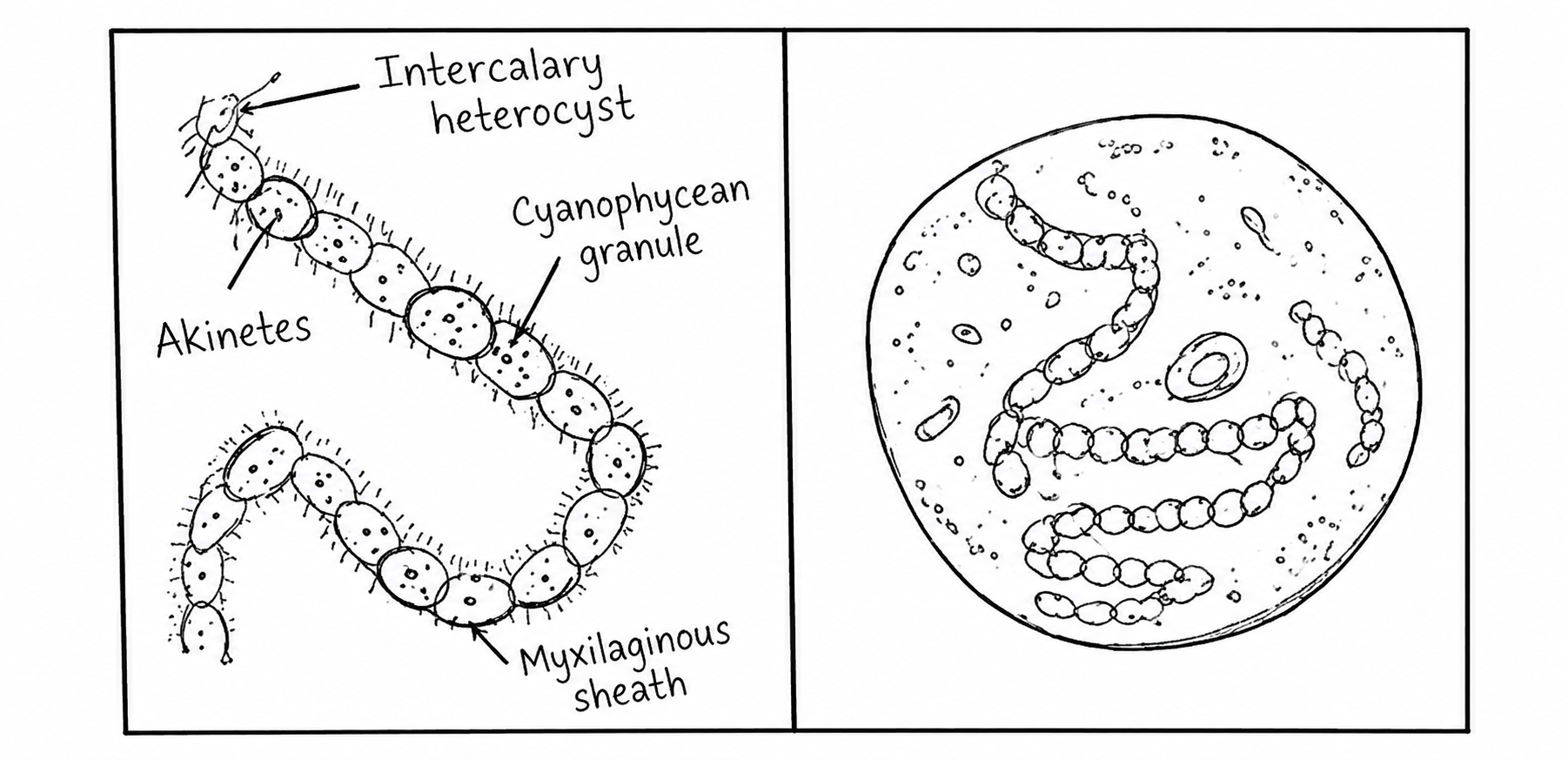
Structure: Nostoc is a simple unbranched filamentous structure; without sheath it is called trichome. Each trichome is made up of round or oval cells. The trichome with an individual hyaline sheath is called the filament.
Reproduction: Reproduction takes place by following methods:
- Fragmentation: Nostoc colony breaks into several small filaments due to mechanical, physiological or other factors.
- Hormogonia: The hormogonia are smaller fragments of the filaments formed within the colony. The hormogonia escape out of colony and develop into new filaments later on into new colony.
- Akinetes: During unfavourable condition, the vegetative cells of Nostoc accumulate enough food materials and secrete thick wall around them to form spore-like structure called akinete. The akinetes undergo resting period. On the return of favourable condition they grow into new filaments.
Heterocyst: The heterocysts are the larger cells found on the filament of Nostoc in between the vegetative cells. The heterocyst can give rise to new filament and later on into new colony.
Economic importance of cyanobacteria
- Large colonies of Nostoc are edible and too rich in nitrogenous substance.
- They are associated with lichens, Anthoceros, roots of Cycas and other plants. The association is beneficial to the plants. They fix atmospheric nitrogen.
- It increases the nitrogen content in the soil.
- Some cyanobacteria like Lyngbya can be used as antibiotics. They are also used as food for several animals.
- Species of Anabaena do not allow mosquito larvae to grow.
- Species of cyanobacteria can grow on the walls and roofs of buildings during rainy seasons causing discoloration, corrosion and leakage.