All the living cells have a unit property of multiplication such a property of multiplication is known as cell division.
Cell cycle
The entire changes or events taking place during the cell division of mother cell into daughter cell are known as cell cycle. The cell cycle completes in to the following phases.
- Interphase
- G1 Phase
- S Phase
- G2 Phase
- M-Phase or Mitotic Phase (Karyokinesis)
- Cytokinesis
G1 Phase or Gap one phase or Growth phase
- Active synthesis of RNAs, carbohydrates and lipids occurs.
- Cell grow in size, vacuoles disappear
- Protein synthesis takes place
S-Phase or Synthetic phase
- Replication of DNA molecule
- Synthesis of histones
- Actual duplication of chromosomal materials
G2 phase or Second Growth phase
- Synthesis of spindle proteins
- Synthesis of three types of RNA molecules by DNA
- Duplication of mitochondria, plastids
M-Phase
It is the division of nucleus. The 'M' stands for metabolic phase of mitosis and meiotic phase for meiosis.
- Prophase
- Metaphase
- Anaphase
- Telophase
Cytokinesis
It is the last stage of cell cycle. In this stage the division of cytoplasm takes place and finally a mother cell is divided into daughter cell.
Types of Cell division
- Amitosis cell division
- Mitosis cell division
- Meiosis cell division
Amitosis or direct cell division
It is a direct cell division. It occurs among the unicellular organism like some protozoes, bacteria, yeast etc.
At the end of amitosis, two daughter cells are formed which are necessarily not identical to each other and also with mother cell.
Mitosis cell division
Mitosis is known as reductional or indirect cell division. It occurs among the vegetative or somatic cells. The number of chromosomes remain constant. The mitosis takes place on haploid or diploid cells.
The mitosis cell division completes in the following phases:
i) Interphase
It is the resting phase in which no visible changes occur in the nucleus but cell is metabolical active. The features of this stage are as follows:
- Cell has a large nucleus with intact nuclear membrane and distinct nucleolus.
- DNA chromosome is duplicated into exact copies
- RNA and protein are also synthesized
- The size of the nucleus and cell enlarge.
ii) Karyokinesis
It is the division of the nucleus. It is highly complicated and completes into the following stages:
a) Prophase
- Chromatin fibers begin to condense and become as chromosome.
- The shortening and thickening of chromosomes begin.
- Each chromosome appears to consist of two chromatids due to longitudinal splitting.
- Nuclear membrane and nucleolus begin to disorganize and disappear by the end of this phase.
b) Metaphase
- The nuclear membrane and nucleolus disappear
- The spindle fibers appearing at two opposite poles and get attached to centromere of chromosomes
- All the chromosomes come to lie at the equator of the cell in a single line.
- Chromosomes are distinctly visible thus can easily be counted and determine their shape and size.
c) Anaphase
- The centromeres of chromosomes split longitudinally so that two sister chromatids separate from each other.
- Each chromatid has got its own centromere and known as daughter chromosomes.
- Each chromosome appears as 'V' or 'J' or 'I' shaped.
- At the end two groups of equal number of chromosome are formed at the two opposite pole.
d) Telophase
- All the daughter chromosomes to their respective poles get organized into nucleus.
- Each daughter nucleus has equal number of chromosomes as their mother cell.
- The spindle fibers may partially or completely degenerate.
iii) Cytokinesis
It is the division of cytoplasm, it takes place by cell furrow method along the animal cells and cell plate method along the plant cells.
Cell plate Method:
In plant cells, cytokinesis occurs by cell plate formation. Small granular bodies which are the element of golgi complex and endoplasmic reticulum gather in the equatorial region of the cell to form cell plate. The cell plate becomes middle lamella.
Significance of Mitosis
- It maintains the fixed number of chromosomes in somatic cells
- It helps in growth and development of new organs in multicellular organisms.
- It repairs old cells and regenerates the damaged tissues of organs
- It helps in asexual reproduction.
Meiosis cell Division
It is known as the reductional cell division. It occurs in the reproductive of sexually reproducing organisms at the time of gamete formation. It takes place on the diploid cells only. At the end of meiosis four daughter cells are formed with half number of chromosomes as that of the mother cell. All the four daughter are not identical to each other and also to mother cell. It comprises of two nuclear division called Meiosis - I and Meiosis - II.
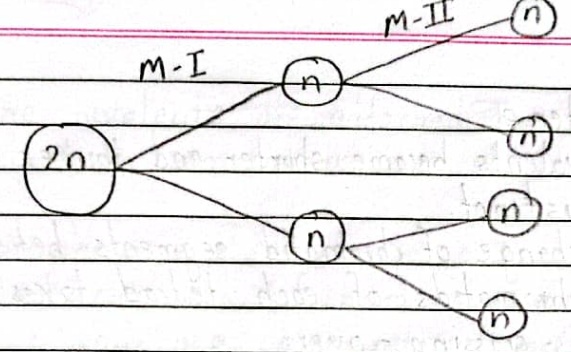
(1) Meiosis - I
It is known as the reductional division. It completes in to the following stages:
a) Prophase - I
It is the longest stage of meiotic cell division. It is highly complicated and completes into the following stages:
① Leptotene
- The size and volume of nucleus increases.
- The chromosomes appear as long, visible due to condensation, shortening and thickening.
- Nuclear membrane and nucleolus remain intact.
(ii) Zygotene
- Chromosomes become more distinct by further shortening and thickening.
- Pairing of homologous chromosomes (one paternal and one maternal) occurs to form bivalents. The process of pairing is called synapsis.
- The nucleolus increases in size.
iii) Pachytene
- The bivalent become more distinct.
- The exchange of chromatid segments between non-sister chromatids of each tetrad takes place. This known as crossing-over.
- The points at which crossing over takes place are known as chiasmata.
iv) Diplotene
- The homologous chromosomes tend to separate although attached at one
- The nuclear membrane remains intact but nucleolus tends to degenerate.
⑥ Diakinesis
- The chiasma moves towards the end of the chromosome due to contraction of chromosomes. This type of movement is known as terminalisation of chiasmata.
- The chromosomes become further shorter & thicker
- The spindle fibres begin to form at the end of this stage.
b) Metaphase - I
- The nuclear membrane and nucleolus disappear & the spindle formation is completed.
- The bivalents arrange themselves into two parallel metaphase plate.
- The bivalents are attached to the spindle fibres by their centromeres.
c) Anaphase - I
- The centromere of chromosome does not divide into two and two chromatids of each chromosome remain joined together by centromere.
- The homologous chromosomes migrate towards the opposite poles of the cell by the contraction of spindle fibres.
- The homologous chromosome at each pole are either paternal or maternal in origin.
- Each pole receive one haploid set of chromosome having two chromatids.
Telophase - I
- The chromosome becomes uncoiled and forms a chromatin thread in the massive structure.
- Spindle fibres disappear
- Nuclear membrane reappears around the two groups of chromosomes at each pole. The nucleolus also appears.
(2) Meiosis - II
It is known as meiotic mitosis. The meiosis - II is the nuclear division. It is similar with mitosis but the two nuclei simultaneously undergo division. It completes in four stages.
a) Prophase - II
- Chromatids become shorter and thicker and clearly visible.
- Each chromosome consists of two chromatids, which are attached to the single centromere.
- The nuclear membrane and nucleolus begin to disappear and the spindle fibres begin to appear.
b) Metaphase - II
- Nuclear membrane and nucleolus disappear
- The chromosomes get arranged on a equatorial plate
- The spindle fibres get themselves organized between the two poles of the cell.
- The centromere of each chromosome is attached with the spindle fibres from both the poles.
c) Anaphase - II
- It starts with the repulsion of centromeres of sister chromatids.
- The centromere of each chromosome separates.
- The separated chromatids are now called chromosomes.
d) Telophase - II
- At each pole, chromosomes uncoil, get elongated and form a network of chromatin fibres.
- Spindle fibres disappear around the pole.
- The nuclear membrane appears around each group of chromosomes and the nucleolus reappears.
Significance of Meiosis
- It maintains constant number of chromosomes in the organisms.
- It causes genetic variations among the species.
- It forms haploid gametes or spores for reproduction
- It maintains the regularity of reproductive cycle.
- It helps in evolutions.
Difference between Mitosis and Meiosis
| Mitosis | Meiosis |
|---|---|
| 1) It occurs in somatic cell and germ cell | 1) It occurs in reproductive cell. |
| 2) It complete in one sequence of stages i.e. in this cell division the cell divides once. | 2) The whole process completes into two successive division i.e. cell divides twice. |
| 3) The daughter cells formed by this division are genetically similar to mother cell. | 3) The daughter cells formed by this division are genetically different from mother cell. |
| 4) A diploid mother cell always produces two diploid cells. | 4) A diploid cell produces four haploid cells. |
| 5) Variations are not produced so no role in evolution. | 5) Variations are produced due to crossing over, so plays important role in speciation and evolution |