Angiosperms
The characteristics of angiosperms are given below:
- They are diploid sporophyte.
- They can grow as trees, shrubs, bushes, herbs
- The herbaceous plants may be ephemerals, annuals, biennials or perennials.
- They show great variation in their habitat, habit and mode of life.
- Usually they are autotrophs and a few are heterotrophs.
Its types are:
Monocotyledons
Those angiospermic plants which have only one cotyledon in their embryo with adventitious roots, simple leaves with parallel venation and trimerous flowers are called monocotyledonous plants or monocots.
eg: banana, cereals, bamboos etc.
Dicotyledons
Those angiospermic plants which have two cotyledon in their embryo with a taproot system and reticulate venation in their leaves are called dicotyledonous plants or dicots. Eg: Sunflower, tomatoes, peas, mango etc.
Habit of plants
- Herbs: Small branched or unbranched plants with soft stems are called Herbs.
- Shrubs: Medium-sized plants which produce branches from their base to form them bushy are called shrubs.
- Trees: A tall, strong and perennial plants are called trees.
Life span of plants
- Annual: The plants that complete its life cycle from seed germination to seed production, followed by death within a single season or year belongs to this group. Eg: Maize
- Biennial: It lives for two years to complete the life cycle i.e. growing vegetative parts during the first year and fruiting or dying during the \(2^{nd}\) year. eg: carrot
Habitat of plants
- Mesophytes: The plants which grow in the soils having sufficient moisture and air. eg: Mustard
- Xerophytes: The plants which grow in dry and sandy soils. Eg: Opuntia
- Hydrophytes: The plants which grow in water and also in damp and marshy places. Eg: Hydrilla
- Epiphytes: The plants which grow on trees and take support but not live parasitically. Eg: Vanda
- Parasites: The plants that live on or in another plant and absorbs food from there. Eg: Cuscuta reflexa.
- Saprophyte: The plants that obtain organic matter from dead and decaying parts of plants or animals. eg: Monotropa unifolia
- Insectivorous plants: A plant group of nearly autotrophic plants which generally capture some insects by their special modified leaves and digest the soft portion of the preys belong to this group. Eg: Pitcher plant
The root system
It is the non-green descending part of the vascular plants which grows downward into the soil. It is negatively phototropic but positively geotropic.
Its type:
- Taproot: The root which arises from the radicle of the embryo of a seed and develops into a primary root that grows vertically downwards, is called taproot.
- Fibrous root: The root that develops from any part of the plant body except the radicle is called adventitious root.
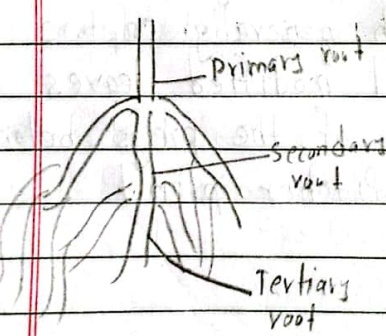
The shoot system
The stem along with the branches, leaves, flowers and other appendages is called shoot system. Its types:
- Erect stem: It is the common type of aerial stem that is enough strong to remain erect or upright without any external support.
- Weak stem: These stems are thin, soft and weak. They can't stand erect and therefore need a support to grow.
The leaf (Phyllopodium)
The leaf is a thin, flattened, green exogenous outgrowth of the stem or its branch, borne at a node and having a bud in its axil. It has limited growth.
A typical leaf has three main parts:
- leaf base
- petiole
- lamina
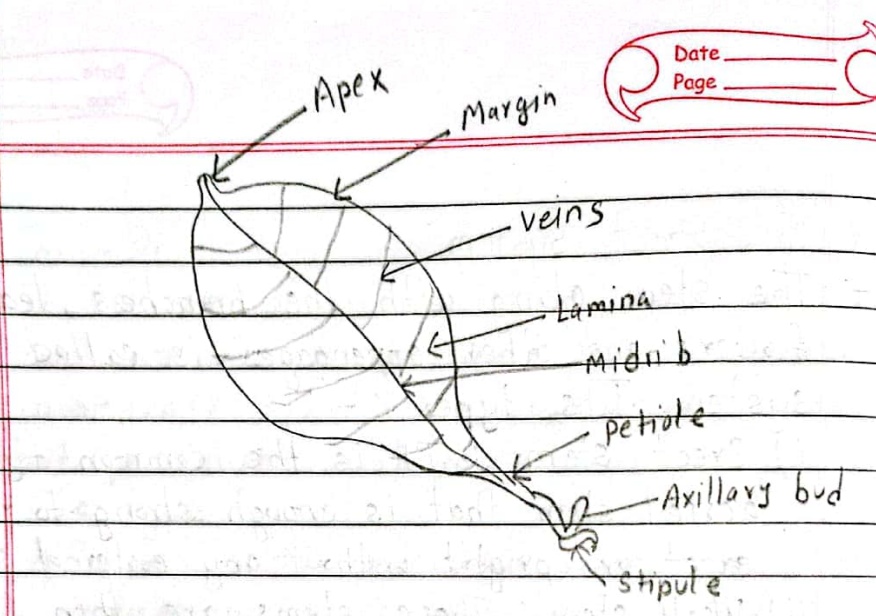
Phyllotaxy of leaf
The arrangement of leaves on the stem and branches is called phyllotaxy.
Stipules
- Stipulate: The leaves having stipules at the base.
- Exstipulate: The leaves without stipules.
Petiole
- Petiolate: The leaves which have petioles
- Sessile: A leaf which does not have a petiole.
Difference between simple leaf and compound leaf
| Simple leaf | Compound leaf |
|---|---|
| A simple leaf is a single leaf which is never divided into smaller leaflets. | A compound leaf is a leaf which is divided to the midrib, forming two or more distinct leaflets. |
| It bears an axillary bud on its axil. | The axils of the leaflets doesn't bear buds. |
| It has single leaf lamina. | The arrangement of leaflets is not in acropetal succession |
| Eg: Mango, peepal | Eg: pea, rose |
Inflorescence
The mode of arrangement of flowers on the floral axis or on the peduncle is called inflorescence.
Its two important types are:
- Racemose Inflorescence
- Cymose Inflorescence
Flower
The flower is defined as highly condensed and modified dwarf shoot of angiospermic plant that serves as a reproductive shoot. A typical flower of angiosperm consists of four floral whorls:
- Calyx: It is outermost whorl and consist of sepals.
- Corolla: It is second whorl which is composed of petals.
- Androecium: It represents the male reproductive whorl and consist of stamens.
- Gynoecium: It is the innermost whorl of the flower and comprises the female organs called carpels. Each gynoecium consists of three parts: ovary, style, stigma.
Some terms of flower
- Complete flower: When calyx, corolla, androecium and gynoecium are present in flower is called complete flower.
- Incomplete flower: A flower which lacks one of the four whorl, is called incomplete flower.
- Bisexual flower: If both gynoecium and androecium are present in the same flower is called bisexual flower.
- Unisexual flower: If any of male and female (staminate & pistillate flower) any one of them is present in flower is called unisexual flower.
- Monoecious plant: When both male and female flowers are present on the same plant.
- Dioecious plant: When male and female flowers are present on separate plant.
Bracts
A small modified or special leaf at whose axil the flower is borne is called bract. If a flower with a bract is called bracteate.
Aestivation
The arrangement of sepals and petals is called aestivation
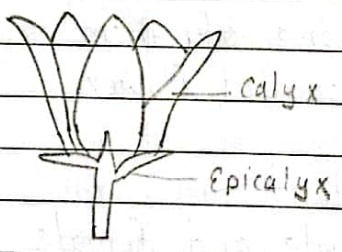
Symmetry of flower
The divisibility of the flower vertically into two halves. Its types:
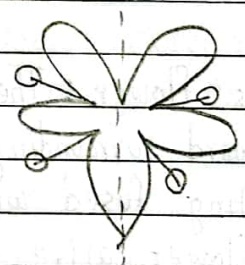
- Actinomorphic: A flower, which can be divided by any vertical plane into two equal and similar halves, is called actinomorphic
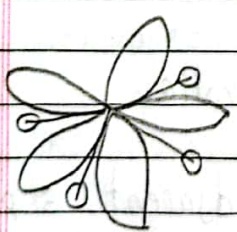
- Zygomorphic: When a flower can be divided into two equal halves by only one vertical plane is called zygomorphic.
- Asymmetrical: A flower, which cannot be divided into two equal halves by any plane is called asymmetrical.
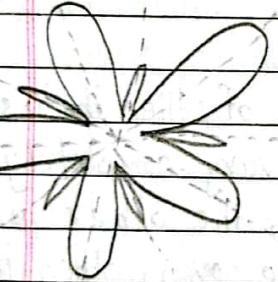
Actinomorphic
Zygomorphic
Asymmetrical
Insertion of floral leaves (types)
- Hypogynous flower: When three floral parts like petals, sepals and stamens are situated below the ovary is called hypogynous and this condition the ovary will be superior
- Perigynous flower: The ovary lies at the base of the cup without touching the wall of the thalamus.
- Epigynous flower: The margin of the thalamus grows upward surrounding the ovary completely and getting fused with it, the other parts of the flower arise above the ovary then the ovary is said to be inferior is called epigynous.
Aestivation of calyx and corolla
- Open: The margin of the adjacent sepals or petals are apart from one another.
- Valvate: The margins of the adjacent floral leaves i.e. sepals and petals simply touch to each other without overlapping.
- Twisted: One margin of a petal of a whorl covers the margin of the adjacent petal and the other margin is covered over by the margin of the adjacent petal.
- Quincuncial: The aestivation with five floral leaves, two floral leaves external, two internal and the fifth one margin external and other margin internal.
- Ascending imbricate: Out of five floral leaves posterior sepal or petal being overlapped by the two lateral ones while they are being overlapped by anterior sepals or petals.
- Descending imbricate: The posterior floral leaf is large and completely external and overlapping the two lateral floral leaves, the later overlapping the two anterior floral leaves.
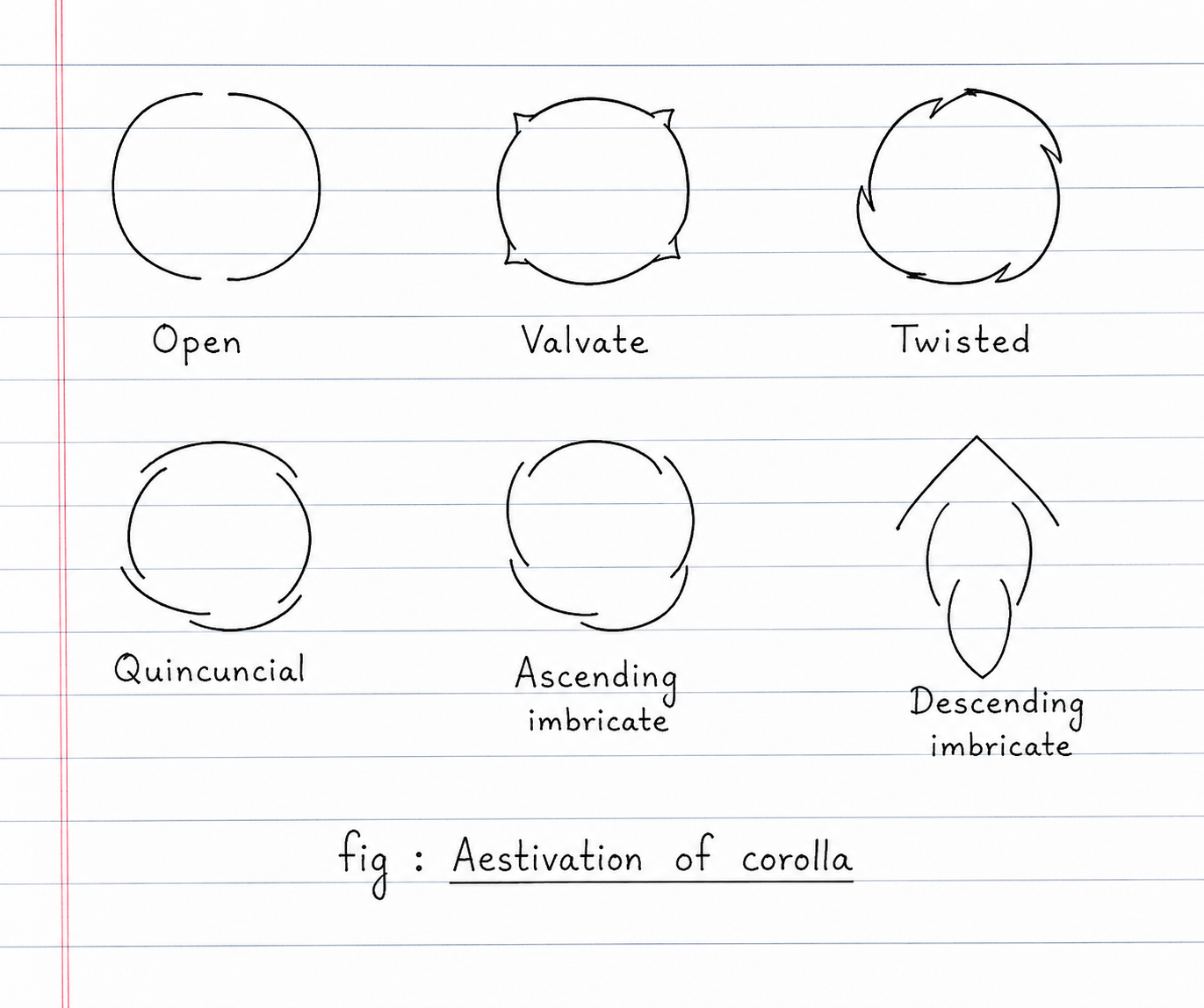
fig: Aestivation of corolla
Perianth
In some plant, the calyx and corolla are not differentiated and a single whorl is present in them are called perianth.
Number of carpels
- Monocarpellary: The pistil is composed of only one carpel
- Bicarpellary: A condition when the pistil is composed of two carpels.
- Tricarpellary: A condition when the pistil is composed of three carpels
- Polycarpellary: A condition when the pistil is composed of many carpels.
Floral formula
A floral formula is a simple and concise way to describe the salient characteristics of a flower.
- Br. — Bracteate; Ebr. — Ebracteate; Brl. — Bracteolate; Ebrl. — Ebracteolate
- ⊕ — Actinomorphic; % — Zygomorphic; ⚥ — Bisexual; ♂ — Male; ♀ — Female
- Kn / K(n) — Sepals n free / fused; Cn / C(n) — Petals n free / fused
- An / A(n) — Stamens n free / fused; G(n) — Carpels n
Family: Brassicaceae — Mustard family
Classification (Cronquist)
Kingdom: Plantae
Division: Magnoliophyta
Class: Magnoliopsida
Subclass: Dilleniidae
Order: Capparales
Family: Brassicaceae
Genus: Brassica
Species: campestris
Distribution: They are economically important species that are grown worldwide.
- Habit and Habitat: They are herbs, annual, watery mesophytes
- Root: Taproot system
- Stem: Erect, branched
- Leaf: They are simple leaf, alternate, petiolate and reticulate.
- Inflorescence: Racemose type imbricate aestivation
- Flower: Ebracteate, Bisexual, Actinomorphic
- Calyx: Four sepals, arranged in two whorls of two,
- Corolla: Four petals i.e. four petals arranged crosswise, valvate aestivation
- Androecium: Six stamens
- Gynoecium: Two carpels
Floral formula: \( Ebr. \oplus \unicode{x2640} K_{2+2} C_4 A_{2+4} G_{(2)} \)
Diagnostic characters
- Plants herbaceous with sulphur smelling glucosinolates
- leaves exstipulate and usually lyrate
- Inflorescence is racemose type typical raceme or corymb
- Flowers ebracteate, bimerous, actinomorphic
- Green nectaries are associated with stamens
- Fruit siliqua or silicula
Eg of brassica family: Brassica campestris, Brassica nigra etc.
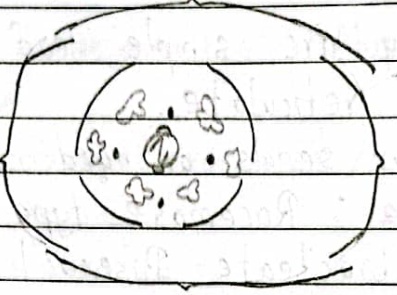
fig: floral diagram of mustard
Family: Fabaceae — Legume, Pea or Bean family
Classification (Cronquist)
Kingdom: Plantae
Division: Magnoliophyta
Class: Magnoliopsida
Subclass: Rosidae
Order: Fabales
Family: Fabaceae
Genus: Pisum
Species: sativum
Distribution: They are widely distributed all over the world.
- Habit and Habitat: Annual herbs
- Root: Taproot
- Stem: Herbaceous, Erect
- Leaves: Rarely opposite, Simple or Compound
- Flowers: Bracteate, bisexual, zygomorphic
- Calyx: Sepals five, valvate
- Corolla: Petals five, Descending imbricate
- Androecium: Stamens ten, usually diadelphous (9) + 1
- Gynoecium: Carpel one i.e. monocarpellary, ovary superior.
Floral formula: Br. % \( K_{(5)} C_{1+2+(2)} A_{(9)+1} \) diadelphous \( G_1 \)
Diagnostic characters
- Plants are mostly herbs and mesophytes.
- Tap root with lateral branches.
- Stem herbaceous or woody, solid.
- Inflorescence is of racemose.
- Flower zygomorphic, bisexual, hypogynous.
- Fruit legume or pod.
Family: Solanaceae — Night shade family
Classification (Cronquist)
Kingdom: Plantae
Division: Magnoliophyta
Class: Magnoliopsida
Order: Solanales
Family: Solanaceae
Genus: Solanum
Species: nigrum
Distribution: The plants are widely distributed from tropical to temperate
- Habit & Habitat: Usually annual or perennial shrubs.
- Root: Taproot
- Stem: Erect, solid or fistular, cylindrical, branched
- Leaf: Exstipulate, alternate, whorled in the floral region.
- Inflorescence: Usually cymose
- Flowers: Ebracteate, Pedicellate, bisexual, Actinomorphic.
- Calyx: Sepals five, Valvate in bud or imbricate aestivation, hairy
- Corolla: Petals five, Twisted or Valvate aestivation
- Androecium: Stamens five, epipetalous
- Gynoecium: Carpels two, ovary superior and obliquely placed.
Floral formula: \( Ebr. \oplus \unicode{x2640} K_5 C_5 A_5 G_{(2)} \)
Diagnostic characters
- leaves: exstipulate, alternate in the vegetative parts but opposite near the inflorescence.
- Inflorescence: cymose type
- Flowers: ebracteate, actinomorphic, pentamerous
- Calyx: gamosepalous, persistent and often enlarged in fruit.
- Corolla: gamopetalous and of various shapes, twisted or valvate aestivation
- Androecium: polyandrous, epipetalous, alternipetalous
- Gynoecium: syncarpous, bilocular with many ovules on swollen placenta.
Eg: Solanum melongena, Solanum tuberosum
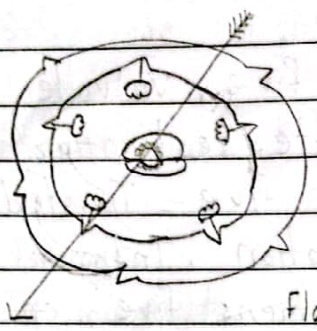
floral diagram
Family: Liliaceae — Lily family
Classification (Cronquist)
Division: Magnoliophyta
Class: Liliopsida
Subclass: Liliidae
Order: Liliales
Family: Liliaceae
Distribution: The plants are cosmopolitan in distribution.
- Habitat: Perennial herbs with rhizome (Aloe), bulb (Allium).
- Root: Fibrous root
- Stem: Herbaceous; fleshy in some plants, aerial branches are erect.
- Leaves: Radical, cauline, stipulate, exstipulate, Alternate, leaf cylindrical and hollow. Venation is usually parallel but reticulate in Smilax.
- Inflorescence: Racemose
- Flower: Bracteate, Ebracteolate, Actinomorphic or zygomorphic, bisexual or unisexual.
- Perianth: Six tepals, arranged in two whorls in three each, petaloid or sepaloid, imbricate aestivation.
- Androecium: Stamens six or three in Ruscus, arranged in two whorls in three each.
- Gynoecium: Carpels three i.e. tricarpellary,
Floral formula: Br. \( \oplus \) \( \unicode{x2640} \) \( P_{(3+3)} \) \( A_{3+3} \) \( \underline{G_{(3)}} \)
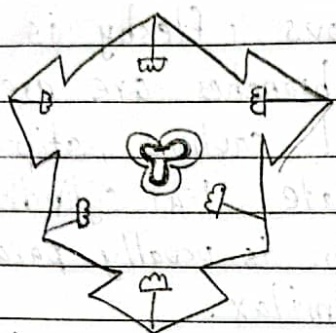
Floral diagram
Distinguishing characters
- Mostly herbs, perennation by rhizomes, bulbs, corms etc.
- leaves alternate, parallel venation, exstipulate
- Flower hypogynous, trimerous bracteate, actinomorphic.
- Stamens polyandrous, arranged in two whorls in three each.
- Tricarpellary, syncarpous, ovary superior, axile placentation
- Fruit is a loculicidal capsule, sometimes a berry.
Eg: Allium cepa, Allium sativum