Introduction to Biology
Biology
The word biology is composed of bio meaning life and logos meaning study. Therefore biology is the study of living organism. The word biology coined by Lamarck and Treviranus. Aristotle is known as father of biology.
Biology includes:
- Zoology (study of animals)
- Botany (study of plants)
The scientists who made contributions to Biology and regarded as father are:
- The father of Biology is Aristotle
- The father of Zoology is Aristotle
- The father of Botany is Theophrastus
- The father of medicine is Hippocrates
- The father of concept of organic evolution is Empedocles
- The father of evolution is Charles Darwin
- The father of evolutionary theories is Lamarck
Various branches of Biology
Fig. 6.1: Various branches of Biology
Some other branches of Biology
- Morphology - Study of external features of organism
- Anatomy - Study of internal structures of organism
- Histology - Study of structure & function of tissues
- Cytology - Study of structure & function of cell
- Genetics - Study of hereditary character & their inheritance
- Ecology - Study of relationship between living organism and environment
- Embryology - Study of formation and development of embryo upto to hatching or birth
- Evolution - Study of origin of life and evolution to modern plants & animals
- Physiology - Study of life process in animal & plant
- Taxonomy - Study of classification of organism & its principles
- Pathology - Study of diseases caused by organism
- Paleontology - Study of plant or animal fossils
- Microbiology - Study of micro-organism
- Biochemistry - Study of chemistry of living organisms
- Limnology - Study of freshwater and their inhabitants
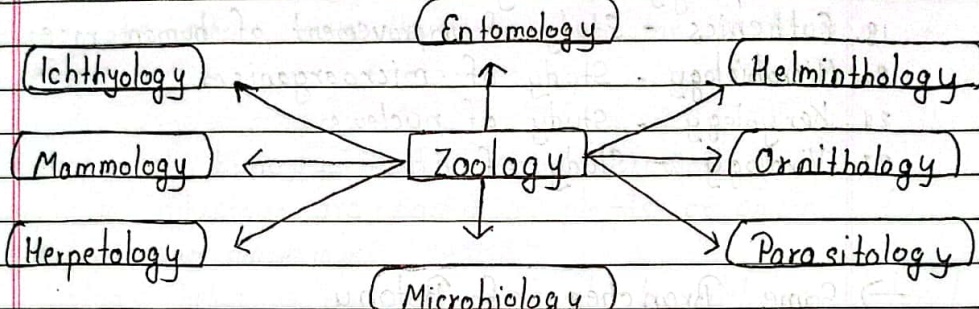
fig. 6.2: Various branches of Zoology
Some other branches of zoology
- Protozoology - Study of unicellular organism
- Parazoology - Study of porifera
- Cnidology - Study of coelenterates
- Helminthology - Study of helminth worms
- Parasitology - Study of parasite worms
- Entomology - Study of insects
- Arachnology - Study of spiders
- Aphidology - Study of aphids
- Malacology - Study of molluscs
- Conchology - Study of shells of molluscs
- Ichthyology - Study of fishes
- Batrachology - Study of frogs
- Herpetology - Study of reptiles
- Ophiology - Study of Snakes
- Saurology - Study of lizards
- Ornithology - Study of birds
- Mammalogy - Study of mammals
- Anthropology - Study of human evolution and culture
- Euthenics - Study of improvement of human race
- Microbiology - Study of microorganism
- Karyology - Study of nucleus
- Virology - Study of virus
Some Branches of Botany
- Bacteriology - Study of bacteria
- Virology - Study of virus
- Phycology - Study of algae
- Mycology - Study of fungi
- Bryology - Study of bryophytes
- Pteridology - Study of pteridophytes
- Pomology - Study of fruits and fruit yielding plants
- Anthology - Study of flowers
- Floriculture - Study of cultivation of plants for flowers
Scope of biology in the specific field
Scope of biology in the field of health and medicine
- All the health workers such as doctors, nurses, HA etc come from biological background
- The concept of biology helps to develop different vaccines after the successful experiments upon wild animals.
Scope of biology in the field of agriculture
- Hybrid plants are genetically modified plants (GM). GM plants can accelerate/replicate production of crops.
- Various insects such as butterfly, honey-bee etc. pollinate plants and thus increase the production of crops.
Scope of biology in the field of industry
- Many industries are based on plants or animals for their raw materials.
- Biology helps us to produce goods by utilizing natural resources as raw materials of the industries in a sustainable manner.
Relation of biology with other sciences
Relation with chemistry
- All the living organism have organic & inorganic compound
- Energy is transferred in the body in the form of organic chemical such as glucose.
- The genetic materials such as DNA and RNA are formed by chemicals.
Relation with physics
- Various physiological activities of plants are dependent on intensity of light as well as energy.
- light affects the living organism during photosynthesis, movement of plants or animals, seed formation etc.
Relation with sociology
- Animal behaviour and social relationship are dependent on social activities.
- Due to social nature, many animals follow the pattern of the social customs.
- The study of behaviour and social systems of human involves principles and laws of biology. Such sociobiologists and other social scientists are influenced by biology.
Scopes in Biology
- Agriculture
- Human health
- Biodiversity conservation
- Environment
- Industries
- Diseases
- Economic value
- Aesthetic value
- Scientific value
- Applied biology