Ecology
Ecology is the study of the reciprocal relationship between living organisms and their environments. Ecology is divided into Autecology and Synecology.
[1] Autecology: The study of individual animal or plant species or its population throughout life history its relation to the habitat which it grows is called autecology.
Synecology: Each of the major causes of distribution of communities and its structure, nature, development & causes are studied by synecology.
Biomes
Each of the major terrestrial ecosystems of distinctive terrestrial areas with their climax plants and associated animals are known as biomes.
Ecological Niche or Niche
The specific part of habitat occupied by individuals of a species is given by its circumscribed by its range of temperature of food and its average availability, microclimate, shelter, activity timing etc. is known as ecological niche or niche.
Ecotypes
The species having wide range of distribution involve especially adapted local populations are called ecotypes.
Ecotone
The zone where two or more different communities meet and integrate is called transition zone or ecotone.
Productivity
Productivity can be defined as the amount of organic matter produced or synthesized by the producers of an ecosystem in a given area in a given time.
Ecological Factors (Ecofactors)
The various things or substrates or factor affecting any ecosystem are called Ecological Factors. The Ecofactors determine growth and survival of the living organisms in ecosystem.
The Ecofactors are of following types:
- Biotic factors
- Autotrophs (producers)
- Consumers (heterotrophs)
- Decomposers
- Abiotic factors
- Topographic factors
- Altitude
- Direction of slopes
- Steepness of slope
- Climatic
- Light
- Temperature
- Wind
- Humidity
- Edaphic
- Soil
- Water
- Topographic factors
Food Chain
The energy of nutrients in the form of food passed from one trophic level to another trophic level of any ecosystem by the repeated process of eating and being eaten. Such a process is called food chain.
e.g.: In Pond Ecosystem
phytoplankton → zooplankton → small fishes → large fishes
In Grassland ecosystem
Grasses → Herbivores → Carnivores → Top Carnivores
Types of Food Chain
Grazing food chain: The food chain found in grassland starting from producer and ends with tertiary consumer are known as grazing food chain. e.g.
Grasses → Herbivores → Carnivores → Top Carnivores
Detritus Food Chain:
Organic matters → Detritivores → producers
Parasitic food chain: The food chain which begins from host and ends with hyperparasites by passing through parasites is called parasitic food chain. e.g.:
Host → parasites → hyperparasites
Food Web
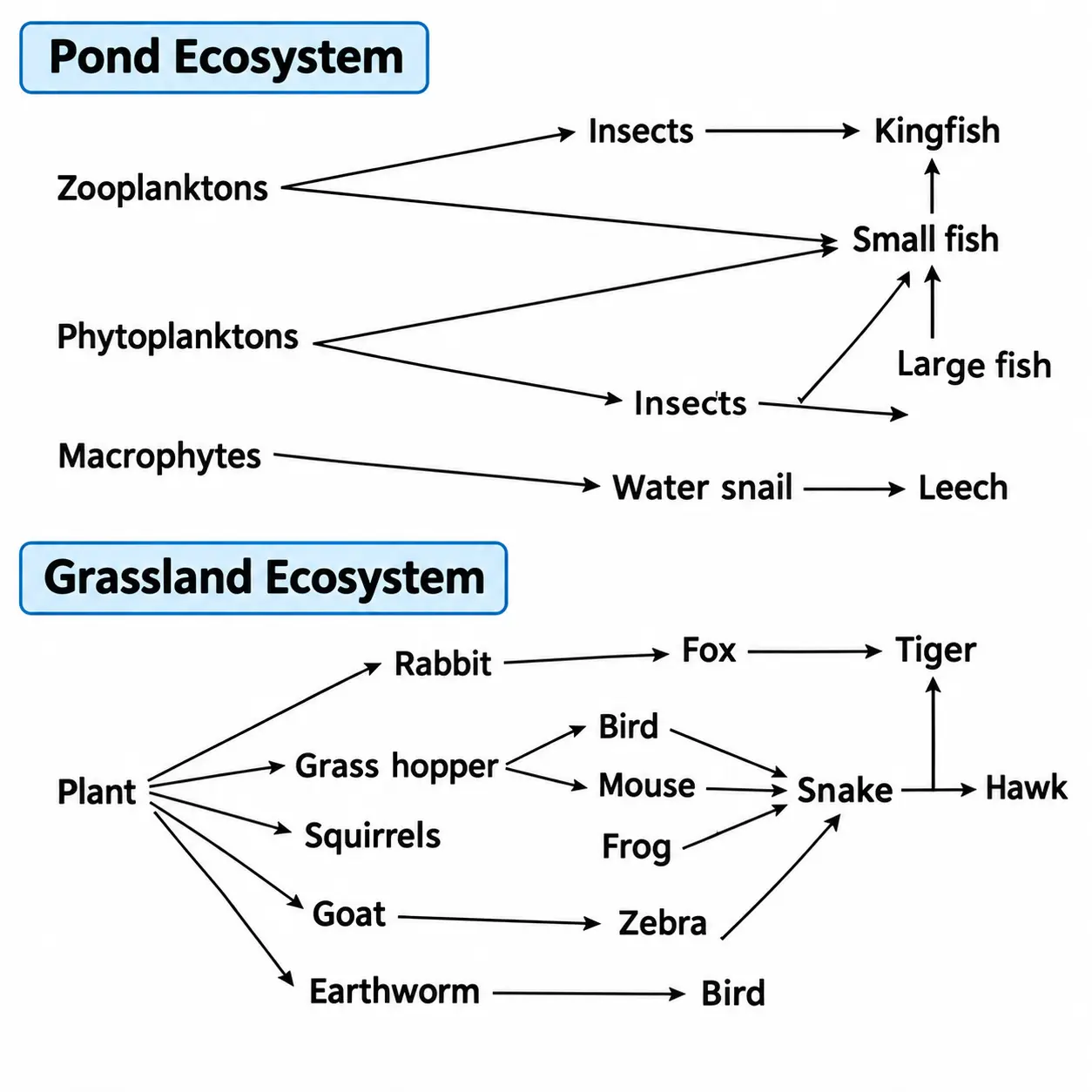
In any ecosystem, not only one food chain but many food chains operate in different regions. These food chains remain interconnected with each other and form a complex network like structure. Such a net like structure formed by the interconnection of different food chains of an ecosystem is called food web.
Ecological Pyramid
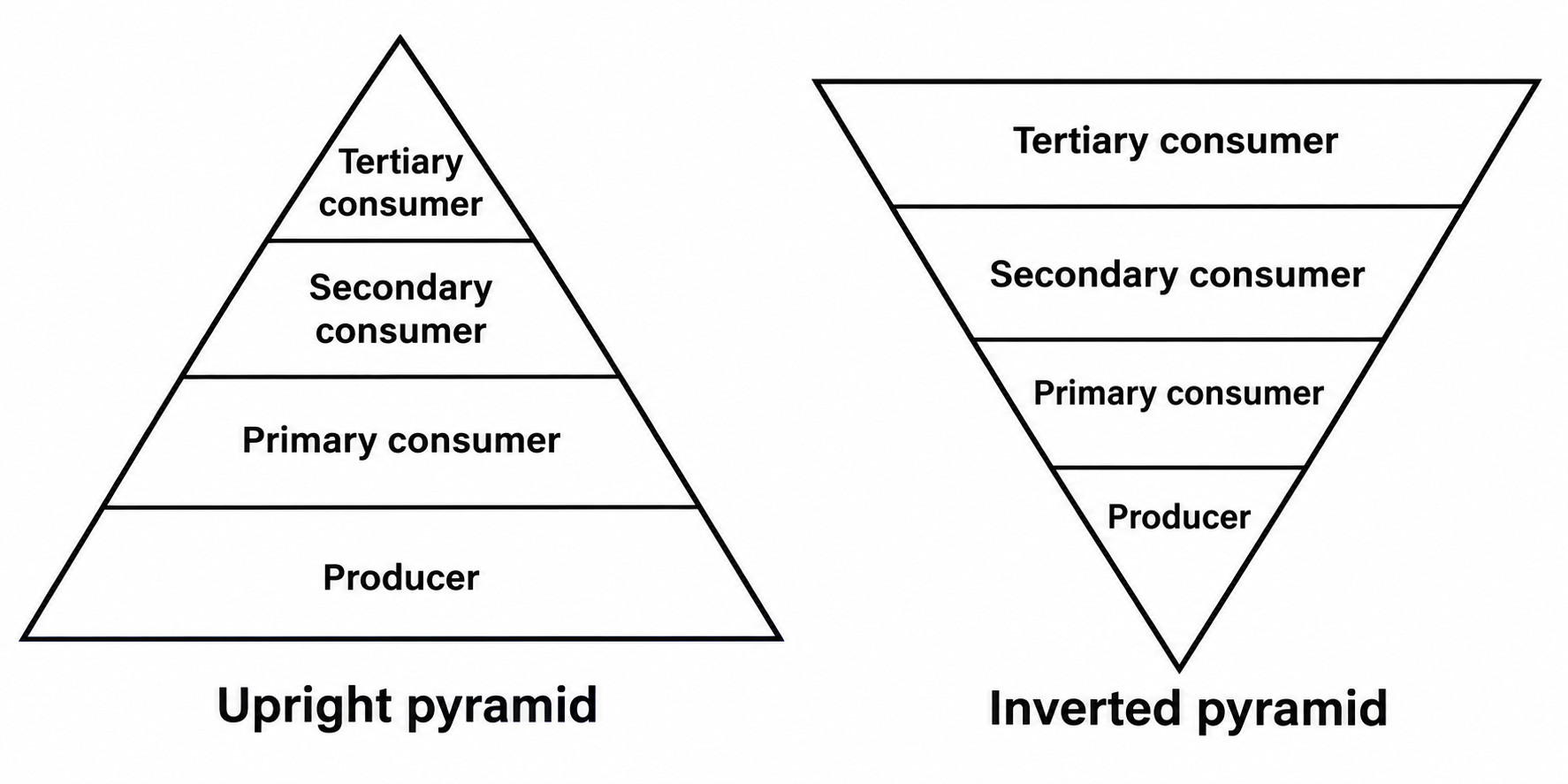
The different aspects of an Ecosystem can be graphically represented in pyramid form, such as pyramidal representation of different aspects of an Ecosystem is called ecological pyramid. The ecological pyramid is either upright or inverted. In an upright pyramid, the base is broad while the top is narrow. In an inverted pyramid, the base is narrow while top is broad.
- Tertiary consumer
- Secondary consumer
- Primary consumer
- producer
Upright pyramid · Inverted pyramid
Types of Ecological Pyramid
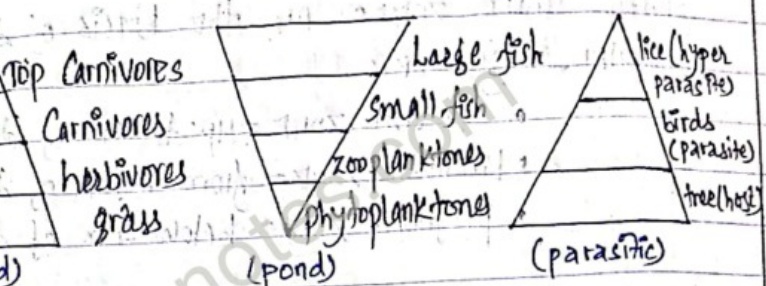
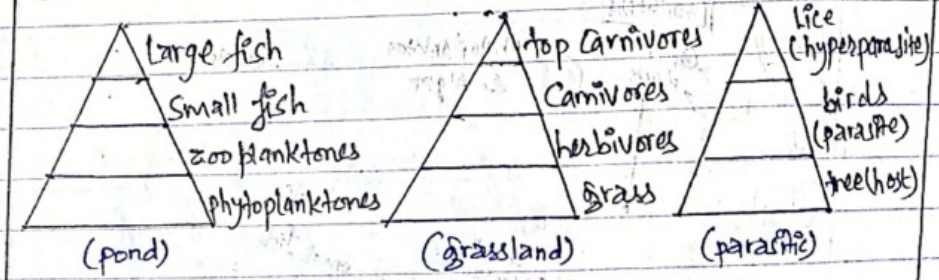
Pyramid of Number: The graphical representation of total number of individual occupying a particular trophic level of any ecosystem in pyramidal form is called pyramid of number.
Pyramid of biomass: The total dry weight of the organism is known as biomass. The graphical representation of total dry weight of the organism at a particular trophic level of an ecosystem in pyramidal form is called pyramid of biomass.
(grassland)
Pyramid of Energy: The graphical representation of energy flow between the different trophic levels of the ecosystem in pyramidal form is called pyramid of Energy.
Pond Ecosystem
Pond ecosystem is a fresh water ecosystem. The pond water is ecologically known as LENTIC water. Thus it is a lentic water system. The pond water is differentiated into three zones on the basis of depth of water. They are:
- Littoral zone = up to 6m of depth
- Limnetic zone = from 6–10m of depth
- Profundal zone = below 10m of depth
Structure of Pond Ecosystem
The pond Ecosystem consists of the following:
A) Abiotic / Biotic Components
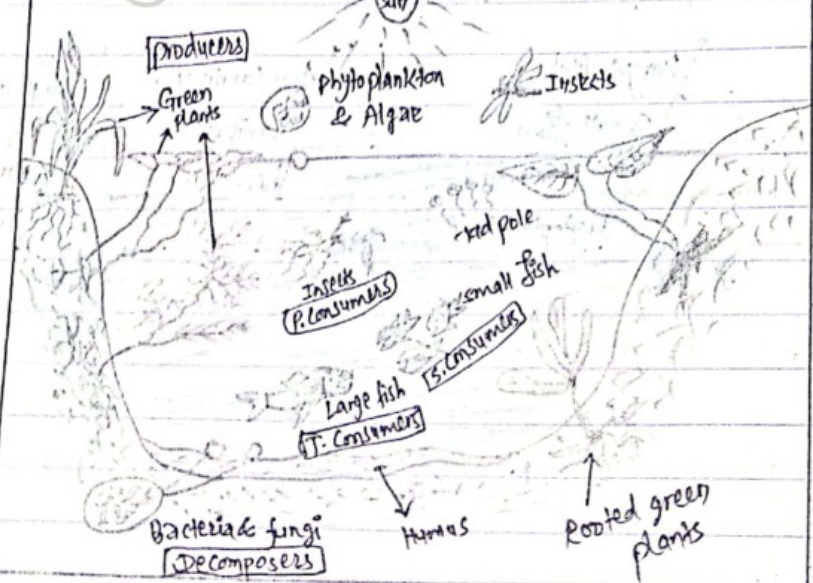
A pond Ecosystem
Abiotic components
The ecosystem have non-living components are called abiotic components. The abiotic components are:
- Organic Substance — like carbohydrates, proteins, lipids, nucleic acids. Which are synthesized by plants and essential for growth, development and maintenance of life.
- Inorganic Substances like nitrates, sulphate, phosphates etc. which are necessary for the growth and development of the living organisms.
- Various Ecological Factors: Like Sunlight, air, water, Soil, etc.
Biotic Components
The living Components of a ecosystem are called biotics. The biotic components are:
Producer: the living organism which synthesize their own food by the process of photosynthesis are called producers. All green plants are the producers of the ecosystem. The producers are as follows:
Phytoplanktons: All phytoplanktons are rootless lower plants found growing in pond, which are found floating on the surface of the pond water.
e.g. Spirogyra, Zygnema, Volvox etc.
II. Macrophytes: The macrophytes are rooted plants found growing in pond. They are also called hydrophytes. The hydrophytes of pond ecosystem are as follows:
Floating hydrophytes: These are rooted plants found growing inside the water but they lies float phase.
Submerged Hydrophytes: These are rooted plants found growing in pond. The little plant body lies inside pond water. e.g.: Hydrilla
Emergent hydrophytes: These are rooted plants found growing in pond. Though they grow in pond the entire plant body comes out of the pond water.
E.g.: Sagittaria, Ranunculus.
Consumer: those living organisms which do not prepare their food and obtain their food from producer or other organisms are called consumer. On the basis of source of food the consumer are of the following types:
I. Primary Consumer: The living organisms which do not prepare their own food and obtain their food from producer are called primary consumer. The primary consumer of pond ecosystem are as follows:
Zooplanktons: These are lower animals found floating on the pond water. They feed on phytoplankton and are usually microscopic and occur in a colony. e.g.: Daphnia, Stentor, etc.
Benthos: The benthos are comparatively larger animals found on pond water. They feed on phytoplanktons and also on hydrophytes. e.g. water insects.
Secondary Consumer: The living organisms which do not prepare their own food and obtain their food from primary consumer are called secondary consumer. E.g. Frog, Water Snake, Small Fish etc.
Tertiary Consumer: The Living Organisms which do not prepare their own food and obtain their food from Secondary Consumer are called tertiary consumer. e.g. Large fish.
Decomposer: The decomposer are also called mineralizers, as they add minerals to the habitat especially soil. They act upon the dead producers and consumers. They can convert the complex organic matter into simple organic forms. It includes species of saprophytic fungi and bacteria. Mucor, Rhizopus.
Grassland Ecosystem
Grassland ecosystem is a terrestrial ecosystem. The grassland ecosystem usually found on the subtropical region of the world with moderate rainfall. Koshi Tappu and Shuklaphanta Wildlife reserve are considered as grassland ecosystem.
Structure of Grassland ecosystem
The grassland ecosystem consist of following components:
- A) Abiotic components
- B) Biotic components
[A] Abiotic Components
The non-living components of an ecosystem are called abiotic components. They are:
- a) Organic Substances Like Carbohydrates, proteins, lipids, nucleic acids, etc. which are synthesized by plants & essential for growth, development and maintenance of life.
- b) Inorganic Substances: Like nitrates, Sulphate, Phosphates etc. Which are necessary for the growth and development of the living organisms.
- Various Ecological Factors: Like Sunlight, air, water, soil etc.
Biotic Components
The living components of an ecosystem are called biotic components. They are:
Producer: The living organisms which can synthesize their own food by the process of photosynthesis are called producers. All green plants are the producers of the ecosystem. e.g.: Imperata, Cynodon, trees, etc.
Consumer: Those Living Organisms which do not prepare their own food and obtain their food from other organisms are called consumer. On the basis of source of food the consumer are of the following types:
Primary Consumer: The living organisms which do not prepare their own food and obtain their food from producer are called primary consumers. All grass eating animals (herbivores) and insects like grasshopper, millipede, centipedes etc are primary consumers.
Secondary consumer: The living organisms which do not prepare their own food and obtain their food from primary consumer are called secondary consumer, e.g. Carnivores like fox, jackal, frog, lizards, snakes, bats.
Tertiary consumer: The living organisms which do not prepare their own food and obtain their food from secondary consumer are called tertiary consumers. They are top carnivores e.g. eagle, hawks etc.
Decomposer: The decomposers are also called mineralizers, as they add minerals to the habitat especially soil. They act upon the dead producers and consumers. They can convert the complex organic matter into simple organic forms. It includes species of saprophytic fungi and bacteria e.g. Mucor, Rhizopus.
Community
Community can be defined as the total number of organism including plants, animals and micro-organism occupying natural relationship and beneficial adjustment. The population can be defined as the total number of individuals of species occupying a particular habitat. Thus Community refers to the assembly or group of different populations of a natural habitat.
Characters of Community:
- species diversity
- Dominance
- Growth form and structure
- Trophic structure
- Succession
Succession
Succession can be defined as the process of establishment of a community replacing the existing community and the natural habitat during the course of time. The succession is gradual process which occurs very slowly and continuously. The succession begins with the establishment of pioneer community and ends with the establishment of climax community. A pioneer community is such community which initially occupies a natural habitat. The climax community is such community which finally occupies the natural habitat during the course of time.
Types of Succession
Depending upon the nature of bare area on which it develops, the succession is of two types — Primary and Secondary.
a) Primary Succession
When the succession starts from a bare and sterile area or from an area which has not been changed physically by organisms is known as primary succession, e.g. Succession in a pond (hydrosere), succession on bare rock (lithosere) and succession in desert (xerosere).
b) Secondary Succession
When the succession starts on the area which has been previously colonized but has been cleared off by some reasons is known as Secondary Succession. It is formed when the main species of the community are destroyed by fire, erosion, wind, flood or any other human activities.
General Process of Succession
The general process of succession is carried out through Sequential Steps:
Nudation: It is the development of nude or bare area without any form of life on it. The nude area is formed due to land slide, erosion, fire, human activities etc.
Invasion: The successful establishment of species in a nude area is called invasion.
Coaction & Competition: Coaction and competitions develop for food and space among the individual species due to increase in number of different species. The species which cannot compete may be replaced from the community but due to high productivity and their ecological amplitude they may be maintained in an area.
Reaction: It is the process of modification of environment due to the influence of living organisms on the soil, water, light and temperature of the environment change as a result of reaction.
Stabilization of climax: The climax community is more or less stable for a longer period of time, not being replaced by other communities.