Mycota (Fungi)
General characteristics of fungi
- The fungi are eukaryotic multicellular and heterotroph organism.
- Its body is thallus (not differentiated into root, stem and leaves).
- The thallus is called hypha (plural: hyphae).
- They occur in different habitats.
- They are the major decomposer of the ecosystem.
- They are chlorophyllous.
- Their cell wall is made up of chitin.
- The sex organs are usually unicellular.
Classification
According to Alexopoulos (1962) on the basis of the organization of vegetative thallus, morphology of reproductive structures, the way of spores production and particular life cycle involved the kingdom mycota is classified as following:
1) Oomycetes
- They range from a primitive unicellular thallus to a profusely branched filamentous mycelium.
- Most of them are terrestrial and obligate parasite.
- Sexual reproduction takes place by the formation of Oospore and asexual by biflagellate zoospores.
Eg: Phytophthora infestans
2) Zygomycetes
- They are mostly saprophytic and some are parasitic.
- Sexual reproduction occurs by conjugation of gametangia resulting in the formation of zygospore.
Eg: Rhizopus, Mucor etc.
3) Ascomycetes
- They are mostly terrestrial occurring as saprophytes or parasites.
- Asexually reproduce by non-motile spores, conidia, oidia or chlamydospores.
Eg: Saccharomyces cerevisiae, Aspergillus.
4) Basidiomycetes
- Mycelium is highly developed, profusely branched and septate.
- They are saprophytic or parasitic.
- Asexual reproduction takes place by fragmentation, budding, oidia, conidia.
Eg: Mushrooms, Puccinia
5) Deuteromycetes
- The fungi are saprophytic as well as parasites.
- The mycelium consists of well developed septate, profusely branched hyphae without haustoria.
- The sexual or perfect stage is absent in the life cycle, therefore, they are called fungi imperfecti.
Eg: Alternaria, Helminthosporium
Outline of Mycota
- Mycota
- Eumycotina (true fungi)
- Myxomycotina (slime moulds)
- Lower true fungi (aseptate mycelium): Oomycetes (water moulds), Zygomycetes (conjugation fungi)
- Higher true fungi (septate mycelium): Ascomycetes (sac fungi), Basidiomycetes (club fungi), Deuteromycetes (fungi imperfecti)
Difference between Ascomycetes and Basidiomycetes
| Ascomycetes | Basidiomycetes |
|---|---|
| 1) It is commonly known as Sac fungi. | It is commonly known as Club fungi. |
| 2) It sexually reproduces by ascospores. | 2) It sexually reproduces by basidiospores. |
| 3) Usually 8 ascospores are formed. | 3) Usually 8 basidiospores are formed. |
| 4) The ascospores are produced on ascus. | The basidiospores are produced on basidium. |
| 5) The ascospores are endogenously formed. | The basidiospores are formed exogenous. |
| 6) Eg: Yeast | 6) Eg: Mushroom |
Mucor
Kingdom: fungi
Division: Mycophyta
Class: Phycomycetes
Subclass: Zygomycetes
Family: Mucoraceae
Genus: Mucor
Species: mucedo
Occurrence
Mucor is a saprophytic fungus growing on dead and decaying organic matters. They usually grow on moist bread, pickles, leather, stale foods stuff etc. They are commonly called pin mould or black mould.
Structure
The body is thallus and the thallus is called hyphae. The hypha is aseptate and multi-nucleated called coenocytic hyphae. In Mucor the thallus or hyphae are of following types:
- Prostrate hyphae: It grows over the substratum. They appear as thin thread like cottony mass which parallel spray throughout the substratum.
- Rhizoidal hyphae: It grows under the substratum. They absorb food and mineral nutrients from the substratum.
- Aerial hyphae: It grow aerially from the prostrate hyphae. They usually develop at the time of reproduction. The tips of the aerial hyphae bear reproductive structure.
Reproduction
Mucor reproduces by means of three methods:
1) Vegetative reproduction
The hyphae break up into small fragments. Each fragment develops into a new thallus.
2) Asexual reproduction
It takes place by the formation of asexual spores like chlamydospores, oidia, sporangiospores.
- i. Chlamydospores: Mucor reproduces asexually by means of chlamydospores during unfavorable condition. They are thick walled resting spores. It undergo rest during unfavorable condition and on the return of favourable condition germinate into new thallus.
- ii. Oidia: When the hyphae are grown in high concentration of sugar, the hyphae become septate and the thin-walled short segments are separated called oidia.
- iii. Sporangiospores: They are thin-walled non motile spores formed on sporangia. The tip of the aerial hyphae starts to swell up. The sporangia is differentiated into peripheral fertile part called sporo-plasm and central sterile part called columella. On getting suitable substratum it develop into new thallus.
3) Sexual reproduction
In Mucor takes place by conjugation during unfavorable condition i.e., food supply is scanty. During sexual reproduction, two hyphae of different strains come close together. The two gametangia come in contact with each other. Each nucleus of both gametangia behaves as male and female gametes. The wall of contact gets dissolve and plasmogamy occur. After plasmogamy the +ve and −ve nuclei get fused (karyogamy) to form diploid nuclei (zygote). The entire structure called zygospore.
The zygospore is surrounded by two walls—outer exine and inner intine. Before germination all the diploid nuclei degenerate except one nucleus. The functional nucleus undergoes meiosis and four haploid nuclei are formed. Out of four haploid nuclei, three nuclei get degenerate and only one become functional. The zygospores absorb water, swells and exine rupture. The intine comes out in the form of germ tube called promycelium. Each nucleus collects cytoplasm and secrete thin wall around them to form spores like structure called germ spores.

∴ life cycle of Mucor
Yeast
Kingdom: fungi
Division: Mycophyta
Class: Ascomycetes
Family: Saccharomycetaceae
Genus = Saccharomyces
Species = cerevisiae
Yeast is unicellular ascomycetes. It grows on sugary substances like stale food stuffs, ripe fruits, sugarcane juice, fruit juice etc. The cell is oval in shape surrounded by cell wall made up of chitin. The cell membrane lies inner to the cell wall and lipoproteinous in nature. Reserve foods are in the form of glycogen or acid oil droplets found on the cytoplasm.
Reproduction
Yeast reproduces by vegetative, asexual and sexual methods.
1) Vegetative reproduction
Vegetative reproduction takes place by budding and fission.
i) Budding
It is the most common method of reproduction among the yeast. During budding small outgrowth develops on one end of the cell. The nucleus elongate and outgrowth further develops finally the nucleus divide into two and one of the nucleus moves towards the outgrowth which further develops and forms bud. At maturity the bud is released such process is known as budding.
ii) Fission
During fission, constriction appears on either side of the cell wall. The nucleus starts to elongate and the constriction further deeper. The nucleus finally divides into two and moves towards the opposite ends. Due to constriction the cell divides into two daughter cell. The process is known as fission.
2) Sexual reproduction
The sexual reproduction in Yeast takes place by conjugation between the two opposite cells or ascospores. On the basis of mode of sexual reproduction, the Yeast shows three types of sexual life cycles i.e. Haplobiantic life cycle, Diplobiontic life cycle and Haplo-diplobiontic life cycle.
i) Haplobiotic life cycle
In the haplobiotic life cycle haploid stage is dominant. It is shown by Schizosaccharomyces octosporus. The vegetative cell is haploid which multiplies by fission. At the time of sexual reproduction, two cells of opposite strains come closer to each other. Small protuberances develop on both of the cells facing opposite to each other. The wall of the contact dissolves and plasmogamy occurs. It is followed by karyogamy and forms zygote which is the only diploid stage. The zygote undergoes meiosis and four haploid nuclei are formed, they again under goes mitosis and eight haploid nuclei are formed. Each nucleus collects cytoplasm and form ascospore.
ii) Diplobiontic life cycle
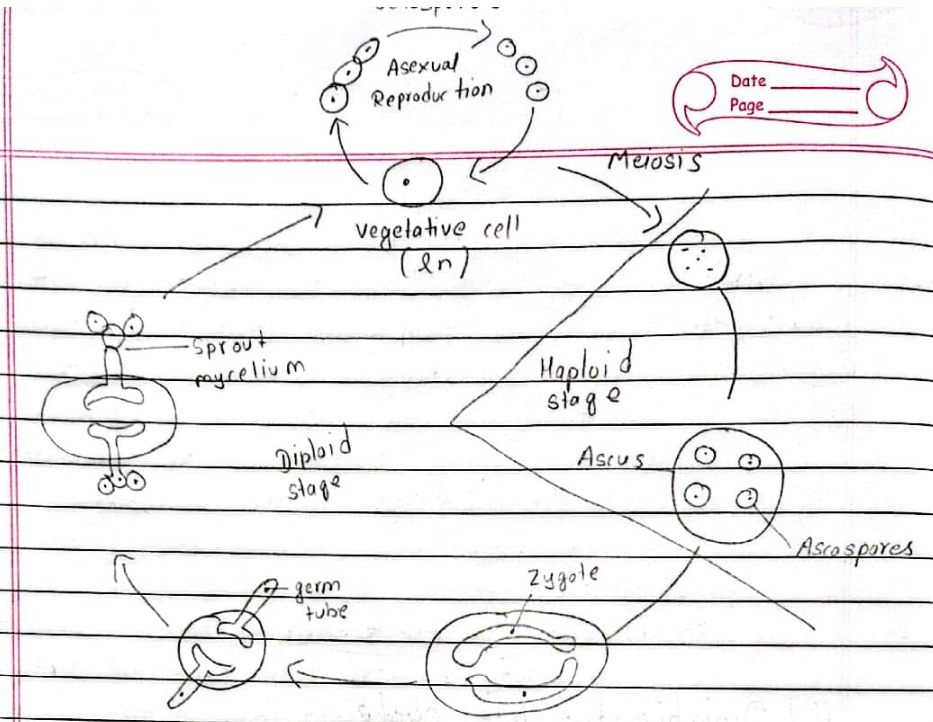
In diplobiontic life cycle diploid phase is dominant. It is shown by Saccharomyces ludwigii. The vegetative cell is diploid which multiplies by budding. At the time of sexual reproduction, the diploid cell undergoes meiosis to form four haploid nuclei which becomes ascospores and the mother cell becomes ascus. Two ascospores of opposite strains fuse within the ascus and diploid zygote are formed. Now the zygotes germinate in the form of germ tube called sprout mycelium which cut off by diploid vegetative cell by the budding. Thus in entire life cycle only ascospores are haploid and rest all are diploid.
iii) Haplo-diplobiontic life cycle
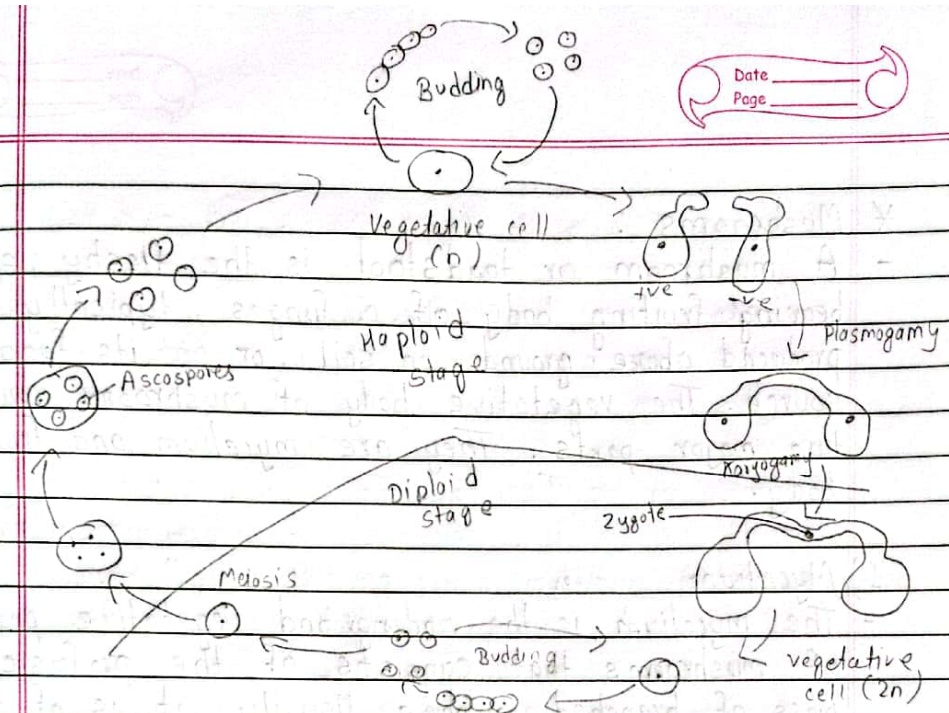
In haplo-diplobiontic life cycle, both haploid and diploid phases are more or less equally dominant in their life cycle. It is shown by Saccharomyces cerevisiae. The vegetative cell is haploid which multiplies by budding. At the time of sexual reproduction, two haploid cells of opposite strains come closer to each other for conjugation. After the formation of conjugation tube plasmogamy occurs. The plasmogamy is followed by karyogamy and zygote is formed. Now the diploid zygote starts multiplication by budding, the diploid vegetative cells asexually multiplies again at the time of sexual reproduction. The diploid vegetative cells under goes meiosis to form four haploid nuclei.
Economic importance of fungi
(A) Useful activities
- Fungi in medicine: Penicillium produces antibiotics as penicillin.
- Fungi in industries: Different species of fungi are used in various industries.
- Fungi as food: Some fungi like many species of Mushrooms and Morels are used as food.
- Fungi in hormone production: Some fungi are used in hormone production like Gibberellin.
- Fungi in study: Some fungi are used in genetic studies.
(B) Harmful activities
- Many fungi cause food spoilage, vegetables, eg: Mucor
- Many fungi destroy timber and timber products, eg: Aspergillus
- Many mushrooms are poisonous, eg: Amanita verna.
- Many fungi are parasites to plants as well as animals.
Mushrooms
A mushroom or toadstool is the fleshy, spore-bearing fruiting body of a fungus, typically produced above ground, on soil, or on its food source. The vegetative body of mushrooms contains two major parts. They are mycelium and fruiting body.
1) Mycelium
The mycelium is the underground vegetative part of mushrooms that consists of the profuse mass of branched hyphae. Usually, it is of two types: primary mycelium and secondary mycelium.
- a) Primary mycelium: It originates by the germination of uninucleate basidiospores carrying either "+" or "−" strain. The cells are uninucleate that is monokary. It is short lived and becomes bi-nucleate by fusing of two compatible hyphae.
- b) Secondary mycelium: It originates from primary mycelium. After fusion of the hyphae of two opposite strains, the nucleus from one hypha migrates to the other and later gives rise to the binucleate secondary mycelium that is dikaryotic. It is long lived and the abundant.
fig (A, B) Agaricus mycelium (A) Monokaryotic (B) Dikaryotic
2) Fruiting body (The basidiocarp)
The mature fruiting body can be differentiated into three parts that is stipe, pileus and annulus. Each mushroom consists of a short fleshy stalk called stipe and stipe is crowded with a large and circular an umbrella like head called pileus.
Gills
A transverse section of the gill (T.S of gill) shows the following 3 distinct structures:
- Trama: It is the middle part of the gill. This region is made up of loosely arranged tissue of long slender hyphae. These hyphae run, more or less, longitudinally.
- 2) Sub-hymenium or hypothecium: The hyphae of the trama region curve outwards towards each surface of the gill. They end in small diameter cells forming a compact layer known as sub-hymenium.
- 3) Hymenium or thecium: It is the outermost layer and lies on the surface of sub-hymenium covering both sides of the gill. Some branches emerge out almost at right angle to the sub-hymenium and develop a palisade like layer consisting of basidia (fertile) and the paraphyses (sterile).
Advantages of mushroom
- Some of the mushrooms are commonly cultivated for delicious food for human consumption.
- Mushrooms are the richest source of plant protein.
- Nowadays mushrooms are cultivated business point of view by farmers to improve their economic condition.
- Several mushrooms have high medical value.
- Decrease the risk of cancer.
- Promote lower cholesterol.
- Protect brain health.
- Stimulate a healthier gut.
- Support a healthy immune system.
Disadvantages of mushroom
Sometimes toad stools, which are highly poisonous are mistakenly taken by humans resulting in death.
- Boletus satanas causes pain, vomiting and diarrhea.
- Amanita muscaria causes gastric disturbances intensifies people and paralyses the central nervous system in man and animals.
Difference between poisonous and non-poisonous mushroom
| Poisonous mushroom | Non-poisonous mushroom |
|---|---|
| 1) They are found under the shade of bushes. | They are found in open places. |
| 2) They are usually colourful. | 2) They are usually white or dull. |
| 3) They burn or sting the tongue when tasted. | 3) They do not burn or sting the tongue when tasted. |
| 4) They have a pointed cap. | |
| 5) They are also called toadstools. | 5) They are also called puffballs. |
| 6) They have a bad smell. | 6) They have good smell. |
| 7) They are harmful. | 7) They are biologically important. |
| 8) Eg: Amanita caesarea, A. muscaria etc. | 8) Eg: Agaricus campestris, A. brunnescens etc. |