The word virus is derived from the Latin word virus; Venenum = poisonous meaning fluid poison. Viruses are known as obligatory parasites as they are fully dependent on the living organisms for multiplication.
A mature virus particle outside the host is called virion. The branch of biology that deals with the study of viruses is called virology.
Characteristics of viruses
- All the viruses are minute and simplest organisms which can be observed only by the use of electron microscope.
- The diameter of viruses ranges from about 10–300 nm; on average they are 50 times smaller than bacteria.
- They are metabolically inactive outside the host cell because they do not have enzyme systems and protein synthesis machinery. Thus they are obligatory intracellular parasites.
- They are composed of nucleic acid either DNA or RNA or both.
- Viruses do not have cellular structures i.e. as they lack true nucleus, cytoplasm and cytoplasmic organelles like mitochondria, Golgi complex etc.
- They show response to chemicals, heat & temperature. Outside the host cell, they can be crystallized and behave as the chemicals.
- They cannot show the independent mode of life. They are highly specific to their host. Viruses cannot reproduce by fission or conjugation. Viruses undergo mutation.
Classification on the basis of nucleic acids
On the basis of nucleic acids, viruses are classified into the following three types:
- DNA virus: The virus that possesses DNA as the genetic material
- RNA virus: The virus that possesses RNA as the genetic material
- DNA-RNA virus: The virus that possesses both DNA & RNA as the genetic material
Structure of bacteriophage
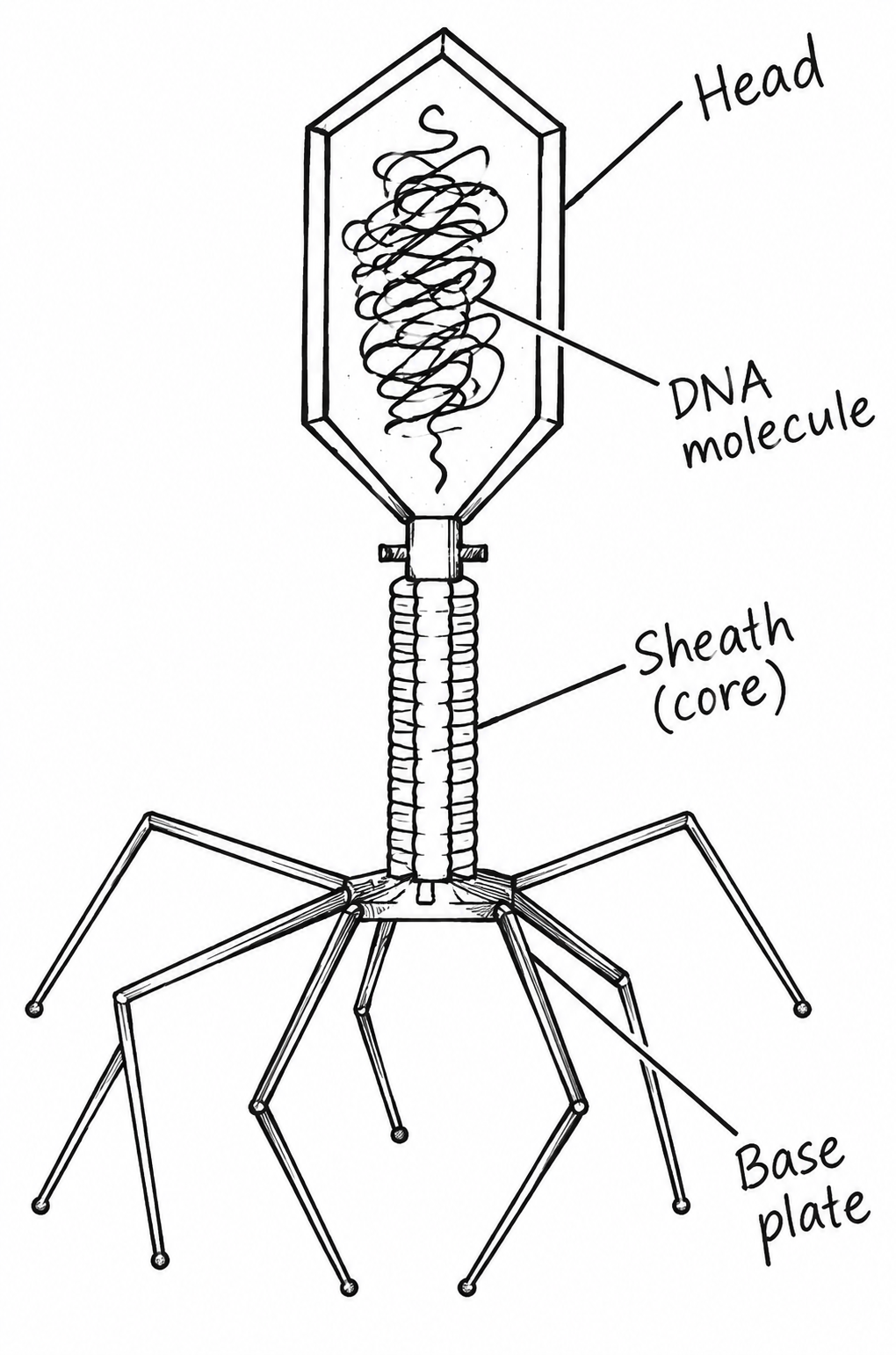
The shape and size of bacteriophage may vary from species to species. Some phages are spherical, comma-shaped while majority of them have tadpole-shaped structure. The tadpole-shaped bacteriophages have polyhedral head, a short neck, collar, straight tail. The head is bipyramidal hexagonal shape. The contents of head are enclosed by a capsid which is about 350 Å thick. The capsid is made up of about 2000 capsomeres. The head encloses the double stranded greatly folded DNA. The tail rests on a hexagonal end plate that bears six tail fibres.
Mode of transmission of viruses
- Transmission through soil: Some viruses like tobacco mosaic virus, potato mosaic virus, wheat mosaic virus etc. lie in the soil with the plant debris. They are transmitted to the new crops which are growing in the same field.
- Transmission by mechanical means: A large number of viruses are transmitted by mechanical means by contact of infected & healthy leaves by wind, by grafting infected buds in the healthy plants, by agricultural tools like knife while cutting.
- Transmission by seeds: A number of viruses like tobacco mosaic virus, mosaic viruses of legumes are transmitted through the infected seeds.
- Transmission through the nematodes & fungi: Many soil-borne viruses like wheat mosaic viruses are transmitted by nematodes & fungi present in the soil.
- Transmission by contact: Viruses can be transmitted by slight rubbing contact of the infected and healthy plant organs by the action of wind or other means.
- Transmission through vectors: Some viruses are transmitted through some specialised vectors like insects.
- Transmission by vegetative propagation: If the vegetative preparation of infected plant parts are used for vegetative propagation then the propagated plants are also infected.
- By smokers: Tobacco mosaic virus remains infective in dry tobacco leaves for many years. It is spread by the fingers of smokers by the smoke remaining pieces of cigarettes after smoking.
Economic importance of viruses
[1] Positive effects
- The temperate phage viruses help in transfer of genetic material from one bacterium to the other. Some of the viral infected plants are beautiful.
- Viruses may destroy the bacterial cells and make water free from bacteria.
- Bacteriophages can be used in the treatment of several bacterial diseases like cholera, dysentery.
[2] Harmful effects
- Viruses cause numerous diseases in human beings. Examples: polio, rabies, AIDS etc.
- Some of the common viral plant diseases are tobacco mosaic, tomato mosaic, potato mosaic etc.