Capacitor
The object/device which can store charge are called capacitor. It is also defined as the device which is designed for storing charge are called capacitor. In electronic symbol, it is represented as:
Capacitance
The ability of a capacitor to store charge is defined as capacitance of that capacitor. It is represented by \( C \) and the SI unit of capacitance is farad or coulomb/volt. The small units are generally used and these are:
\( 1\,\mu F = 10^{-6}\,F \)
\( \therefore 1\,pF = 10^{-12}\,F \)
If a charge is given to a capacitor, the potential difference across the plates rises, if potential difference across the plates of a capacitor rises, the charge stored in it also increases that means the charge stored in the capacitor is found that directly proportional to the potential difference across the plates of the capacitor i.e.
Where, 'c' is proportionality constant known as capacitance of that capacitor.
Now, \( q = cv \)
\( \therefore c = \frac{q}{V} \) —①
1 farad
If one coulomb charge stored in the capacitor having potential difference 1 volt then the capacitance of capacitor is said to be 1 farad.
Principle of capacitor
When a charge conducting plate placed near the uncharged plate, Then, the opposite charge induced on the uncharged plate. If charged plate have positive charge as shown in the figure, negative charge induced on other plate at front side (the side towards charged plate) and positive charge induced on the side of plate which is free to move but negative charge are bound and cannot moved. If we grounded the positive charge neutralizes and only negative charge left on that plate. Now, due to opposite charge on two different plate placed near each other creates potential difference across the plates. If charge on plates goes on increasing potential difference also increase. Similarly, If potential difference across plates increases, the charge on plates increases. In this way, a capacitor can hold charges.
Different types of capacitor
i) Isolated spherical capacitor
Consider a metallic sphere having radius R' with charge +q. Let the sphere is isolated. Now, the electrostatic potential at the surface of sphere is given as:
\( V = \frac{1}{4\pi\varepsilon_{0}} \frac{q}{R} \)
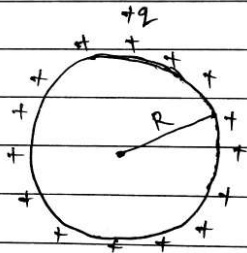
\( \frac{q}{V}=4\pi\varepsilon_{0}R \) ①
According to defⁿ of capacitance of a capacitor,
\( c=\frac{q}{V} \) —②
so, from ① and ②.
\( \therefore C=4\pi\varepsilon_{0}R \)
This is the formula for the capacitance of a com isolated spherical capacitor.
Parallel Plate capacitor
Consider, two parallel plates having surface area A' placed at distance d, with each other. let the charge on the plate is q due to which the electrostatic field between plates is uniformed and given as:
\( E=\frac{V}{d} \) ①
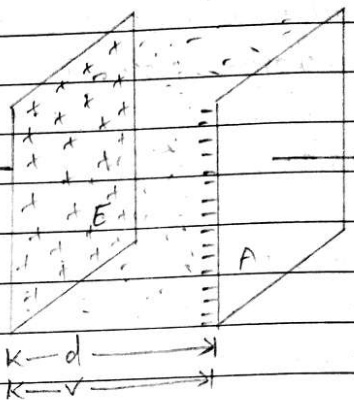
where \(V\) is the potential difference across the plate.
If \(V\) be the surface charge density of the plate which is given by \(Q = \frac{q}{A}\) then,
Intensity due to plane charge conductor is given as,
\(E = \frac{\sigma}{\xi}\)
Now, from eqn ① and ②,
\(\frac{\sigma}{\xi} = \frac{V}{d}\)
or, \(\frac{q}{\Delta t} = \frac{V}{d}\)
or, \(\frac{q}{AE} = \frac{V}{d}\)
\(\therefore \frac{q}{V} = \frac{AE}{d}\)
According to the def of capacitance of capacitor,
\(\therefore C = \frac{q}{V}\)
From eqn (iii) and eqn (iv),
\(\therefore C = \frac{AE}{d}\)
Eq(v) is the capacitance of parallel plate capacitor.
Now, if there is dielectric medium having dielectric constant \( \varepsilon_{r} \) then Capacitance of capacitor of parallel plate capacitor becomes
Combination of capacitor
Capacitors are combined in two different ways, given as:
- Series combination
- Parallel combination
Series combination
When two or more than two capacitors are combined in such a way that positive terminal of one capacitor connected to the negative terminal of another capacitor is alternate terminals are connected together, then the combination is called series combination.
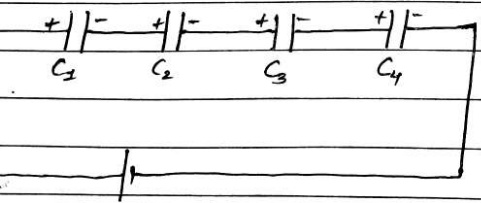
Consider, three capacitors having capabilities \( C_{1}, C_{2}, C_{3} \) are connected in a with a potential difference V'. Let, \( V_{1}, V_{2}, V_{3} \) and \( q_{1}, q_{2}, q_{3} \) are the potential difference and charge on each capacitor respectively. If C be the equivalent resistance capacitance of all capacitors then
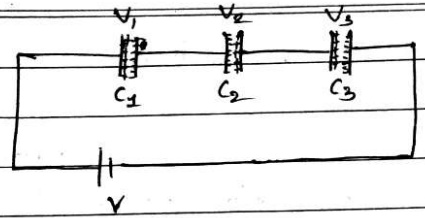
Here, due to conduction and induction process, the charge stored on each capacitor is same and also equal to total charge i.e.
\( q = q_{1} = q_{2} = q_{3} \)
Again, the potential differences across each capacitor are collectively equal to the total potential difference i.e. the sum of individual p.d's equal to the total p.d' i.e.
$$ V=V_{1}+V_{2}+V_{3} $$Now, the equivalent capacitance, C' can be written as,
$$ c=\frac{q}{V} $$ $$ \text{or,} \quad C = \frac{q}{V_{1} + V_{2} + V_{3}} \quad (\text{Since } V = V_{1} + V_{2} + V_{3}) $$Taking residual on both sides,
$$ \frac{1}{c} = \frac{V_{1} + V_{2} + V_{3}}{q} $$ $$ \text{or,}\frac{1}{c} = \frac{v_{1}}{q} + \frac{v_{2}}{q} + \frac{v_{3}}{q} $$ $$ \text{or} \quad \frac{1}{c} = \frac{v_{1}}{q_{1}} + \frac{v_{2}}{q_{2}} + \frac{v_{3}}{q_{3}} \quad \left[\text{since,} \quad q = q_{1} = q_{2} = q_{3}\right] $$ $$ \text{or,} \quad \frac{1}{c} = \frac{1}{\frac{q_{1}}{V_{1}}} + \frac{1}{\frac{q_{2}}{V_{2}}} + \frac{1}{\frac{q_{3}}{V_{3}}} $$ $$ \therefore \frac{1}{c} = \frac{1}{c_{1}} + \frac{1}{c_{2}} + \frac{1}{c_{3}} $$② For series combination.
From above relation, it is cleared that the reciprocal of equivalent capacitance of a capacitor's connected in series is equal to the sum of reciprocal of individual of capacitor.
- The number of capacitors are connected in series, the reciprocal of equivalent capacitance is equal to the sum of individuals' reciprocal of individual capacitance.
- The equivalent capacitance is less than the smallest capacitance.
- The same charge stored in each capacitor.
Series maa jodhda equivalent capacitance ko value kam hunxa. Yeti kam hunxa ki sabai madhya to small value bhanda pani kano hunxa.
Parallel combination
If two or more than two capacitors are connected in a such way that same terminals are connected together. Then the combination is called parallel combination.
Consider three capacitor having capacities \( C_{1}, C_{2} \) and \( C_{3} \) are connected with potential difference V'. Let, \( V_{1}, V_{2}, V_{3} \) and \( q_{1}, q_{2}, q_{3} \) are the p-d and charge on each capacitor respectively. Given as:
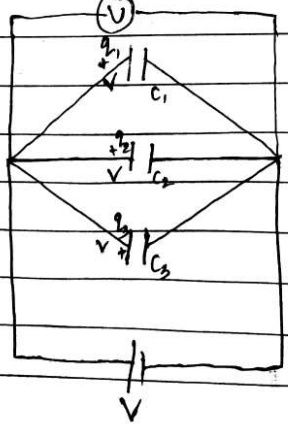
Here, the potential difference occurs the all capacitors are same and equal to total potential difference applied in the circuit i.
\( V = V_{1} = V_{2} = V_{3} \)
And, total charge stored in the capacitors is the sum of charges stored in each capacitor i.e.
$$ q=q_{1}+q_{2}+q_{3} $$Now,
The equivalent capacitance can be written as:
$$ c=\frac{q}{v} $$ $$ \text{or,} c = \frac{q_{1} + q_{2} + q_{3}}{v} $$ $$ \text{or,} c = \frac{q_{1}}{v} + \frac{q_{2}}{v} + \frac{q_{3}}{v} $$ $$ \text{or,}c=\frac{q_{1}}{V_{1}}+\frac{q_{2}}{V_{2}}+\frac{q_{3}}{V_{3}} \ (\text{Since, } V=v_{1}=v_{2}=v_{3}) $$ $$ \therefore c = c_{1} + c_{2} + c_{3} \cdots \rightarrow \text{③} $$Hence, Eq(3) gives the equivalent capacitance of a capacitor connected in parallel series.
Energy stored in the capacitor
The work done during the charging of capacitor stored in the form of electrical potential energy and this is called energy stored in the capacitor.
When a capacitor is connected to p.d., the capacitor starts to charge when the charges on the plates of capacitor increases from zero. The electric field intensity setup between the plates which also goes on increasing. This electric field opposes the further charging of capacitor.
and to charge the capacitor, battery have to perform work against these electric field and this work stored as electrical potential energy.
Consider, a capacitor of capacitance 'C' connected to a potential difference 'V' initially, the small amount of charge stored in the capacitor and for this small work during this process can be written as:
Now, to charge the capacitor fully, i.e. from 0 to q, the total work can be obtained as:
\( \int d w = \int_{0}^{q} v\, dq \)
\( \therefore W = \int_{0}^{q} v \cdot dq \)
We know that, \( c = \frac{q}{v} \) or, \( v = \frac{q}{c} \)
putting these values in ①,
$$ \text{or} \quad W = \int \frac{q}{c} \cdot dq $$ $$ \text{or,} \quad W=\frac{1}{c}\int\limits_{0}^{q} q \cdot dq $$ $$ \text{or,}W=\frac{1}{c}\left[\frac{q^{2}}{2}\right]_{0}^{q} $$ $$ \text{or} \quad W = \frac{1}{2} \frac{q^{2}}{c} $$ $$ \text{or,}w=\frac{1}{2}\frac{(cv)^{2}}{c} $$ $$ \text{or,}W=\frac{1}{2}\times\frac{c^{2}V^{2}}{c} $$ $$ \therefore W = \frac{1}{2} C V^{2} $$This is the energy stored in the capacitor.
\( U = W = \frac{1}{2} C V^{2} \)
Energy density of a capacitor
The energy density of a capacitor is defined as energy stored in the capacitor per unit volume.
Consider, a parallel plate capacitor of capacitance 'c' have area of plates 'A' and the separation between these plates is 'd'. If the capacitor is connected with p.d. 'v' then the energy stored in the capacitor can be written as
If the space between plates of the capacitor filled with air then the capacitance can be written as:
\(\therefore C=\frac{\varepsilon_{0} A}{d} \rightarrow (i)\)
Now, accord to def of energy density, we have
energy density (u) = \(\frac{\text{Energy stored}}{\text{Volume}}\)
$$ \text{or,} u = \frac{\frac{1}{2} c v^{2}}{A d} $$ $$ \text{or,} \quad u = \frac{1}{2} \frac{\varepsilon_{0} A}{d} \frac{V^{2}}{A d} $$ $$ \text{or,}u=\frac{1}{2}\varepsilon_{0}\frac{v^{2}}{d^{2}} $$Since, \( E = \frac{v}{d} \),
So, \( [u = \frac{1}{2} \varepsilon_{0} E^{2}] \) Where \( E = \text{field intensity} \)
Hence, The energy density of a capacitor \( U = \frac{1}{2} \varepsilon_{0} E^{2} \)
Loss of energy in joining capacitor
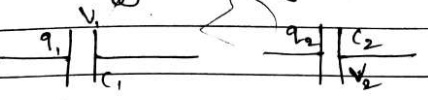
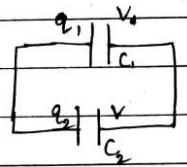
When two different capacitor charged differently and connected together then, the charge flows from a capacitor at higher potential to another potential at lower potential unless the potential of both capacitor becomes equal. In this process, some energy lost during the connection of capacitor as heat energy.
Consider two capacitor having capacitance \( C_{1} \) and \( C_{2} \) stored charge \( q_{1} \) and \( q_{2} \) when connected with potential \( v_{1} \) and \( V_{2} \) respectively. Here, energy stored in each capacitor is given as:
$$ \frac{1}{2}c_{1}v_{1}^{2}\text{ and }\frac{1}{2}c_{2}v_{2}^{2} $$The total energy of both capacitor before combination is given as:
\( E_{1}=\frac{1}{2}C_{1}V_{1}^{2}+\frac{1}{2}C_{2}V_{2}^{2} \)
When these capacitors are connected together, the potential of both capacitor becomes equal called common potential which can obtained as:
$$ c=\frac{q}{V} $$ $$ \text{or,}v=\frac{q}{c} $$ $$ \text{or,} v = \frac{q_{1} + q_{2}}{c_{1} + c_{2}} \quad \left( \because q = q_{1} + q_{2}, \quad c = c_{1} + c_{2} \right) $$ $$ \text{or} \quad V = \frac{C_{1}V_{1} + C_{2}V_{2}}{C_{1} + C_{2}} $$Again, the total energy after combination can be written as
\( E_{2}=\frac{1}{2}c v^{2} \)
$$ E_{2}=\frac{1}{2}(c_{1}+c_{2})\left(\frac{c_{1}v_{1}+c_{2}v_{2}}{c_{1}+c_{2}}\right)^{2} $$Now, the loss in energy is:
$$ \begin{align*}E_{1}-E_{2}&=\frac{1}{2}C_{1}V_{1}^{2}+\frac{1}{2}C_{2}V_{2}^{2}-\frac{1}{2}(C_{1}+C_{2})\left(\frac{C_{1}V_{1}+C_{2}V_{2}}{C_{1}+C_{2}}\right)^{2}\\&=\frac{C_{1}C_{2}\left(V_{1}-V_{2}\right)^{2}}{2\left(C_{1}+C_{2}\right)}\end{align*} $$from above relation, we can conclude that the term \( (V_{1}-V_{2})^{2} \) gives always positive value and hence the difference in energy \( (E_{1}-E_{2}) \) is always positive. So, this proves that \( E_{1} > E_{2} \) that means there is always loss in energy after joining the capacitors.
Sharing of charge between capacitors
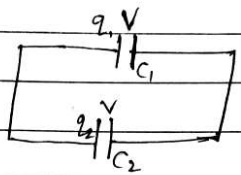
Consider two charge capacitor of capacities \( C_{1} \) and \( C_{2} \) having potential \( V_{1} \) and \( V_{2} \) respectively. Initially, the charge on each capacitor can be written as:
\( q_{1}=c_{1}V_{1} \) and \( q_{2}=c_{2}V_{2} \)
let the capacitors are connected to each other with a wire with like charges at the same point. The capacitor will share charge with each other till they acquire common potential. let \( q_{1}^{\prime} \) and \( q_{2}^{\prime} \) are new charges on each capacitor and can be given as:
\( q_{1}^{\prime}=c_{1}V \) and \( q_{2}^{\prime}=c_{2}V \)
Since, the total charged is conserved,
\( \text{So,} q_{1} + q_{2} = q_{1}^{\prime} + q_{2}^{\prime} \)
\( C_{1}V_{1} + C_{2}V_{2} = C_{1}V + C_{2}V \)
\( V(C_{1} + C_{2}) = C_{1}V_{1} + C_{2}V_{2} \)
\( \therefore V = \frac{C_{1}V_{1} + C_{2}V_{2}}{C_{1} + C_{2}} \)
This is the common potential,
Again, \( q_{1}+q_{2}=q \)
\( q=C_{1}V_{1}+C_{2}V_{2} \)
Now, charge on each capacitor can be determined as,
\( q_{1}^{\prime}=c_{1}V \)
\( q_{1}^{\prime}=c_{1}\left(\frac{c_{1}V_{1}+V_{2}C_{2}}{c_{1}+c_{2}}\right) \)
\( \therefore q_{1}^{\prime}=c_{1}\frac{q}{c_{1}+c_{2}} \)
Similarly,
\( \therefore q_{2}^{\prime}=c_{2}\frac{q}{c_{1}+c_{2}} \)
Uses of capacitor
- They can be used as device for storing charge.
- They are used in increasing the efficiency of alternating current power transmission.
- The ignition system of any auto mobile engine contains a capacitor to eliminate the sparking of the points when they open or close.
- Capacitor are used in Scientific investigation.
- It is used to give electric field of desired configuration.
- They are used in filter circuit, oscillations in time delay devices, etc.
Dielectric
A material which cannot conduct electric current but can transmit electric field is called dielectric. For e.g., mica, paper, glass, etc.
There are two types of dielectric:
- Non-polar dielectrics
- Polar dielectrics
Non-polar dielectrics
The dielectrics made up by molecules in which center of positive charge coincides with center of negative charge are called non-polar dielectrics. For e.g., Benzene, oxygen, Nitrogen, Methane, etc.
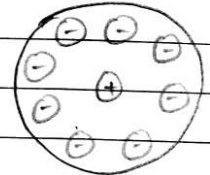
Fig.- Non-polar dielectric
Polar dielectrics
If the center of positive charge and negative charge in a molecule is not coincided then the molecule is called polar molecule and the dielectric mode by such type of molecule is called polar dielectrics. For eg. HCl, NH₃, CO₂, etc.
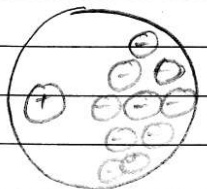
Fig.: Polar dielectric