Scalar and Vector Quantities
Scalar quantity: The physical quantities which have magnitude but no direction are called Scalar quantities. They can be added or Subtracted according to the rule of Algebra. E.g.: Temperature, pressure, time, Work, distance etc.
2. Vector quantity: The physical quantities which have both magnitude and direction are called vector quantities. They can be added or subtracted according to the rule of vector addition. E.g: Velocity, force, displacement etc.
A vector is graphically represented by a straight line with arrow at one end. The direction of arrow represents the direction of the vector and length of the line represents the magnitude of the vector. Example:
O → A
1-magnitude-direction
A. Triangle Law of Vector Addition
According to the law of vector addition, the side OB represents the resultant \( (\vec{R}) \) of the vectors both in magnitude and direction. Thus,
$$ \overrightarrow{R} = \overrightarrow{P} + \overrightarrow{Q} $$
from triangle OCB,
$$ OB^{2} = OC^{2} + CB^{2} $$
$$ OB^{2} = (OA + AC)^{2} + CB^{2} $$ —①
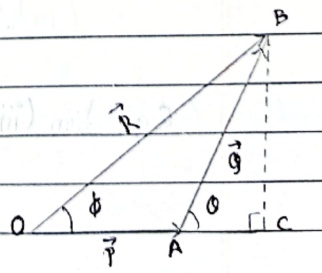
In triangle \( ACB \) with \( \theta \) as the angle between \( P \) and \( Q \)
$$ \cos\theta = \frac{AC}{AB} $$ and $$ \sin\theta = \frac{BC}{AB} $$
or, $$ AB\cos\theta = AC $$ and $$ BC = AB\sin\theta $$
or, $$ AC = Q\cos\theta $$ and $$ BC = Q\sin\theta $$
Substituting the value of AC and BC in eq.(i), we get;
i.e. $$ R^{2} = (P + Q \cos \theta)^{2} + (Q \sin \theta)^{2} $$
or, $$ R^{2} = P^{2} + 2PQ \cos \theta + Q^{2} \cos^{2} \theta + Q^{2} \sin^{2} \theta $$
or, $$ R^{2} = P^{2} + 2PQ \cos \theta + Q^{2} $$
Hence,
$$ R = \sqrt{P^{2} + 2PQ \cos \theta + Q^{2}} $$ —②
Equation (ii) gives the magnitude of resultant vector \( \overrightarrow{R} \)
Again, in △ OCB,
$$ \tan \alpha = \frac{BC}{OC} $$
or, $$ \tan \alpha = \frac{BC}{OA + AC} $$
or, $$ \tan \alpha = \frac{Q \sin \theta}{P + Q \cos \theta} $$
$$ \therefore \alpha = \tan^{-1} \left(\frac{Q \sin \theta}{P + Q \cos \theta}\right) $$ —③
Equation (iii) gives the direction of resultant vector \( \overrightarrow{R} \).
B. Parallelogram Law of Vector Addition
According to parallelogram law of vectors, the diagonal \( OR \) will give the resultant vector \( \overrightarrow{R} \) such that;
$$ \overrightarrow{R}=\overrightarrow{A}+\overrightarrow{B} $$
$$ \text{From }\Delta PNQ,\text{ we have} $$
$$ \sin\theta = \frac{QN}{PQ} $$
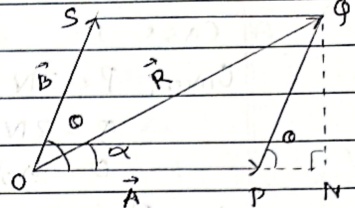
$$ or,\ QN = PQ \sin \theta $$
$$ PN=PQ\cos\theta $$
$$ R^{2} = (OP + PN)^{2} + NQ^{2} $$
$$ =(A+B\cos\theta)^{2}+(B\sin\theta)^{2} $$
$$ =A^{2}+2AB\cos\theta+B^{2}\cos^{2}\theta+B^{2}\sin^{2}\theta $$
$$ =A^{2}+2AB\cos\theta+B^{2} $$
$$ \therefore R = \sqrt{A^{2} + B^{2} + 2AB\cos\theta} $$
The equation (iii) gives the magnitude of resultant vector \( \overrightarrow{R} \). Let \( \alpha \) be the angle between \( \overrightarrow{R} \) and \( \overrightarrow{A} \).
In \( \Delta ONQ \), we have
$$ \tan\alpha=\frac{QN}{ON}=\frac{QN}{OP+PN} $$
or, $$ \tan\alpha=\frac{B\sin\theta}{A+B\cos\theta} $$
$$ \therefore \alpha=\tan^{-1}\left(\frac{B\sin\theta}{A+B\cos\theta}\right) $$ —— (iv). It gives the direction of \( \overrightarrow{R} \).
Numerical example
Two forces each of \( 2N \) i.e. \( P = 2N \) and \( Q = 2N \), act on a body at \( 90^{\circ} \) and at \( 180^{\circ} \). Find the magnitude and direction of the resultant.
Solution:
Case-I
Now, The magnitude of the two forces is given by;
$$ R = \sqrt{P^{2} + Q^{2} + 2 \times P \cdot Q \cos \theta} $$
$$ =\sqrt{2^{2} + 2^{2} + 2 \times 2 \times 2 \times \cos 90^{\circ}} = \sqrt{4 + 4} $$
$$ =2\sqrt{2}\ N $$
Again,
The direction is given by; $$ \alpha = \tan^{-1}\left(\frac{Q}{P}\right) $$
$$ = \tan^{-1} 1 $$
$$ = 45^{\circ} $$
Case II
Given, \( P = 2N \), \( Q = 2N \) and \( \theta = 180^{\circ} \)
Now, The magnitude of the two force is given by
$$ R = \sqrt{P^{2} + Q^{2} + 2PQ\cos\theta} $$
$$ =\sqrt{P^{2} + Q^{2} + 2PQ\cos180^{\circ}} $$
$$ = \sqrt{2^{2} + 2^{2} + (2 \times 2 \times 2 \times (-1))} $$
$$ = \sqrt{8 - 8} $$
$$ R = 0 $$
Here, The magnitude of the resultant force is zero
C. Types of Vector
i. Unit Vector
A vector which has magnitude one (unity) is called unit vector. It is denoted by an alphabetical letter with the cap over it. E.g.: \( \hat{A} \) is the unit vector of vector \( \vec{A} \).
ii. Null (or zero) vector
The magnitude of a null vector is zero and is represented by \( \vec{0} \). Null vector is introduced to give the meaning to the operation like, \( \vec{A} - \vec{A} = \vec{0} \). So, it can have any direction.
iii. Parallel Vector
Two vectors having same direction are called parallel vectors. For example, \( \overrightarrow{A} \) and \( \overrightarrow{B} \) are parallel vectors.
iv. Equal Vector
Two vectors having same magnitude and direction are called equal vectors.
v. Negative of a vector
Two vectors having same magnitude but acting in opposite direction are called negative vector.
vi. Collinear Vector
Vectors having equal or unequal magnitude but acting along the parallel straight lines are called collinear vectors.
vii. Coplanar Vector
Vectors lying on the same plane are called Coplanar vectors.
Product of Two Vectors
1. Scalar product or dot Product of Two Vectors
The product of two Vectors is said to be scalar product if two vectors multiplied together to give a scalar quantity.
The scalar product or dot product of two Vectors \( \overrightarrow{a} \) & \( \overrightarrow{b} \) with angle \( \theta \) between them is denoted by \( \overrightarrow{a} \cdot \overrightarrow{b} \) and defined by;
$$ \overrightarrow{a} \cdot \overrightarrow{b} = AB \cos \theta $$
2. Vector Product or cross product
The product of two vectors is said to be vector product if two vectors multiplied together to give a vector quantity. The vector product of two vectors \( \overrightarrow{A} \) & \( \overrightarrow{B} \) with angle \( \theta \) between them is denoted by \( \overrightarrow{A} \times \overrightarrow{B} \) and defined as;
$$ \overrightarrow{A} \times \overrightarrow{B} = AB \sin\theta $$
Scalar Multiplication
$$ \hat{i} \cdot \hat{i} = 1 \cdot 1 \cos 0 = 1 = \hat{j} \cdot \hat{j} = \hat{k} \cdot \hat{k} $$
$$ \hat{i} \times \hat{i} = 1 \times 1 \sin 0 = 0 = \hat{j} \times \hat{j} = \hat{k} \times \hat{k} $$
Note:
$$ \overrightarrow{i} \times \overrightarrow{j} = \overrightarrow{k} \longrightarrow \overrightarrow{j} \times \overrightarrow{i} = -\overrightarrow{k} $$
$$ \overrightarrow{j} \times \overrightarrow{k} = \overrightarrow{i} \longrightarrow \overrightarrow{k} \times \overrightarrow{j} = -\overrightarrow{i} $$
$$ \overrightarrow{k} \times \overrightarrow{i} = \overrightarrow{j} \longrightarrow \overrightarrow{i} \times \overrightarrow{k} = -\overrightarrow{j} $$
Resolution of a vector
The process of splitting of a vector into its components is called resolution of a vector.
Case - I
from \( \Delta OPQ \)
$$ \cos\theta = \frac{b}{h} = \frac{Ax}{A} $$
$$ \text{or, } Ax=A\cos\theta $$
Also,
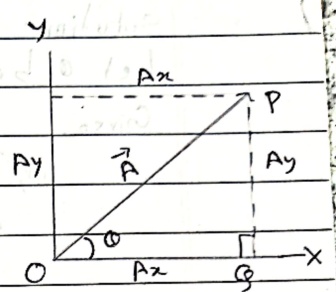
$$ \sin\theta=\frac{P}{h}=\frac{Ay}{A} $$
$$ \text{or, } Ay = A \sin \theta $$
Case - II
$$ \sin\theta = \frac{P}{h} = \frac{A_{x}}{A} $$
$$ \therefore A_{x}=A\sin\theta $$
$$ \cos\theta = \frac{b}{h} = \frac{Ay}{A} $$
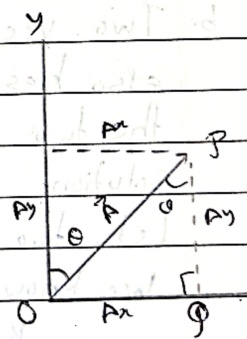
$$ \therefore Ay=A\cos\theta $$
A. Numerical Problems
1. Angle when cross product magnitude equals dot product
\( \vec{A} \) and \( \vec{B} \) are two non-zero vectors. What is the angle between them?
Solution:
Let \( \theta \) be the angle between two vectors.
Given, $$ |\overrightarrow{A} \times \overrightarrow{B}| = \overrightarrow{A} \cdot \overrightarrow{B} $$
or, $$ AB \sin\theta = AB \cos\theta $$
or, $$ \sin\theta = \cos\theta $$
or, $$ \frac{\sin\theta}{\cos\theta} = 1 $$
$$ \tan \theta = 1 $$
$$ or,\ \theta = \tan^{-1}(1) $$
$$ \therefore \theta = 45^{\circ} $$
Hence, the angle between them is \( 45^{\circ} \).
2. Equal magnitude vectors with equal resultant
Two vectors have equal magnitudes and their resultant also has the same magnitude. What is the angle between the two vectors?
Solution:
Let, two vectors be \( (P) \) and \( (Q) \) and their resultant is \( (R) \).
We know,
$$ R^{2}=P^{2}+Q^{2}+2PQ\cos\theta $$ —①
By question:
$$ P=Q=R $$
from eq. (i)
$$ P^{2}=P^{2}+P^{2}+2P^{2}\cos\theta $$
$$ P^{2}=2P^{2}+2P^{2}\cos\theta $$
$$ P^{2}=2P^{2}(1+\cos\theta) $$
$$ \frac{1}{2}=1+\cos\theta $$
$$ \therefore \theta = 120^{\circ} $$
Hence, the angle between the vectors should be 120° for the required solution.
3. Angle between two vectors in component form
If \( \overrightarrow{A} = 4\overrightarrow{i}-\overrightarrow{j} + 3\overrightarrow{k} \) and \( \overrightarrow{B} = 7\overrightarrow{i} + 5\overrightarrow{j} + \overrightarrow{k} \). Find the angle between \( \overrightarrow{A} \) and \( \overrightarrow{B} \).
Solution:
Given,
$$ \overrightarrow{A} = 4\overrightarrow{i}-\overrightarrow{j} + 3\overrightarrow{k} $$ —①
$$ \overrightarrow{B} = 7\overrightarrow{i} + 5\overrightarrow{j} + \overrightarrow{k} $$ —②
from ①
$$ Ax = 4 $$, $$ Ay = -1 $$, $$ Az = 3 $$
from ②
$$ Bx = 7 $$, $$ By = 5 $$, $$ Bz = 1 $$
We know,
$$ \overrightarrow{A} \cdot \overrightarrow{B} = AB\cos\theta $$
or, $$ (AxBx + AyBy + AzBz) = |\overrightarrow{A}| \cdot |\overrightarrow{B}| \cos\theta $$
or, $$ (28 - 5 + 3) = \sqrt{4^2 + (-1)^2 + 3^2} \cdot \sqrt{7^2 + 5^2 + 1^2} \cdot \cos\theta $$
or, $$ 26 = \sqrt{26} \cdot \sqrt{75} \cos\theta $$
or, $$ \cos\theta = \frac{26}{\sqrt{26} \cdot \sqrt{75}} $$
or, $$ \cos\theta = 0.58 $$
or, $$ \theta = \cos^{-1}(0.58) $$
$$ \therefore \theta = 54^\circ $$
Hence, the angle between \( \overrightarrow{A} \) and \( \overrightarrow{B} \) is \( 54^\circ \).
4. Work done by a force
d. If force, \( \overrightarrow{F} = 2\overrightarrow{i} + \overrightarrow{j} - 3\overrightarrow{k} \) is applied on a body and displacement produced is \( \overrightarrow{D} = \overrightarrow{i} - 2\overrightarrow{j} - 3\overrightarrow{k} \). find the work done.
Solution:
Given, \( \overrightarrow{F} = 2\overrightarrow{i} + \overrightarrow{j} - 3\overrightarrow{k} \)
$$ \therefore F_{x} = 2,\ f_{y} = 1,\ f_{z} = -3 $$
Also,
$$ \overrightarrow{D}=\overrightarrow{i}-2\overrightarrow{j}-3\overrightarrow{k} $$
$$ \therefore Dx=1,\ Dy=-2,\ Dz=-3 $$
We know,
Work done = \( \overrightarrow{F} \cdot \overrightarrow{D} \)
$$ = (F_x Dx + Fy Dy + F_z Dz) $$
$$ = [2\cdot1+1\cdot(-2)+(-3)\cdot(-3)] $$
$$ = [2+(-2)+9] $$
$$ = 9 $$ Joule
Hence, Work done is 9 Joule.
5. Angle when \( \overrightarrow{A}-\overrightarrow{B}=\overrightarrow{c} \) and \( A-B=c \)
e. Two vectors \( \overrightarrow{A} \) and \( \overrightarrow{B} \) are such that \( \overrightarrow{A}-\overrightarrow{B}=\overrightarrow{c} \) and \( A-B=c \). Find the angle between them.
Solution:
Let \( \theta \) be the angle between \( \overrightarrow{A} \) and \( \overrightarrow{B} \), then,
$$ \overrightarrow{c} = \overrightarrow{A}-\overrightarrow{B} $$
Squaring both sides;
$$ (\overrightarrow{c})^{2} = (\overrightarrow{A})^{2} + (\overrightarrow{B})^{2} - 2\overrightarrow{A}\cdot\overrightarrow{B} $$
$$ C^{2} = A^{2} + B^{2} - 2AB\cos\theta $$ —①
We have, \( C = A - B \)
$$ C^{2} = A^{2} + B^{2} - 2AB $$ —②
Now,
Comparing equation ① and ②, we get;
$$ \cos\theta = 1 $$
$$ \theta = \cos^{-1}(1) $$
$$ \therefore \theta = 0 $$
Thus, the angle between two vectors \( \overrightarrow{A} \) and \( \overrightarrow{B} \) is \( 0^{\circ} \).
B. Short Answer Questions
-
Why cannot be vectors added algebraically?
Ans: Apart from magnitude, the vectors also have directions, so they cannot be added algebraically.
-
State the essential condition for the addition of vectors.
Ans: The essential condition for addition of vectors is that they must represent the physical quantities of same nature.
-
Can the resultant of three vectors be zero?
Ans: Yes, if resultant of any two Coplanar vectors is equal in magnitude but opposite in direction to the third vector, resultant of three vectors is zero.
-
Is electric current a vector?
Ans: No, electric current has both magnitude and direction but it doesn't obey the rules of vector algebra, it obeys the rules of ordinary algebra. That's why, electric current isn't a vector, but it's a scalar quantity.
-
Is a physical quantity having magnitude and direction necessarily a vector quantity? Explain.
Ans: No. For a physical quantity to be a vector, it should have both magnitude and direction and it must obey the rules of vector algebra.