Elasticity and plasticity
The property of the body which regains its original configuration after removing deforming force is called elasticity.
For example: the property of the body like quartz, phosphor bronze etc are perfectly elastic in nature.
The property of the body which doesn't regain its original configuration after removing deforming force is called plasticity.
For example: The property of body like paraffin wax, wet clay etc are perfectly plastic in nature.
Deforming Force
The force which is responsible for change in configuration is called deforming force.
Restoring Force
The force which is responsible for regain its original position is called Restoring force.
Stress
The deforming force or restoring force per unit area is called stress.
i.e. Stress = Deforming force or Restoring force / Area
\(\Rightarrow\) stress = \(\frac{F}{A}\)
It is a scalar quantity and its SI unit is \(Nm^{-2}\). It's dimensional formula is \([ML^{-1}T^{-2}]\)
Types of stress
Normal stress
The deforming force per unit area acting perpendicular to it is called normal stress.
Fig: Normal Stress
Bulk stress / volume stress
When a body is immersed in liquid, the liquid molecules strikes to the Surface from all direction and such force applied by liquid molecules per unit area is called bulk molecular stress.
fig: Bulk Stress
Shear stress / tangential stress
The stress in which force is applied tangentially in two opposite faces and which change only shape but not volume is called shear stress.
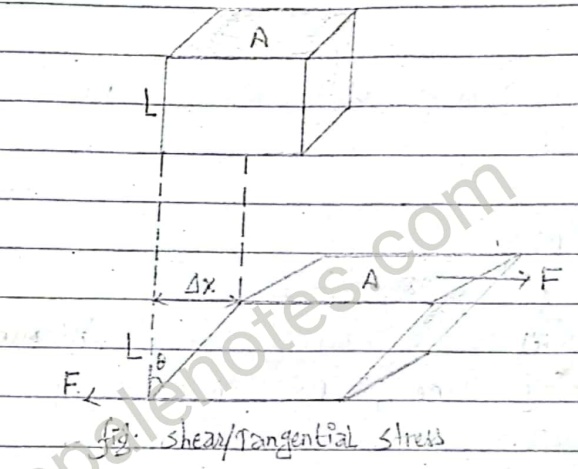
Shear/Tangential Stress
Strain
the ratio of change in configuration to the original configuration is called strain.
Types of Strain
Longitudinal strain
The ratio of change in length to the original length is called Longitudinal Strain.
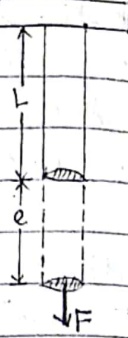
i.e., Longitudinal strain = \(\frac{\text{change in length}}{\text{original length}} = \frac{\Delta L}{L} = \frac{e}{L}\)
$$ K \rightarrow L \rightarrow K \rightarrow \Delta L \rightarrow \quad | \rightarrow F $$
fig: Longitudinal strain.
Volumetric strain
The ratio of change in volume to the original volume is called Volumetric Strain.
i.e., Volumetric Strain = \(\frac{\Delta V}{V}\)
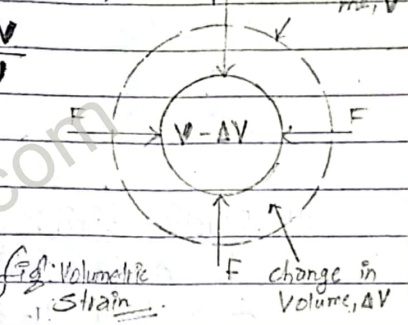
fig: Volumetric Strain; change in Volume \(\Delta V\)
Lateral strain
The ratio of change in diameter to the original diameter is called lateral strain.
i.e., lateral strain = \(\frac{\Delta d}{d}\)
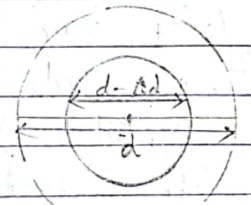
fig: lateral strain
Shear strain
When a body is subjected to shear stress then angle between vertical faces at displaced position and original position is called shear strain.
i.e. shear strain = angle of deviation from the original position = \(\theta\)
From figure,
\(\tan\theta = \frac{\Delta x}{x}\)
If \(\theta \ll 1\), then, \(\tan\theta \approx \theta\)
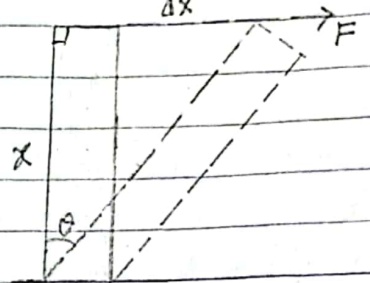
\(\therefore \theta = \frac{\Delta x}{x}\)
fig: Shear strain
Elastic Limit
The maximum Value of deforming force which can be applied to a body up to which it remains elastic is called elastic limit.
Hooke's law
It states that "within elastic limit the elongation produced in a body is directly proportional to the deforming force applied to it."
If F is the deforming force applied for elongation, then by Hooke's law:
\(\frac{e}{A} \propto \frac{F}{A}\)
or, \(\frac{F}{A} \propto \frac{e}{L} \cdot \frac{L}{A}\)
since, \(\frac{F}{A}=Stress\), \(\frac{e}{L}=Strain\) & \(\frac{L}{A}=Constant\) for given wire
Thus, Hooke's law can be restated as "within elastic limit stress is directly proportional to strain."
Experimental Verification of Hooke's law
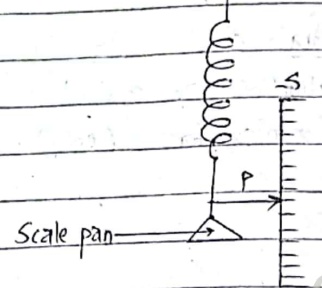
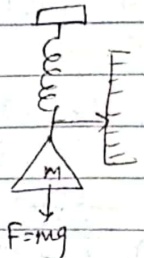
fig: Experimental arrangement of verification of Hooke's law.
in this experiment, spring is suspended vertically as shown in figure above.
scale pan and pointer are attached to the lower end of spring. scale pan is attached in order to keep load and pointer is attached in order to check scale reading.
When the scale pan is empty, note the reading of pointer on the scale and put some weight on the scale pan. then, again note the reading of pointer on the scale.
the difference in two reading will give the elongation in spring for the weight on the scale pan. Go on adding the weight on the scale pan in the step by step and note the corresponding elongation in the spring finally if we plot the graph between weight on scale pan and elongation in the spring then we obtained a straight line passing through origin as shown in figure below:
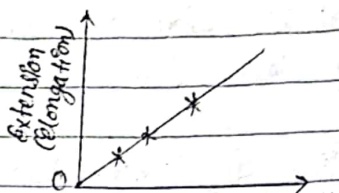
(Load applied)
fig: stress-strain graph for Hooke's law
From above graph, elongation \(\propto\) load applied
i.e., elongation \(\propto\) deforming force (\(e \propto F\))
Which is Hooke's law.
Types of modulus of elasticity
Young's modulus of elasticity (Y)
The ratio of normal stress to the longitudinal strain is called Young's modulus. It's SI unit is \(Nm^{-2}\) or Pa.
i.e., \(Y = \frac{\text{normal stress}}{\text{Longitudinal strain}}\)
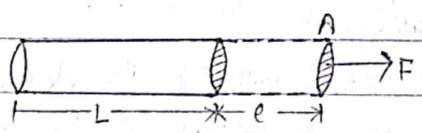
fig: Young's modulus
Let, L = original length of wire, e = elongation, A = cross sectional area and F = Applied deforming force.
then, \(Y = \frac{F/A}{e/L} = \frac{F}{A} \times \frac{L}{e} = \frac{FL}{eA}\)
Bulk modulus of elasticity [B] or [K]
The ratio of bulk stress to the Volumetric strain is called Bulk modulus.
i.e. \(B[K] = \frac{\text{Bulk Stress}}{\text{Volumetric Strain}}\)
Let,
F = Applied deforming force
A = cross-sectional area, V = original volume
\(\Delta V\) = change in Volume.
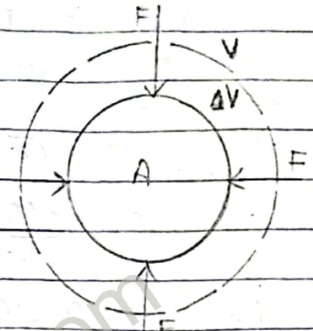
$$then,\quad K = \frac{F/A}{-\Delta V/V} = -\frac{F}{A}\times\frac{V}{\Delta V} = -\frac{FV}{A\Delta V}$$
fig: Bulk modulus.
Shear modulus of elasticity [η]
the ratio of shear stress to the shear strain is called shear modulus.
i.e.
Shear modulus \((\eta)=\frac{F/A}{\theta}=\frac{F}{A}\times\frac{1}{\theta}=\frac{F}{A\theta}\)
Energy stored in a stretched wire
let us consider a uniform metallic wire having initial length 'L' and cross sectional area 'A'.
By applying force 'F', it is elongated by 'e'.
then, Young's modulus of material is given by: \(\frac{F/A}{e/L} = \frac{FL}{eA}\)
\(\Rightarrow F = \frac{YAe}{L}\) …… (i)
If the wire is stretched through a small length 'de' then small amount of workdone is given by:
\(dw = F \cdot de\)
\(= \frac{YAe}{L} de\) …… (ii)
Now, total amount of workdone on the wire when stretched from \(0\) to \(e\) is given by:
\(W = \int_{0}^{e} dw = \int_{0}^{e} \frac{Y A e}{L} de = \frac{Y A}{L} \int_{0}^{e} e de = \frac{Y A}{L} \left[ \frac{e^{2}}{2} \right]_{0}^{e} = \frac{Y A}{2L} \left[ e^{2} - 0 \right]\)
\(\Rightarrow W = \frac{1}{2} \cdot \frac{Y A e^{2}}{L}\)
using eqⁿ (i),
\(\Rightarrow W = \frac{1}{2} F \cdot e\)
$$\therefore E=\frac{1}{2}F\cdot e$$
P.E. per unit Volume (Energy density) = \(\frac{Y A e^{2}}{2L} \times \frac{1}{A \cdot L} = \frac{1}{2} \cdot Y \cdot \frac{e^{2}}{L^{2}} = \frac{1}{2} \cdot Y \cdot (Strain)^{2}\)
this work done is stored in the form of P.E.
PE per unit volume = \(\frac{1}{2}\) Stress \(\times\) Strain
Numericals
Q.[A]
A Copper wire and steel wire of the same cross sectional area and of length 1m and 2m, respectively are connected end to end. A force is applied, which stretched their combined length by 1cm. Find how much each wire is elongated.
length of Copper \((L_{c}) = 1m\), \(Y_{c} = 1.2 \times 10^{11}\) N/m^{2}
length of Steel \((L_{s}) = 2m\), \(Y_{s} = 2 \times 10^{11}\) N/m^{2}
\(e_{s} + e_{c} = 0.01\) -- (1)
$$\frac{Y_{s}}{Y_{c}}=\frac{FL_{s}/(e_{s}A)}{FL_{c}/(e_{c}A)}=\frac{L_{s}}{e_{s}}\times\frac{e_{c}}{L_{c}}$$
$$\Rightarrow e_{s}=1.2 e_{c}$$
$$\text{or:} \quad e_{s} + e_{c} = 0.01$$
$$\Rightarrow e_{c}=4.5\times10^{-3}m$$
putting the value of \(e_{c}\) in eq(1)
\(e_{s} + 4.5 \times 10^{-3} = 0.01\)
\(\Rightarrow e_{s} = 5.5 \times 10^{-3} m\)
Catapult / rubber cord
the rubber cord of a Catapult has a cross-sectional area 1 mm^{2} and total unstretched length 10 cm. It is stretched to 12 cm and then released to project a missile of mass 5 g. Calculate the velocity of projection.
\(A = 1 mm^{2} = 10^{-6} m^{2}\), \(L = 10 cm = 0.1 m\), \(e = 12 cm - 10 cm = 2 cm = 0.02 m\).
\(m = 5 g = 5 \times 10^{-3} kg\), \(Y = 5 \times 10^{8} N/m^{2}\)
\(Y = \frac{F}{A} \times \frac{L}{e}\)
\(F = 10^{2} N\)
\(\Rightarrow v = 20 m/s\)
thus, velocity of projection is 20 m/s.
Q.B.3[A]
A wire of length \(2.5 m\) and area of cross-section \(1 \times 10^{-6} m^{2}\) has a mass of \(15 kg\) hanging on it. What is the extension produced? How much the energy stored in the wire when young's modulus of wire is \(2 \times 10^{11} N/m^{2}\).
\(L = 2.5 m, A = 1 \times 10^{-6} m^{2}, Y = 2 \times 10^{11} N/m^{2}, e = ?, E = ?, m = 15 kg\)
Now
$$Y=\frac{F}{A} \times \frac{L}{e}$$
\(2 \times 10^{11} = \frac{mg \times 2.5}{1 \times 10^{-6} \times e}\)
$$2e \times 10^{5} = 150 \times 2.5$$
\(\Rightarrow e = 18.75 \times 10^{-5} m\)
Again, Energy Stored \(E = \frac{Fe}{2} = \frac{150 \times 18.75 \times 10^{-5}}{2} = 0.14 J\)
Q.B.3[B]
A uniform steel wire of density \(8000 kg/m^3\) weight 20g and is 2.5 m long. It lengthens by 1 mm when stretched by a force of 80N. Calculate the Value of the Young's modulus of Steel & the energy stored in the wire.
$$\rho=8000\ kg/m^{3}, m=20g=2\times10^{-2}\,kg, L=2.5\,m, e=1\,mm=10^{-3}\,m, F=80\,N, Y=? , E=?$$
$$\rho=\frac{M}{A L}$$
$$8000 = \frac{2 \times 10^{-2}}{A \cdot L}$$
$$\Rightarrow A = 10^{-6} \, m^{2}$$
$$Y = \frac{F}{A} \times \frac{L}{e} = \frac{80 \times 2.5}{10^{-6} \times 10^{-3}} = 2 \times 10^{11} \, N/m^{2}$$
$$E = \frac{F e}{2} = \frac{80 \times 10^{-3}}{2}$$
$$\therefore E = 40 \times 10^{-3} \, J$$
Thus, Young's modulus = \(2 \times 10^{11} N/m^{2}\) Energy Stored = \(40 \times 10^{-3} J\)
Force to double length
What force is required to stretch a steel wire of cross-sectional area \(1cm^{2}\) to double its length?
\(A = 1cm^{2} = 10^{-4}m^{2}\), \(e = L\), \(Y = 2 \times 10^{11} N/m^{2}\)
Now, \(Y = \frac{F}{A} \times \frac{L}{e}\)
or, \(2 \times 10^{11} = \frac{F}{10^{-4}} \times \frac{L}{L}\)
\(\Rightarrow F = 2 \times 10^{7} N\) thus required force \(2 \times 10^{7} N\).
Q.3[D]
Calculate the work done in stretching a steel wire 100 cm in length and of cross-sectional area 0.030 cm² when a load of 100 N slowly applies before the elastic limit is reached?
\(L=100cm=1m\)
\(A=0.030cm^{2}=0.000003m^{2}\)
\(F=100N\), \(Y=2\times10^{11}N/m^{2}\), \(W=?\)
\(Y=\frac{F}{A}\times\frac{L}{e}\)
\(W=\frac{Fe}{2}\)
\(\therefore W=8.33\times10^{-3}\) J
thus, total work done = \(8.33 \times 10^{-3} J\)
Steel wire density 7800
A uniform steel wire of density 7800 kgm\(^{-3}\) weights 16 gm and is 250 cm long. It lengthens by 1.2 mm when stretched by a force of 80 N. Calculate the Young's modulus and the energy stored in the wire.
\(\rho=7800\ kg/m^{3}, m=16\ g=1.6\times10^{-2}\ kg=0.016\ kg, L=250\ cm=2.5\ m, e=1.2\ mm=1.2\times10^{-3}\ m\)
\(F=80N, Y=? , E=?\)
\(7800=\frac{0.016}{A\times2.5}\)
then, \(Y=\frac{F}{A}\times\frac{L}{e}=\frac{80\times2.5}{A\times1.2\times10^{-3}}\)
Again, \(E=\frac{Fe}{2}=\frac{80\times1.2\times10^{-3}}{2}=4.8\times10^{-2}J\)
thus, Young's modulus \(=2\times10^{11}\ N/m^{2}\) and Energy Stored \(=4.8\times10^{-2}J\)
Q.B.3[F]
A steel cable with cross-sectional area \(3cm^{2}\) has an elastic limit of \(2.4 \times 10^{8}\) Pa. Find the maximum upward acceleration that can be given a 1200 kg elevator supported by the cable if the stress is not exceed one third of elastic limit.
\(A = 3cm^{2} = 3\times10^{-4}m^{2}\)
Elastic limit \(2.4\times10^{8}Pa\), Stress \(= \frac{1}{3}\) Elastic limit \(= 8\times10^{7}Pa\)
\(M = 1200kg\)
Now, \(Stress = \frac{F}{A} = \frac{Ma}{A}\)
\(8 \times 10^{7} = \frac{1200 \times a}{3 \times 10^{-4}}\)
\(\Rightarrow \boxed{a = 20 \, m/s^{2}}\)
Thus, required acceleration is \(20m/s^{2}\).
Q.3[G] Brass rod
A vertical brass rod of circular section is loaded by placing a 5 kg weight on top of it. If its length is 50 cm & radius of cross section is \(1 cm\), find the contraction of rod and the energy stored in it.
\(m = 5 kg, L = 50 cm = 0.5 m, r = 1 cm = 0.01 m, A = \pi r^{2} = \pi (0.01)^{2} = \pi \times 10^{-4} m^{2}\)
\(Y = 0.91 \times 10^{11} N/m^{2}, F = mg = 5 \times 10 = 50 N\)
Now,
\(Y = \frac{F}{A} \times \frac{L}{e}\)
\(0.91 \times 10^{11} = \frac{50 \times 0.5}{\pi \times 10^{-4} \times e}\)
Again, \(E = \frac{1}{2} F e\)
thus, contraction of rod \(8.74 \times 10^{-7} m\) & stored energy is \(2.18 \times 10^{-5} J\).
Q.3[H]
Calculate the work done in stretching a steel wire 100cm in length and of cross sectional area 0.03 cm² when a load of 100N is slowly applied without the elastic limit being reached?
$$L = 100 cm = 1 m, A = 0.03\ cm^{2} = 3\times10^{-6}m^{2}, F = 100 N, Y = 2\times10^{11}N/m^{2}$$
$$Y = \frac{F}{A} \times \frac{L}{e}$$
$$2 \times 10^{11} = \frac{100 \times 1}{3 \times 10^{-6} \times e}$$
$$\Rightarrow e=1.67\times10^{-4}m$$
$$\therefore W=\frac{Fe}{2}=8.3\times10^{-3}J$$
$$\Rightarrow F=4335.99(N)$$
Steel wire density 8000 (24 g)
A steel wire of density \(8000 kg \cdot m^{-3}\) weights 24 g and is 250 cm long. It lengthens by 1.2 mm when stretched by a force of 80 N. Calculate the Young's modulus for the steel and the energy stored in the wire.
$$8000\ kg/m^3, m=24g=24\times10^{-3}kg, L=250cm=2.5m, e=1.2mm=1.2\times10^{-3}m.$$
$$\text{we have,} \quad F=80N.$$
$$8000=\frac{24\times10^{-3}}{A\times2.5}$$
\(A = 1.2 \times 10^{-6} m^2\)
$$Y = \frac{F}{A} \times \frac{L}{e} = \frac{80 \times 2.5}{1.2 \times 10^{-6} \times 1.2 \times 10^{-3}}$$
thus, energy stored in wire \((E) = \frac{F e}{2} = \frac{80 \times 1.2 \times 10^{-3}}{2} = 0.048 J\)