Gas laws
[1] Boyle's law
It states, "On keeping temperature constant, the volume of given mass of gases is inversely proportional to the pressure i.e., \( V \propto \frac{1}{P} \)
\( \Rightarrow pV = \text{Constant} \)
\( \Rightarrow [P_1 V_1 = P_2 V_2] \) which is relation for Boyle's law:
A Graphical representation of Boyle's law:
- Curve like hyperbola
- straight line passing through origin \( (y=mx+c) \) parallel to \( x \)-axis.
[2] Charles' law of two types
(1) Charles' law at constant pressure
It states, "On keeping pressure constant, the volume of given mass of gases is directly proportional to the temperature.
i.e., \( V \propto T \)
\( \Rightarrow \frac{V}{T} = \text{constant} \)
\( \Rightarrow \) \( \frac{V_1}{T_1} = \frac{V_2}{T_2} \) which is relation for Charles' law at constant pressure.
(ii) Charles' law at Constant Volume
It states: On keeping constant volume, the pressure is directly proportional to the temperature.
\( P \propto T \)
\( \Rightarrow \frac{P}{T} = \text{constant} \)
\( \Rightarrow\left[\frac{P_{1}}{T_{1}}=\frac{P_{2}}{T_{2}}\right] \) which is relation for Charles' law at Constant Volume.
Absolute zero temperature
The hypothetical temperature at which Volume of a gas becomes zero called absolute zero temperature. It is equal to -273°C or 0K.
Validation of Charles Law
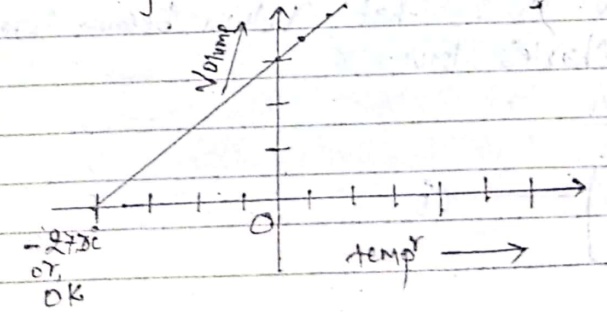
\( f_{B}^{\prime}(V)\nu(T) \)
Equation of State for an Ideal gas
Fig: Changing pressure, Volume and temperature of gas:
Let us consider, One mole of gas is kept in a cylinder provided with a frictionless piston. Let \( P_{1}, V_{1}, T_{1} \) be the initial and \( P_{2}, V_{2}, T_{2} \) be the final pressure, Volume and temp respectively. To reach final stage two step one is shown in figure above.
In first step, temperature \( T_{1} \) is kept constant & pressure is increase to \( P_{2} \) so that the volume is decreased and become \( V \). then from Boyle's law:
In Second step, pressure \( P_{2} \) is kept constant and temperature is increase to \( T_{2} \). So that volume becomes increase to \( V_{2} \). Then from Charles' law:
\( \Rightarrow\left[\frac{V}{T_{1}}=\frac{V_{2}}{T_{2}}\right] \)
\( \Rightarrow PV = RT \)
Q.1 What are difference between ideal gas and real gas?
| Ideal gas (perfect gas) | Real gas |
|---|---|
| The hypothetical gases that do not exist in nature are called ideal gases. | The gases that exist practically in nature are called real gases. |
| Ideal gas obey the Boyle's law, Charles' law and Combined gas eq. | Real gas does not obey Boyle's law, Charles' law and Combined gas eq. |
| They follow gas law at all temperatures. | They follow gas law at low pressure and high temperature. |
| Inter atomic force in ideal gas is equal to zero. | Interatomic force in real gases is non zero and significant. |
Q.2[A] Find the dimensional formula of Universal Gas Constant \( R \)
Ans: we have, \( PV = nRT \)
\( R = \frac{PV}{nT} \)
Dimensional formula of \( R \)
\( [R] = [MLT^{-2}][L][K^{-1}] \) [\( \therefore n \) is dimensionless]
\( \therefore \) Dim. formula of \( R = [M L^{2}T^{-2}K^{-1}] \)
Kinetic Molecular Theory of Gases
The main postulates (or assumptions) of this theory are as:
- Every gas consist of a large no. of small particle called molecules. The gaseous molecules are so small that the volume occupied by a single molecule can be neglected as compared to the total volume of gas.
- The gaseous molecules are in motion. They collide with each other and also with walls of Containers.
- The molecular collision is perfectly elastic i.e. there is no loss of k.e.
- The pressure exerted by a gas is due to continuous bombardment of gas molecules on the wall of vessel.
- There is no force of attraction between gas molecules.
- The average kinetic energy of gas molecules is directly proportional to the absolute temperature, i.e. K.E. ∝ T.
- There is no effect of gravity on gas molecules.
Root mean Square (rms) speed
The root of the mean of the square of the speed of gas molecules is called root mean square speed. It is denoted by \( \overline{c} \) and given by:
\( \overline{C}=\sqrt{\frac{V_{1}^{2}+V_{2}^{2}+\cdots+V_{N}^{2}}{N}} \)
Pressure exerted by gas
Let us consider a gas is kept inside a cubical vessel of side \( l \) at temperature 'T'. Also, let M be the mass of a gas molecule and N be the total number of gas molecules so, total mass of gas, \( [m = N \cdot M] \). Also let, \( V_x, V_y \) and \( V_z \) are the component of velocity along x, y, z axis respectively. Then resultant velocity is given by:
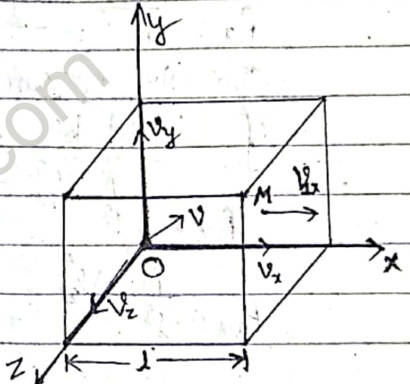
Again, Consider a gas molecule moving along x axis with the velocity \( v_{x} \) and after striking the surface of vessel and rebounced with the same velocity. Then, change in momentum of that molecule be,
Let \( t \) be the time taken by gas molecules to travel from origin to right face and back to origin. Then,
\( t = \frac{2l}{V_{1x}} \)
Therefore force exerted by that gas molecule on the Surface of Cubical vessel.
\( f_{1x} = \frac{\Delta p_{1x}}{t} = \frac{2MV_{1x}}{2l} = \frac{M}{l} V_{1x}^{2} \)
Now, pressure exerted by that molecule on the wall of Vessels.
\( p_{1x} = \frac{f_{1x}}{A} = \frac{M}{l}V_{1x}^{2} = \frac{M}{l^{3}}V_{1x}^{2} \)
Similarly, pressure exerted by other molecules on the same surface of Vessel be.
$$ P_{2x}=\frac{M}{l^{3}}V_{2x}^{2} $$
$$ P_{3x} = \frac{M}{l^{3}} V_{3x}^{2} $$
Thus, total pressure exerted by gas molecules along x-axis be,
\( P_{x}=P_{1x}+P_{2x}+\cdots+P_{Nx} \)
\( =\frac{M}{l^{3}}\left[V_{1x}^{2}+V_{2x}^{2}+\cdots+V_{Nx}^{2}\right]\rightarrow(10) \)
$$ P_{Nx} = \frac{M}{l^{3}} V_{Nx}^{2} $$
\( p_{y} = \frac{M}{l^{3}} \left[ V_{1y}^{2} + V_{2y}^{2} + \cdots + V_{Ny}^{2} \right] \)
\( P_{z} = \frac{M}{l^{3}} \left[ V_{1z}^{2} + V_{2z}^{2} + \cdots + V_{Nz}^{2} \right] \)
Now, pressure exerted by gas molecules in a whole vessel is the average of \( p_{x} \), \( p_{y} \) and \( p_{z} \).
i.e. \( p = \frac{p_{x} + p_{y} + p_{z}}{3} \)
\( \Rightarrow p = \frac{M}{3l^{3}} \left[ (V_{1x}^{2} + V_{2x}^{2} + \cdots + V_{Nx}^{2}) + (V_{1y}^{2} + V_{2y}^{2} + \cdots + V_{Ny}^{2}) + (V_{1z}^{2} + V_{2z}^{2} + \cdots + V_{Nz}^{2}) \right] \)
\( \Rightarrow p = \frac{M}{3l^{3}} \left[ V_{1}^{2} + V_{2}^{2} + \cdots + V_{N}^{2} \right] \)
Now, from definition of root mean square speed;
\( \overline{c} = \sqrt{\frac{V_{1}^{2} + V_{2}^{2} + \cdots + V_{N}^{2}}{N}} \)
\( \Rightarrow \overline{c}^{2} N = V_{1}^{2} + V_{2}^{2} + \cdots + V_{N}^{2} \) — ①
Using ① in eqⁿ (10)
\( P = \frac{M}{3l^{3}} \overline{C}^{2} N = \frac{NM}{3l^{3}} \overline{C}^{2} = \frac{m}{3V} \overline{C}^{2} \) [∵ NM = m and \( V = l^{3} \)]
\( P = \frac{1}{3} \cdot \frac{m}{V} \cdot \overline{C}^{2} = \frac{1}{3} \rho \cdot \overline{c}^{2} \) [∵ \( \rho = \frac{m}{V} \)]
\( \Rightarrow \) \( \left[P = \frac{1}{3} \rho \overline{c}^{2}\right] \) Which is required relation for pressure exerted by gas on the wall of vessel.
K.E. of gas
Since, pressure exerted by
\( P = \frac{1}{3} \rho \overline{c}^{2} \)
\( P = \frac{1}{3} \frac{m}{V} \overline{c}^{2} \)
\( 3PV = m \overline{c}^{2} \)
\( \frac{1}{2} m \overline{c}^{2} = \frac{3}{2} PV \)
\( KE \) of gas: \( \frac{3}{2} PV \)
Also, \( P = \frac{1}{3} \frac{N \cdot M}{V} \cdot \overline{c}^{2} \)
\( 3PV = NM \overline{c}^{2} \)
\( \frac{1}{2} M \overline{c}^{2} = \frac{3}{2} \frac{PV}{N} \)
\( P = nRT \)
So, KE of gas molecule: \( \frac{3}{2} \frac{nRT}{N} \)
Again,
\( N = n \cdot N_A \)
∴ KE of gas molecule: \( \frac{3}{2} \frac{nRT}{n \cdot N_A} = \frac{3}{2} kT \)
Where \( k = R / N_A \), called Boltzmann constant.
Ideal gas equation from Kinetic Molecular Theory (K·M·T)
We have, pressure exerted by gas molecule,
$$ p = \frac{1}{3} \rho \bar{c}^{2} $$
$$ p = \frac{1}{3} \frac{m}{V} \bar{c}^{2} $$
\( \Rightarrow [pV = \frac{1}{3} m \bar{c}^{2}] \rightarrow \) ①
If 'M' be the mass of molecules and 'N' be the no. of molecules in gas, then, m = NM
\( \Rightarrow pV = \frac{1}{3} NM \bar{c}^{2} \rightarrow \) ②
Also,
\( \frac{1}{2} M \bar{c}^{2} = \frac{3}{2} kT \)
\( \Rightarrow M\bar{c}^{2} = 3kT \rightarrow \) ③
Using eqⁿ ③ in eqⁿ ②
or,
\( pV = \frac{1}{3} N \cdot 3kT \)
\( \Rightarrow [pV = NkT] \)
Also, N = n·NA
\( \Rightarrow pV = n \cdot N_A \cdot kT \)
\( \Rightarrow pV = n \cdot R \cdot T \) [∵ \( R = N_A k \)]
\( \Rightarrow [pV = nRT] \)
this is ideal gas equation.
Gas laws from K·M·T of gas
[1] Boyle's law
We have,
$$ P = \frac{1}{3} \rho \overline{c}^{2} $$
$$ \text{Or} \quad P = \frac{1}{3} \frac{m}{V} \overline{c}^{2} $$
$$ \Rightarrow [PV = \frac{1}{3} m \overline{c}^{2}] $$
Since, \( K_E \left( \frac{1}{2} m \overline{c}^{2} \right) \propto T \)
\( \Rightarrow \) at Constant temperature,
\( \frac{1}{2} m \overline{c}^{2} = \text{constant} \)
\( PV = \text{Constant} \)
\( \Rightarrow [P \propto \frac{1}{V}] \)
\( \Rightarrow \) which proves Boyle's law.
[2] Charles' law
We have
If Volume is Constant, then,
\( \Rightarrow P \propto T \)
And if pressure is constant, then,
\( V \propto T \)
Which proves Charles' law.