Work
Work is said to be done by force if body travels any certain distance.
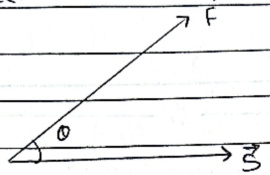
let S be the certain distance travelled by a body by applying force (f) and also let θ be the angle between f and S then,
\( W = F \cdot \overrightarrow{S} \)
\( \therefore W = F S \cos \theta \)
Special Cases
i. When force is applied in the direction of displacement.
i.e. \( \theta = 0^{\circ} \)
Now, \( W = FS \cos \theta = FS \)
i.e. There is maximum work done. (Positive)
When force is applied perpendicular to the displacement.
i.e. \( \theta = 90^{\circ} \)
Now, \( W = F S \cos \theta = 0 \)
There is no work done.
When force applied is opposite to the displacement
i.e. \( \theta = 180^{\circ} \)
Now, \( W = F \cdot \cos 180^{\circ} \)
∴ Work done is negative.
Work - Energy Theorem
Here, \( W = \overrightarrow{F} \cdot \overrightarrow{S} \)
\( = f_{S} \cos \phi \)
\( = f_{S} \)
\( m_{as} \) ——— ①
Now
\( k \cdot \varepsilon = \frac{1}{2} m v^{2} \) ——— ②
Equation of motion:
from ① & (iii), we get
\( W_{2} m.v^{2} \)
\( \frac{2}{2}mv^{2}=k\cdot\varepsilon \)
∴ Work is energy
motion
\(\overrightarrow{F}\) \(u\) in initial velocity
\( W = F \cdot \overrightarrow{S} \)
\( = F S \cos \theta \)
\( = f s \)
\( = M a S \) — ①
Also,
\( k \cdot \varepsilon = \frac{1}{2} m v^{2} - \frac{1}{2} m u^{2} \) — ②
Equation of motion:
\( v^{2} = u^{2} + 2 a s \)
\( 0, v^{2} - u^{2} = 2 a s \)
\( a s = v^{2} - u^{2} \) — ③
from equation ① & ③ we get;
\( W = m, \frac{(v^{2} - u^{2})}{2} = \frac{1}{2} m v^{2} - \frac{1}{2} m u^{2} \)
\( W + \frac{1}{2} m u^{2} = \frac{1}{2} m v^{2} \)
\( W + (k \cdot \varepsilon)_{i} = (k \cdot \varepsilon)_{f} \) [∵ \( (k \cdot \varepsilon)_{f} > (k \cdot \varepsilon)_{i} \)]
For opposite Work:
\( -W + (k \cdot \varepsilon)_{i} = (k \cdot \varepsilon)_{f} \)
\( or, (k \cdot \varepsilon)_{i} = W + (k \cdot \varepsilon)_{f} \)
\( \therefore (k \cdot \varepsilon)_{i} > (k \cdot \varepsilon)_{f} \)
Energy
The ability or capacity of doing work is called energy.
It is scalar quantity and its SI unit is Joule.
Types of Mechanical Energy
i. kinetic energy
The energy possessed by a body by virtue of its motion is called kinetic energy.
\( k \cdot \varepsilon = \frac{1}{2} m v^{2} \)
Potential Energy
The energy possessed by a body by virtue of its position or molecular arrangement (configuration) is called potential energy.
P.E = mgh
Conservation of Energy
Statement: Energy can neither be created nor be destroyed but can be converted from one form to another form.
Energy at A
\( E_{T} = E_{k} + E_{p} \)
\( = \frac{1}{2}mv^{2} + mgh \)
\( \therefore E_{T} = mgh \)
Energy at B
\( E_{T2} = E_{k} + E_{p} \)
\( =\frac{1}{2}mv_{1}^{2}=\frac{1}{2}m(u^{2}+2gx) \)
\( \therefore E_{k2}=mgx \)
\( E_{p} = mg(h-x) \)
\( E_{T} = E_{k} + E_{p} \)
\( = mgx + mg(h-x) \)
\( =mgx + mgh - mgx \)
\( = mgh \)
\( \therefore E_{T} = mgh \)
\( E_{p} = mgh = 0 \)
\( So, E_{T} = 0 + mgh \)
\( \therefore E_{T} = mgh \)
Graphical representation:
| Point | Energy |
|---|---|
| ε | 100 |
| ρ | 50 |
| k | 40 |
| ε_k | 40 |
Conservative and Non-conservative force
A force is said to be conservative if work done by it doesn't depend upon distance but depends upon displacement.
A force is said to be non-conservative if work done by it doesn't depend upon displacement but depends upon the distance. Eg: frictional force, viscous force, etc.
Collision
Collision is a mutual interaction between two particles for a short interval of time so that momentum and kinetic energy may be changed.
There are two types of collision:
- Elastic Collision
- Inelastic Collision
Elastic Collision
If the kinetic energy and momentum of colliding objects are conserved in the collision, it is called said to be elastic collision. In this collision, nature of force is conserved conservative. Collision between atomic or subatomic particles between gas molecules are perfectly elastic collision.
Characteristics of Elastic Collision
- The total linear momentum is conserved.
- Total kinetic energy is conserved
- Total energy is conserved
- Total mechanical energy is conserved.
- The forces involved during the interaction are conservative forces.
Inelastic Collision
If the total linear momentum remains conserved but total kinetic energy doesn't remain conserved during the collision, it is said to be inelastic collision.
Characteristics of Inelastic collision
- Total momentum is conserved
- Total kinetic energy is not conserved
- The total energy is conserved.
- Total mechanical energy doesn't remain conserved.
- The forces involved during the interaction are non-conservative forces.