Circular Motion
If path repeats in certain time (period), this type of motion is called periodic motion or circular motion.
Time Period
It is the time required to complete one repeating path.
Types of Circular Motion
- i. Rotational → rotation of earth, rotation of axle
- ii. Revolutional → earth's revolution, electron's motion
- iii. Vibrational → Motion of eyelid, motion of heart, vibration of lungs
Translational motion
- i. Distance travelled = s
- ii. Velocity = u, v
- iii. Acceleration = a
- iv. Time = t
- v. a = v − u
Circular motion
- i. Angular displacement = θ
- ii. Angular velocity = ω₀, ω
- iii. Ang. Acceleration = α 'alpha'
- iv. Time = t
- v. α = ω − ω₀
\( V_{i} \) \( V = u + at \)
\( V_{ii} \) \( S = ut + \frac{1}{2}at^{2} \)
\( V_{1}^{i} \). \( W = W_{0} + \alpha t \)
\( V_{11}^{i} \). \( Q = Q_{0}t + \frac{1}{2} \alpha t^{2} \)
\( V_{j11}F=ma \)
\( viii \). \( c = I \alpha \)
Angular Velocity (ω)
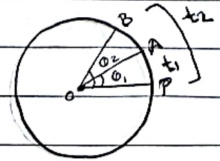
let \( O_{1} \) = Angle Angular displacement of a particular particle at point A
let \( O_{2} \) = Angular displacement of a particle at point B
\( t_{1} \) = Time taken to travel angular displacement \( \theta \),
\( t_{2} \) = Time taken to travel angular displacement \( \theta_{2} \).
Angular Velocity = Angular displacement of AB time
$$ \text{op}_{W}=\frac{Q_{2} - Q_{1}}{t_{2} - t_{1}} $$ $$ \therefore W_{avg} = \frac{O_{2} - O_{1}}{t_{2} - t_{1}} $$ $$ \begin{array}{c} \text{Winst} =\frac{O_{2}-O_{1}}{t_{2}-t_{1}} \end{array} $$ $$ \text{eg}W_{\text{inst}} = \underset{\Delta t \to 0}{\text{lim}} \frac{\Delta \theta}{\Delta t} $$∴ \( W_{inst} = d\theta \), \( W_{inst} = \) instantaneous Value of dt angular velocity.
Relation between O and L
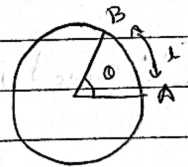
Here,
$$ \textcircled{2} = \text{angular displacement} $$ $$ l_{2}\text{linear displacement}(s) $$ $$ \gamma = x_{a} d i u s\text{of circle} $$Now,
$$ Q=\frac{d}{v}l $$ $$ \therefore l = \gamma Q $$Differentiating both side w.r.t 't', we get;
\( a_{1} \) \( \frac{d1}{dt} \) = \( \frac{d(x_{0})}{dt} \)
\( a_{2} \) V = \( \gamma \cdot \frac{dQ}{dt} \)
\( \therefore V = x \cdot Q \)
Expression for centripetal Acceleration
Let us consider a body moving in a circular path of radius 'r' and centre '0' with uniform speed in clockwise direction as shown in figure (a). Suppose \( \vec{V}_{p} \) and \( \vec{V}_{0} \) be the velocities of the body at point P and Q respectively.
Let \( \Delta V \) be the change in velocity in small time \( \Delta t \). P'e. \( \Delta t \) be the distance travelled and '0' be the angular displacement in small time \( \Delta t \).
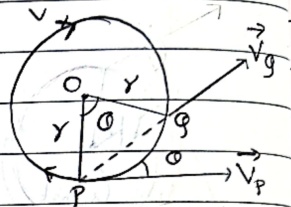
Fig: (a)
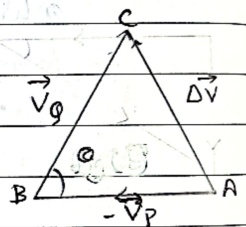
fig(b)
Let, \( V_{z} \mid \vec{V}_{p} \mid = \mid \vec{V}_{p} \mid \) (:: Speed is uniform)
From, figure (a)
\( O = \frac{\overrightarrow{PQ}}{y} \)
\( = \frac{\Delta L}{x} \) — ①
from figure (b)
\( \overrightarrow{AB} + \overrightarrow{BC} = \overrightarrow{AC} \)
or, \(-V_{p} + V_{q} = \overrightarrow{AC} \)
or, \(-V_{p} + V_{q} = \Delta\overrightarrow{V} \)
or, \(\Delta\overrightarrow{V} = V_{p} - V_{p} \)
$$ \frac{O}{B C}=\frac{A C}{B C} $$ $$ \begin{array}{rcl}o&,&\\r_{1}&,&\\&\end{array}Q&=\begin{array}{rcl}\overrightarrow{\Delta V}&&\\&\overrightarrow{V_{Q}}&\end{array} $$ $$ f _c r o m ( i ) c a n d ( i i ) $$ $$ \frac{\Delta L}{\alpha}=\frac{\Delta v}{v} $$ $$ (1)\Delta V=\frac{V\cdot\Delta L}{x} $$ $$ \text{Dividing both sides by} \Delta t \text{and taking} \lim_{\Delta t \to 0} $$ $$ \begin{array}{cc} \lim \\ \Delta t \to 0 & \Delta t \end{array} \quad \begin{array}{cc} \Delta v \\ \Delta t \end{array} = \lim \\ \Delta t \to 0 \quad \begin{array}{cc} V & \Delta L \\ y & \Delta t \end{array} $$ $$ o_{Y}a = \frac{V}{Y} \cdot V $$ $$ o r,a=\frac{V^{2}}{y} $$Again,
$$ a=\frac{\left(\gamma w\right)^{2}}{y} $$ $$ \therefore a=w^{2}r $$Centripetal Acceleration \( a=\frac{v^{2}}{r} \)
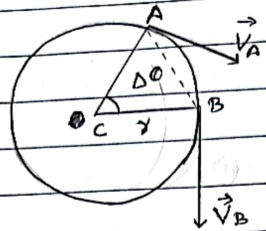
let, \( x = \) radius of circle
\( \Delta O = \) Angle made by the particle when it travels from A to B
Displacement = \( \Delta L = \overrightarrow{AB} \)
\( \overrightarrow{V}_{A} \) and \( \overrightarrow{V}_{B} \) are velocities at A and B
\( |\overrightarrow{V}_{A}| = |\overrightarrow{V}_{B}| = V_{A} + V_{B} \)
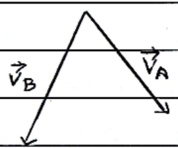
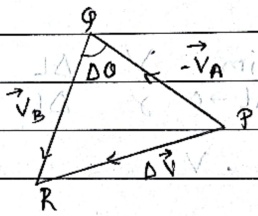
Now.
$$ \begin{array}{c} we have \Delta\vec{V}=\vec{V}_{B}-\vec{V}_{A} \\ \left(\therefore\left|\vec{V}_{B}\right|=\left|-\vec{V}_{A}\right|=V\right) \end{array} $$In \( \Delta s \) \( A C B \) \( \approx n \Delta P G R \)
$$ \frac{\Delta L}{\Delta V}=\frac{C A}{9P} $$ $$ \begin{array}{cc} or,&\Delta L \\ \Delta V & v\end{array} = \frac{v}{v} $$ $$ \text{a.}\Delta V=\Delta t.\frac{V}{r} $$Dividing both side by \( \Delta t \)
\( o_{r} = \frac{\Delta v}{\Delta t} = \frac{\Delta L}{\Delta t} \left( \frac{V}{r} \right) \)
Taking limit in \( \Delta t \) i.e. \( \Delta t \to 0 \)
\( \lim_{\Delta t \to 0} \frac{\Delta v}{\Delta t} = \left( \frac{v}{v} \right) \cdot \lim_{\Delta t \to 0} \left( \frac{\Delta t}{\Delta t} \right) \)
Direction of \( \overrightarrow{a} \) = It is directed towards the centre of circular path.
Centripetal force (F) = ma
\( = m v^{2} \) [:: a = \( v^{2}/2 \)]
\( x \)
Centripetal force is directed along the centre of the circle.
Applications of Centripetal Force
1. Motion of a car in a curved path
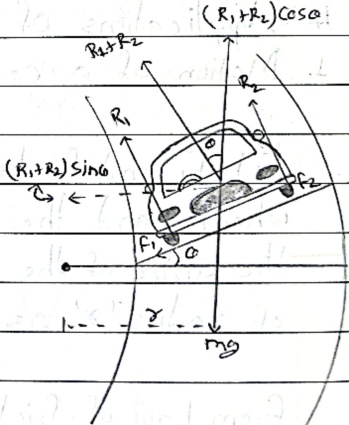
let f_{1} and f_{2} be the forces between the wheels and the road, directed towards the centre of the horizontal curved track of radius 'x' as shown in fig(1)
from Law of friction
\( F_{1} + f_{2} = M (R_{1} + R_{2}) - \textcircled{1} \)
where M is the coefficient of sliding friction between road and tires.
R₁ and R₂ = forces of normal reaction of the road on the wheels.
As there is no motion of car in the vertical direction, we have
\( R_{1} + R_{2} = mg \) —⑩
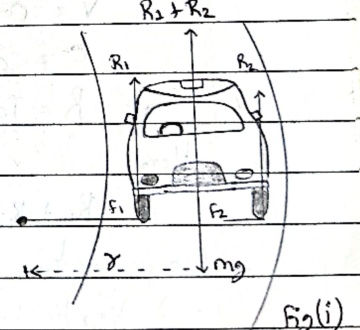
As the force of friction provides the necessarily centripetal force then,
\( F_{2} + f_{2} = M \cdot V^{2} \) —⑩
from ① and ⑩, we have
\( H_{mg} = mv^{2} \)
\( \therefore V_{2} \sqrt{Mg} \)
This gives the maximum limit of speed of a vehicle while turning on a circular path.
2. Motion of a Car in on a Banked road
Let, \( m = \text{mass of} \text{car} \)
\( r = \text{radius of track} \)
\( V_2 = \text{constant speed} \)
\( \odot z = \text{angle of banking} \)
\( R = \text{Total normal reaction} \)
\( R = R_1 + R_2 \) has two rectangular components: horizontal component \( R \sin\theta \) and vertical component \( R \cos\theta \). Here, \( R \sin\theta \) balances \( mg \) and \( R \cos\theta \) provides the centripetal force. That is,
\( R \cos\theta = mg \) — ①
And \( R \sin\theta = MV^2 \) — ⑩
Dividing ⑩ by ①, we get
\( \tan\theta = \frac{V^2}{R} \) — ⑩
(1) \( V_{2}^{2} r g \tan \theta \)
\( \therefore V_{2} \sqrt{r g \tan \theta} - (1) \)
It gives the max. safe speed of the vehicle.
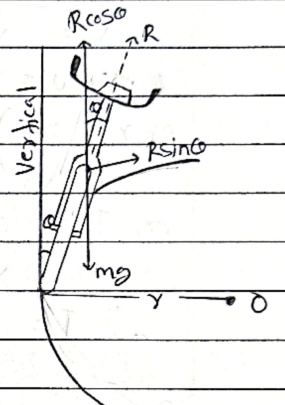
Motion of a cyclist
(Let), m = mass of cyclist
γ = radius of path
V = constant speed
θ = angle of inclination
The reactional force 'R' can be resolved into two components
\( R \cos \theta = \) opposite to 'mg'
\( R \sin \theta = \) along the centre '0'.
Now,
\( R \cos \theta = mg \) —①
\( R \sin \theta = \frac{mv^{2}}{r} \) —⑩
Dividing ⑩ by ① we get;
\( T \tan \theta = V^{2} \)
∴ θ = \( \tan^{2}\left(\frac{v^{2}}{8g}\right) \) or, \( V = \sqrt{2g} \)
Motion of a Conical Pendulum
Let m_{2} mass of particle
\( \gamma = \gamma_{0} \)
\( \gamma = \gamma_{0} \times \frac{1}{2} \)
\( V = \text{constant speed} \)
\( \phi = \phi_{0} \)
\( T = \text{Tension in the string} \)
Now,
\( T\cos\phi = mg \) —①
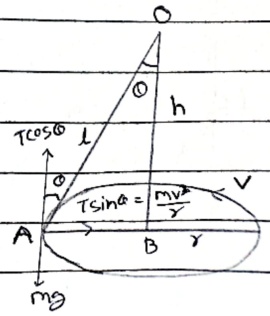
\( T\sin\theta = \frac{mv^{2}}{r} \) —①
Dividing ① by ①, we get
\( T\tan\theta = \frac{v^{2}}{2g} \) —⑩
Time period of a conical Pendulum
from equation (11), we have
\( V^{2} = \gamma g \tan \theta \)
\( \alpha_{1}, V = \sqrt{\gamma g \tan \theta} \)
\( \alpha_{2}, \gamma \omega = \sqrt{\gamma g \tan \theta} \) [since, \( V = \gamma \omega \)]
\( \alpha_{3}, \gamma \left( \frac{2\pi}{T} \right)^{2} \sqrt{\gamma g \tan \theta} \) [since, \( \omega = \frac{2\pi}{T} \)]
or, \( T^{2} = \frac{2\pi r}{\sqrt{2gTano}} \)
\( \therefore T_{2} = \frac{2\pi}{\sqrt{2gTano}} = (v) \)
from equation (1) and \( \Delta A_{OB}, \sin\theta = \frac{AB}{OA} = \frac{x}{l} \), where \( l \) is the length of string.
or, \( y = \ln \sin\theta \) — ⑧
Now,
from equation (1) and (2)
\( \therefore T_{2} = \frac{2\pi}{\sqrt{2g\cos\theta}} = (v) \)
This is the required time expression for time period of a conical pendulum.
5. Motion of a particle in vertical circle
let, m = mass of particle
\( \gamma = \text{radius of vertical circle} \)
Let the particle is at p at any instant.
At this point, the tension \( T_{in} \) is the string acts along Po
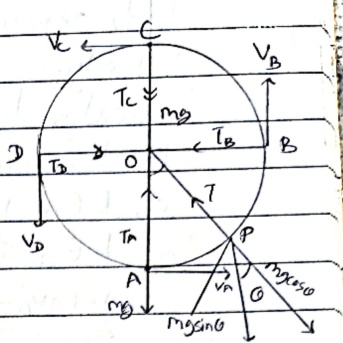
At lowest point A, a part of Tension To balance the weight and remaining part provides necessary centripetal force.
\( T_{A} - mg = m\frac{V_{A}^{2}}{2} \)
At highest point C, tension \( T_{c} \) and weight of the body together provide the necessary centripetal force.
\( T_{c} + mg = M V_{c}^{2} \)
\( T_{C}=\frac{mv_{c}^{2}-mg}{r} \) —⑩
At point B and D, tension on string provides necessary centripetal force.
\( T_{B}=mv_{B}^{2} \) —⑩
It is clear that, tension at lowest point in maximum. At the highest point, if tension is zero in the Spring is zero. Then, \( mg = mv_{c}^{2} \)
\( \therefore V_{C} = \sqrt{2g} \)
This is the minimum velocity at the highest point with which the body revolves and this minimum velocity is also called crip Velocity.
According to the principal of Conservation of Energy
Total energy at point A = Total energy at point C
or, \( K \cdot E_{A} + P E_{A} = K \cdot E_{C} + P \cdot E_{C} \)
or, \( K \cdot E_{A} = K \cdot E_{C} + (P \cdot E_{C} - P \cdot E_{A}) \)
or, \( \frac{1}{2} m V_{A}^{2} = \frac{1}{2} m V_{C}^{2} + m g (2x) \)
or, \( \frac{1}{2} m V_{A}^{2} + m g h = \frac{1}{2} m V_{C}^{2} + m g (h + 2x) \)
or, \( V_{A}^{2} + 2 g h = V_{C}^{2} + 2 g (h + 2x) \)
or, \( V_{A}^{2} + 2 g h = 2 g + 2 g h + 4 g x \)
or, \( V_{A}^{2} = 5x g \)
\( V_{A} = \sqrt{5x g} \)
\( \therefore V_{A} = \sqrt{5} x g \)
It is the reg. expression for minimum velocity at lowest point to complete the vertical circle.