Lenses
A lense is a piece of transparent refracting material bounded by two surfaces out of which at least one is curved. E.glass lens, diamond lens, etc. lens is divided into two classes:
- Convex lens (or Converging lens)
- Concave lens (or diverging lens)
If the lens is thick at centre and thin at edges, is called convex lens. It is of three types:
- Bi-convex lens
- plano-convex lens
- Concavo-convex lens
Concave lens
If the lens is thin at centre and thick at edges, is called concave lens. It is also of three types:
- Bi-Concave lens
- plane-concave Lens
- convexity-concave lens
Lens Formula
The formula which shows the relation between object distance, image distance and focal length of a lens is called lens formula. And is given by,
$$ \frac{1}{f} = \frac{1}{u} + \frac{1}{V} $$Proof
Convex Lens (Real image)
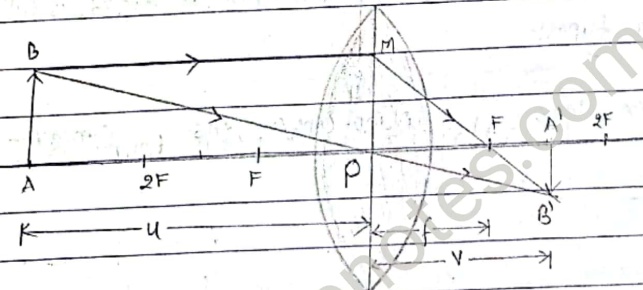
Fig: Real image formed by a convex lens
Let us consider an object (A) is placed \( L^{T} \) to the principal axis of Converters of focal length \( f \). Also let, A'B' be the real image formed by that lens, then
In above figure, \( \Delta ABP \sim \Delta ABP \).
So, \( \frac{A'B'}{AB} = \frac{A'P}{AP} = \frac{V}{u} \)
\( Also, \Delta A'B'F \sim \Delta MPF \)
\( So, \frac{A'B'}{MP} = \frac{A'F}{PF} \Rightarrow \frac{A'B'}{AB} = \frac{A'F}{PF} \) [∴AB=MP]
\( \frac{A'B'}{AB} = \frac{A'P - PF}{PF} = \frac{v - f}{f} \)
From \( eq^{n} \) of (i)
\( \frac{v}{u} = \frac{v - f}{f} \Rightarrow vf = uv - uf \)
\( uv = vf + uf \) — (iii)
Dividing both sides of \( eq^{n} \) with 'uvf'. Then we set,
$$ \text{or:} \frac{uv}{uvf} = \frac{vf}{uvf} + \frac{uf}{uvf} $$ $$ \Rightarrow\left\{\begin{array}{l}\frac{1}{f}=\frac{1}{u}+\frac{1}{v}\end{array}\right\}\rightarrow(iv) $$which is required lens formula.
[2] Convex Lens (Virtual image)
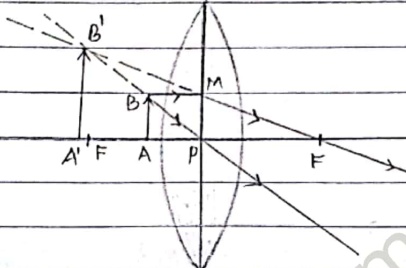
\( AP = u \)
\( A^{\prime}P = -V \)
\( PF = f \)
Fig: Virtual image formed by Convex lens
Let us consider an object AB is placed perpendicularly to the principal axis of Convex Lens of focal length f. Also, let, \( A'B' \) be the visual image formed by that lens then,
In above figure, \( \Delta A B^{\prime}P \sim \Delta A B P \)
So, \( \frac{A^{\prime}B^{\prime}}{AB} = \frac{A^{\prime}P}{AP} = \frac{-V}{u} \)
Also, \( \Delta A^{\prime}B^{\prime}F \sim \Delta M P F \)
So, \( \frac{A^{\prime}B^{\prime}}{M P} = \frac{A^{\prime}F}{P F} \)
\( \frac{A^{\prime}B^{\prime}}{A B} = \frac{A^{\prime}F}{P F} \) [∴ MP = AB]
\( \frac{A^{\prime}B^{\prime}}{A B} = \frac{A^{\prime}P + P F}{P F} \)
\( \frac{A^{\prime}B^{\prime}}{A B} = \frac{-V + f}{f} \)
From \( eq^{n}(i) \) & (ii) we get
\( \Rightarrow \frac{-V}{u} = \frac{-V + f}{f} \)
or, \( -Vf = -uV + uf \)
or, \( uV = Vf + uf \)
Dividing both sides by \( uvf \) of eq.
\( \Rightarrow \frac{u V}{uvf} = \frac{V f}{uvf} + \frac{u f}{uvf} \)
\( \Rightarrow \left[ \frac{1}{f} = \frac{1}{u} + \frac{1}{V} \right] \) — (iv)
Which is required lens formula.
[3] Concave Lens (Virtual image)
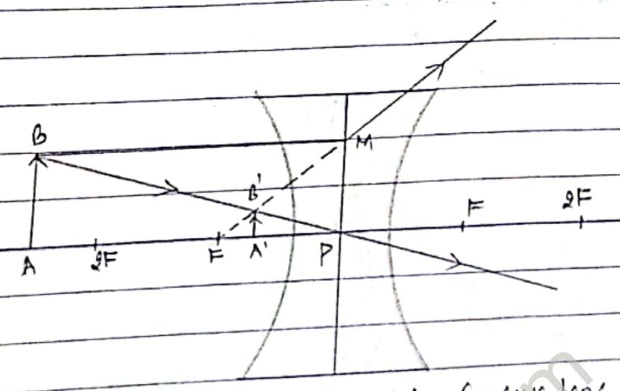
\( AP = u \)
\( A^{\prime}P = -V \)
\( PF = -f \)
Fig.1: Virtual image formed by Concave lens
Let us consider, an object AB is placed perpendicularly to the principal axis of Concave lens of focal length f'. Also, let A'B' be the virtual image formed by that lens. Then,
In above figure, \( \Delta A'B'P \sim \Delta ABP \)
So, \( \frac{A'B'}{AB} = \frac{A'P}{AP} = \frac{V}{u} \)
Also, \( \Delta A'B'F \sim \Delta MPF \)
So, \( \frac{A'B'}{MP} = \frac{A'F}{PF} \)
or, \( \frac{A'B'}{AB} = \frac{A'F}{PF} \) [∴ MP = AB]
or, \( \frac{A'B'}{AB} = \frac{PF - A'P}{PF} \)
\( \frac{A'B'}{AB} = \frac{-f + v}{-f} \) (i)
From \( eq^{n}(i) \) & (ii), we get,
\( \Rightarrow \frac{-v}{u} = \frac{-f + v}{-f} \)
or, \( vf = -uf + uv \)
or, \( uv = vf + uf \) — (iii)
Dividing both sides of (iii) by \( uvf \), then,
\( \frac{uv}{uvf} = \frac{vf}{uvf} + \frac{uf}{uvf} \)
\( \Rightarrow \left[ \frac{1}{f} = \frac{1}{u} + \frac{1}{v} \right] \rightarrow (iv) \)
Which is required lens formula.
Linear magnification
Linear magnification is defined as the ratio of the size of the image to the size of object.
OR
Linear magnification is also defined as the ratio of image distance to the object distance, it is denoted by 'm'.
where
- I = Image height(size), V = Image distance
- O = Object height(size) & u = Object distance
If 'N' numbers of lenses are combined coaxially, the combined magnification is written as,
\( m = m_{1} \times m_{2} \times \cdots \times m_{N} \)
Where, \( m_{1}, m_{2}, \ldots, m_{N} \) be the magnification produced by N number of lenses
Power of lens
→ The reciprocal of focal length of a lens is called power of lens. If focal length = f, expressed in metre, then the power of lens denotes by p is expressed as,
\( P = \frac{1}{f} \)
\( f \, (\text{metre}) \)
The SI unit of power is \( m^{-1} \) which is called dioptre (D).
When, \( f = 1 \) metre, then, \( P = \frac{1}{1\,m} = 1D \)
So, If the focal length of lens is one metre then the power of a lens is called one dioptre.
Lens Maker's Formula
→ the relation which shows the relation between focal length of lens, radii of curvature of two surfaces of lens and the refractive index of the material of lens is called Lens Maker's formula.
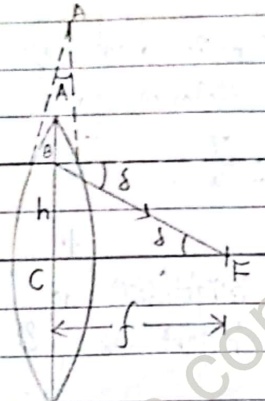
Fig: Refraction through lens.
Let us consider a thin convex lens of focal length f'. A ray of light xB parallel to the principal axis Strikes the point B at height h above the Opticle Centre 'c' as shown in figure. This ray after refraction through lens meets principal axis at Focus' by angle of deviation 'δ'.
From figure, \( \tan\delta=\frac{h}{f} \)
For Small \( \delta \), \( \tan\delta\approx\delta \)
\( \Rightarrow\delta=\frac{h}{f}\longrightarrow(i) \)
Also, lens is supposed to be Small angle prism. Then
\( \delta=A(\mu-1)\longrightarrow(ii) \)
Now, From \( \operatorname{eq}(i) \) and (ii):
\( \frac{h}{f}=A(\mu-1) \)
\( \Rightarrow \frac{1}{f} = (\mu-1)\frac{A}{h} \) ——— (iii)
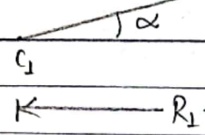
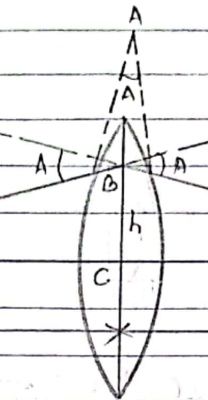
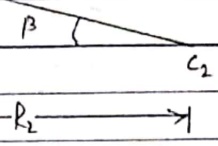
Fig: Lens as a small angle prism
Let us Consider, two light rays passing through \( C_{1} \) and \( C_{2} \) (where \( C_{1} \) & \( C_{2} \) are centre of curvature) meet at point B of the lens. Also let, \( \alpha \) & \( \beta \) are the angle made by \( BC_{1} \) and \( BC_{2} \) with principal axis respectively.
From figure, \( CC_{1} = R_{1} \) & \( CC_{2} = R_{2} \)
\( A = \alpha + \beta \) — (iv)
Also, In Right angle \( \Delta BCC_{1} \),
\( \tan\alpha = \frac{h}{R_{1}} \)
For Small \( \alpha \), \( \tan\alpha\approx\alpha \)
\( \Rightarrow\alpha=\frac{h}{R_{1}} \) — (v)
Again, In Right Angle \( \Delta BCC_{2} \),
\( \tan\beta = \frac{h}{R_{2}} \)
For small \( \beta \), \( \tan\beta \approx \beta \)
\( \Rightarrow \beta = \frac{h}{R_{2}} \rightarrow (vi) \)
Using \( eq^{n}(v) \) & (vi) in \( eq^{n} \) (iv)
\( \Rightarrow A = \frac{h}{R_{1}} + \frac{h}{R_{2}} \)
\( \Rightarrow \frac{A}{h} = \frac{1}{R_{1}} + \frac{1}{R_{2}} \) — (vii)
Again, Using eq(vii) in eq(iii):
\( \Rightarrow \frac{1}{f} = (\mu-1) \left[ \frac{1}{R_{1}} + \frac{1}{R_{2}} \right] \) — (viii)
which is known as lens Maker's formula or equation.
Focal length of Combined Lens
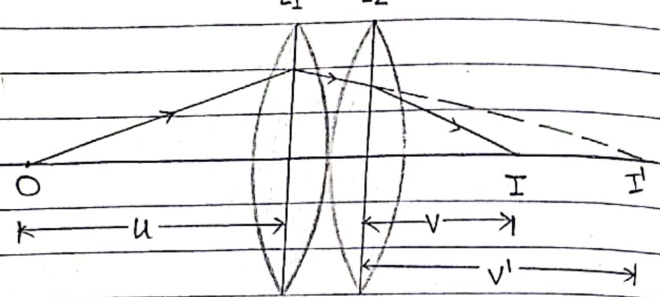
Fig.: Two thin lenses in contact
Let us consider two thin lenses \( L_{1} \) & \( L_{2} \) with their respective focal length \( f_{1} \) & \( f_{2} \) are placed in contact with each other as shown in figure. Also consider a point object 'O' placed on the principal axis of the lens system. The lens \( L_{1} \) forms a real image of object 'O' then using lens formula for lens \( L_{1} \),
The image I formed by Lens \( L_1 \) act as virtual object for lens \( L_2 \) and which form final image at point I. Then, using lens formula for lens \( L_2 \),
Adding \( eq^{n} \) (i) & (ii);
$$ \begin{array}{l} \frac{1}{f_{1}} + \frac{1}{f_{2}} = \frac{1}{u} + \frac{1}{V'} - \frac{1}{V'} + \frac{1}{V} \end{array} $$\( \frac{1}{f_{1}} + \frac{1}{f_{2}} = \frac{1}{u} + \frac{1}{v} \) — (iii)
If F be the Combined focal length for both lenses \( L_{1} + L_{2} \);
\( \frac{1}{F} = \frac{1}{u} + \frac{1}{v} \) — (iv)
From \( eq^{(iii)} \) & (iv)
$$ \frac{1}{F}=\frac{1}{f_{1}}+\frac{1}{f_{2}} $$For 'N' lenses;
\( \Rightarrow \frac{1}{F} = \frac{1}{f_{1}} + \frac{1}{f_{2}} + \cdots + \frac{1}{f_{N}} \) — (v)
\( \Rightarrow P = P_{1} + P_{2} + \cdots + P_{N} \rightarrow (vi) \)
Hence, \( eq^{n} \)(v) helps to determine equivalent focal length & \( eq^{n} \)(vi) helps to find power of combined lenses.