Refraction at Plane Surface
Refraction
The phenomenon of bending of right ray on passing through one medium to another medium due to change in speed called refraction.
Rarer medium
For a pair of medium, the medium in which the speed of light is Comparatively larger is called rarer medium. For e.g.: ray from glass to air.
Dancer medium
For a pair of medium, the medium in which the speed of light is comparatively small is called density medium. For a ray from air to glass
Law of Refraction of Light
The law of refraction of light are:
- The incident ray, refracted ray & Normal at the point of incident lies in the same plane.
- When light travels from rarer to denser medium it bends towards the normal and when light travels from denser to rarer medium it bends away from Normal.
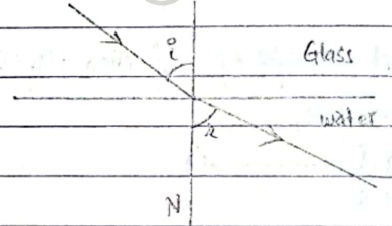
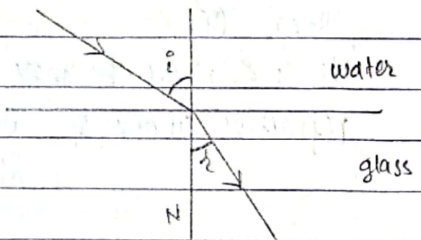
F_{1}=-refraction of light
For a given two medium, the ratio of fine of the angle of incidence to the fine of angle of refraction is constant, called refractive index and denoted by \( w \). which is known as Shell's law.
Note \( \Rightarrow \) all_{b} \( \Rightarrow \) Refractive index of medium'b' w.r.t. medium 'a'. OR Light travelling from medium 'a' to medium 'b'.
Refractive Index
the refractive index in terms of speed of light of a medium is defined as the ratio of speed of light in vacuum (6) to the speed of light in that medium (v).
i.e., Refractive index = Velocity of light in any medium
$$ u=\frac{c}{v} $$Where, \( C = 3 \times 10^{8} \, m/s \)
Principle of Reversibility of light
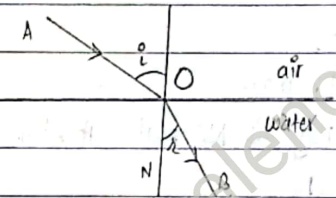
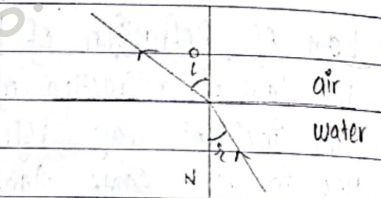
Fig.: Light referrals from air to water. Fig.: Light Refracted from water to air
Let us consider a light ray 'AO' incident at point 'O' of the refracting medium of air and water. Then it beds towards normal and passes along 'OB'.
Let \( {}^{1} \) & {}^{1}r are the angle of incident & angle of refraction respectively. Now, refractive index of water w.r.t. air,
$$ \text{all} w = \frac{\sin i}{\sin x} \quad (i) $$When, the light ray is made to incident on the water-air surface at angle \( 2^{\prime} \). Then, it gets refracted along the previous direction of incident & angle of refraction \( 9s^{\prime}i^{\prime} \). Then, refractive index of air w.r.t. water,
$$ \omega u_{0} = \frac{\sin\alpha}{\sin i} - (i) $$ $$ \Rightarrow a M w \cdot w l a = \frac{\sin^{2} \alpha}{\sin 2^2 \times \sin 2} = 1 $$ $$ \Rightarrow \boxed{\omega \mathrm{li}_{a} = \frac{t}{\mathrm{a} \mathrm{li}_{w}}} $$Real Depth and Apparent Depth
When light ray travels from denser medium to rarer medium it bends away from the normal and the bottom of a pond seems to be raised as shown in figure below:
Let us consider a point 'O' at the bottom of the pond from which a light ray 'OA' incident at angle and get refracted along AB' at angle of refraction 'r'. The point 'O' seems to be at point 'O' on observing from point 'B'.
Here, \( \mathrm{CO} = \mathrm{Real} \) Depth, \( \mathrm{CO}' = \mathrm{App} \)
Fig.: Real & Apparent Depth
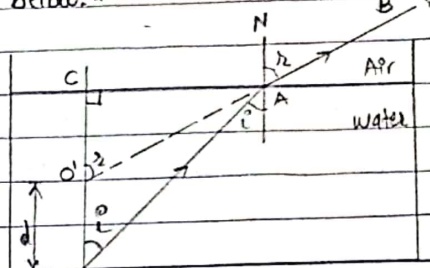
Now, from figure,
\( OO' = CO - CO' \)
Apparent shift(d) = Real depth - Apparent depth
Now,
Refractive index of air work. water,
\( \omega \mu a = \sin i \)
\( \sin i \)
\( \Rightarrow a \mu w = \frac{\sin i}{\sin i} \)
From \( \Delta CAO' \) Also, from \( \Delta CAO \)
\( \sin r = \frac{CA}{O'A} \)
\( \sin i = \frac{CA}{OA} \)
Then, \( eq^{m}(i) \) becomes,
\( a \mu w = \frac{CA}{O'A} \times \frac{OA}{CA} = \frac{OA}{O'A} \)
If \(A\) is very close to \(O\)
\(OA \approx OC\) & \(O'A' \approx O'C\)
\(\Rightarrow a u_{w} = \frac{OC}{O'c}\)
\(\Rightarrow a u_{w} = \frac{Real\ depth}{Apparent\ depth}\)
\(\Rightarrow Apparent\ depth = \frac{Real\ depth}{allw}\)
If \(Real\ depth = t\), Then,
\(\Rightarrow Apparent\ depth = \frac{t}{allw} \rightarrow (iii)\)
Using \(eq^{n}(iii)\) in (i)
\(\Rightarrow d = t - \frac{t}{allw}\)
\(\Rightarrow d = t \left[ 1 - \frac{1}{a u_{w}} \right] - (iv)\)
Which is required relation for Apparent Shift.
Lateral Shift(d)
The perpendicular distance between the direction of incident ray and emergent ray is called the distance shift.
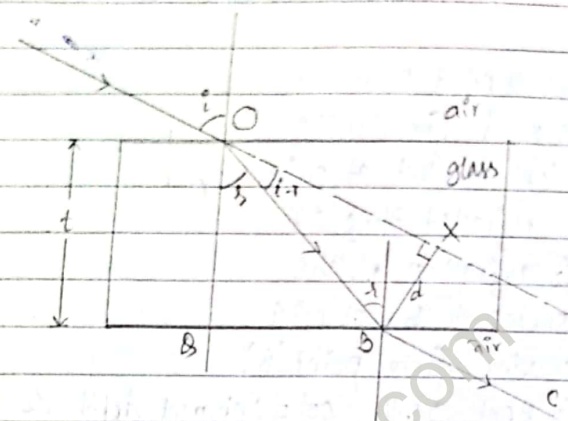
Fig: Refraction through glass slab
Let us consider a glass slab of thickness 't' where a ray of light incident on its upper face at angle of incidence i' along A0 and get reflected along OB inside the slab at angle of refraction i' and finally emerges out from the lower face along BC at angle of emergence e'. Also, let \( Bx = d \) be the lateral shift.
Now, from AOQB,
$$ \cos2=\frac{O B}{O B}=\frac{t}{O B} $$ $$ \Rightarrow OB = \frac{t}{(\cos \angle} -\quad (i) $$ $$ A1S_{0}, F_{on} \Delta O B x $$ $$ \sin(1-r)=\frac{Bx}{OB}=\frac{d}{OB} $$\( O_{1} \), \( d = OB \sin(1 - r) \)
\( O_{1}d = \frac{t}{\cos\lambda} \sin(1 - r) \) [Osing]
Lateral Shift(d) = \( \frac{t}{cos(i-r)} \)
this is required expression.
$$ t \sin (90^\circ - x) $$ $$ W h e n,i\bot90^{\circ} $$ $$ \text{Then,} $$ $$ B x = d = \cos \lambda $$ $$ \begin{array}{c} \text{or,} d = \frac{t \cos \alpha}{\cos \alpha} \end{array} $$ $$ \rightarrow d = t $$this shows that when light incident at angle of \( 90^{\circ} \) then lateral Shift is equal to the thickness of glass slab.
Total Internal Reflection & Critical Angle
Condition for total internal reflection:
- object must be no denser medium.
- Angle of incidence must be greater than the critical angle i.e. I > C
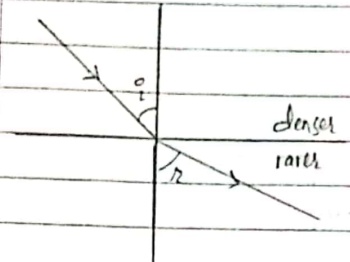
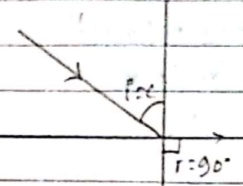
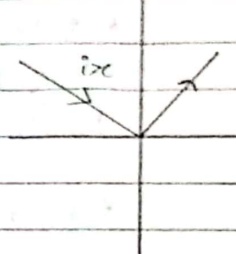
Fig: Refraction of light Fig: Critical angle Fig: Total internal reflection. From density to radius
When light travels from denes medium to rarer medium it bends away from normal on increasing the angle of incidence the angle of refraction also increased and at a particular angle of incidence the angle of refraction becomes 90°. The angle of incidence in denes medium for which the angle of refraction in rarer medium is 90° is called Critical angle's of that medium. When the angle of incidence is further increased beyond the Critical angle the ray of light returns the same medium, called total internal reflection.
Relation between 'u' & 'c'
Let us consider, Glass-air medium in which a light ray AB incident at point B on glass with angle of incident p=c and reflected along BC with angle of refraction \( z=g\theta \).
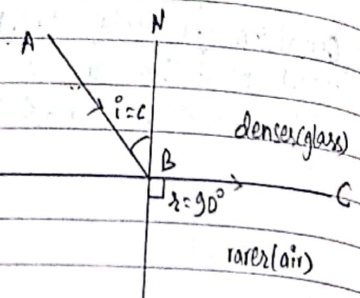
then, representative index of air court. glass, gilo = sin \( ^{2} \) sin \( ^{2} \)
$$ g l l_{a}=\frac{5\pi c}{6n\cdot90^{\circ}} $$ $$ \Rightarrow y\ln a=5\pi r\rightarrow(1) $$ $$ \sqrt{160} $$ $$ a\downarrow l g=g\downarrow l a $$ $$ \text{all}_{g}=\frac{1}{\sin(^\circ)} $$ $$ \theta R_{n} \left[1=\frac{1}{\sin}\right] $$this is required relation between reference order & critical angle.