Statics, kinematics and dynamics
Static:
The branch of mechanics which deals with study of object at rest is called statics.
2. kinematics:
The branch of mechanics which deals with the study of motion without taking into account of the cause of motion
3. Dynamics:
The branch of mechanics which deals with the study of motion of objects by taking into account the cause of motion also.
4. Displacement and distance
The shortest distance between two points is called displacement. It is a vector quantity directed along the direction of motion.
The length of actual path travelled by body between two points is called distance. It is a scalar quantity.
Average Speed and instantaneous speed
The ratio of total distance travelled to the total time taken is known as average speed.
i.e. Average Speed = \( \frac{\text{Total distance travelled}}{\text{Total time taken}} \)
The speed of a body at a particular instant of time on its path is called instantaneous speed.
Average Velocity and instantaneous velocity
Average velocity of a body is defined as the ratio of total displacement to the total time taken.
i.e. Average velocity = Total displacement / Total time taken
The velocity of body at a particular instant of time is called instantaneous velocity.
7. Acceleration and Retardation
The rate of change of velocity is called acceleration.
i.e. \( a = \frac{\text{change in velocity}}{\text{time}} \)
It is a vector quantity and its SI unit is \( ms^{-1} \).
The rate of decrease of velocity is called retardation or negative acceleration.
Equation of motion with uniform acceleration
- \( V = ut + at \)
- \( S = ut + \frac{1}{2}at^{2} \)
- \( V^{2} = u^{2} + 2as \)
- \( S_{n}h = u + \frac{a}{2}(2n-1) \)
Equation of motion under gravity
- \( V = u \pm gt \)
- \( h = ut \pm \frac{1}{2}gt^{2} \)
- \( V^{2} = u^{2} \pm 2gh \)
- \( S_{n} h = u + \frac{1}{2} g (2n - 1) \)
Equation of motion in a straight line [Graphical method]
Solution:
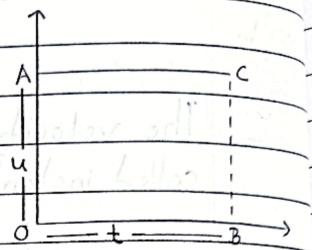
If a body moves with a uniform velocity 'u' then the distance travelled in time 't' is given by;
s = dis. travelled by body
s = ut \( \left[\therefore a = v - u, u = v = \text{uniform}\right] \)
Velocity - Time graph
Area of rect. AOBC \(= A O \times O B \) = ut
\( \therefore S = ut \)
\( S = ut + \frac{1}{2}at^{2} \)
Solution:
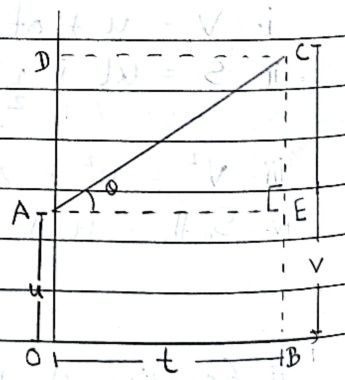
If a body moves with non-uniform velocity with an acceleration 'a' and velocities 'u' (initial velocity) and 'v' (final velocity) then distance travelled by a body in time 't' is given by;
\( S = ut + \frac{1}{2}at^{2} \)
In velocity-Time graph
In \( \Delta ACE \),
\( \therefore \text{slope} = \tan\theta \)
\( \frac{CE}{AE} = \frac{V - u}{t} \)
$$ or,a=\frac{v-u}{t} $$
$$ or, V = u + a t $$
$$ \begin{align*} \text{Displacement}(s)&=\text{Area of Trapezium} AOBC\\&=\text{Area of red} AOBC+\text{Area of} \Delta ACE\\&=\text{AO} \times O B+\frac{1}{2}A C \times C E\\&=u t+\frac{1}{2}t \times(v-u)\\&=u t+\frac{1}{2}t \cdot a t\quad\left[\because CE=v-u=at\right]\\&\therefore s=u t+\frac{1}{2}a t^{2}\end{align*} $$
$$ V^{2}=u^{2}+2a s $$
Solution:
Area of \( A O B C=\frac{1}{2}(\text{sum of parallel side})\times \text{height} \)
$$ or, S=\frac{1}{2}(Ao+BC) \times Ac $$
$$ or, s=\frac{1}{2}(u+v)\times t $$
$$ or, S=\frac{1}{2}(u+v)\times\left(\frac{v-u}{a}\right)\left[\because a=\frac{v-u}{t}\right] $$
$$ or, s=\frac{V^{2}-u^{2}}{2a} $$
$$ or, 2a S=V^{2}-u^{2} $$
$$ V^{2} = U^{2} + 2as $$
Projectile
Any object thrown into space or atmosphere such that it moves under the effect of gravity alone is called a projectile.
Examples:
- a bullet fired from a gun
- a Javelin thrown by an athletes
- a Shell fired from a canon.
Path of the projectile is called trajectory.
The motion of the projectile in the trajectory is called projectile motion.
Properties of projectile motion:
- It is two dimensional motion.
- x = horizontal distance travelled by the projectile
- y = Vertical distance travelled by the projectile
- θ = angle of projection
- Ux = Initial horizontal velocity of the projectile
- Uy = Initial velocity of the projectile
- Vx = Final horizontal velocity of the projectile
- Vy = Final vertical velocity of the projectile
- ax = Vx - Ux = 0 = horizontal acceleration of (\( \because V_{x}=U_{x} \))
\( a_{y}=\pm g=\text{Vertical acceleration of the projectile} \)
\( (+g=\downarrow\ \text{downward motion}) \)
\( -g=\uparrow\ \text{Upward motion} \)
\( u_{x} = u \cos \theta \)
\( u_{y} = u \sin \theta \)
\( u = \text{Initial Velocity of the projectile} \)
\( u = \sqrt{u_{x}^{2} + u_{y}^{2}} \)
\( V = \sqrt{V_{x}^{2} + V_{y}^{2}} \)
\( V = \text{Final Velocity} \)
3. Horizontal velocity of the projectile is always uniform.
So acceleration towards the horizontal direction is always zero i.e. ax = 0
4. Acceleration towards the vertical direction is always equal to acceleration due to gravity (i.e.g)
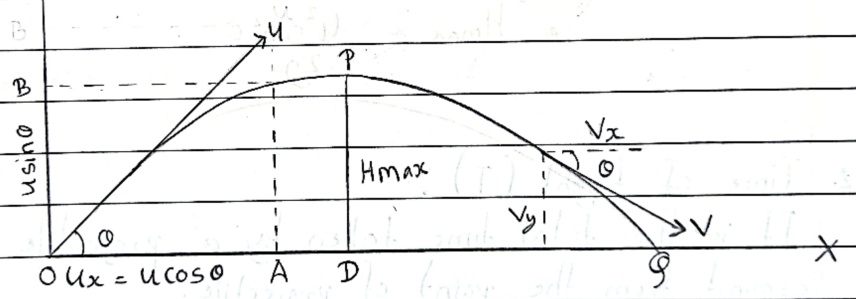
DP = \( H_{max} \) = Maximum Vertical distance or maximum height
OG = R = Horizontal range
Time to travel trajectory \( OPG = T = \text{Time of flight} \)
Air resistance in the projectile motion is neglected.
Maximum Height (\( H_{max} \))
It is the greatest vertical distance travelled by a projectile during its flight.
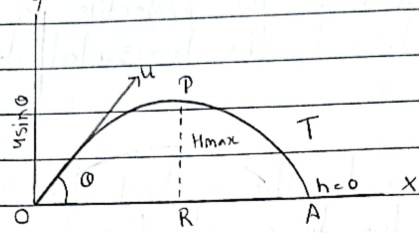
For maximum height; \( V_{y} = 0 \)
\( \therefore V_{y}^{2} = U_{y}^{2} - 2gH_{max} \)
\( or, O^{2} = (u\sin\theta)^{2} - 2gH_{max} \)
\( or, 2gH_{max} = U^{2}\sin^{2}\theta \)
\( or, H_{max} = \frac{U^{2}\sin^{2}\theta}{2g} \)
Time of flight (T)
It is the total time taken by a projectile to return to the ground from the point of projectile.
Now, from the above figure, it is the time to travel trajectory OPA.
At \( A, h=0 \)
Now, \( y = h = U_{y}T - \frac{1}{2}gT^{2} \)
\( or, O = U_{y}T - \frac{1}{2}gT^{2} \)
\( or, \frac{1}{2}gT^{2} = U_{y}T \)
\( or, \frac{1}{2}gT = U_{y} \)
\( or, T = \frac{2Uy}{g} \)
\( T=\frac{2u\sin\theta}{g}=2t \) \( t=\frac{u\sin\theta}{g} \)
3. Horizontal Range (R)
The total distance covered by a projectile during the time of flight is called horizontal range.
For Horizontal motion, the equation of motion is
\( S_{x}=U_{x}T+\frac{1}{2}a_{x} T^{2} \)
\( or, R = U_{x}T \) \( [a_{x}=0] \)
\( or, R = U\cos\theta \cdot T \)
\( or, R = U\cos\theta \cdot \frac{2u\sin\theta}{g} \)
\( \therefore R = \frac{U^{2} \sin 2\theta}{g} \)
Numerical Problems
Problem 1 — Projection from a building
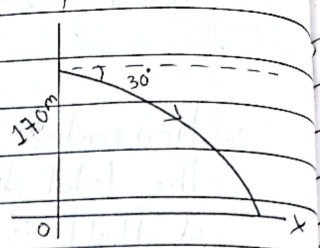
A body is projected down of an angle of 30° with the horizontal from the top of a building 170 m high. Its initial speed is 40 m/s. How long will it take before striking the ground. How far from the foot of the building the body will strike and at what angle with the horizontal.
Solution:
Angle of projection (θ) = 30°
Height of the building (h) = 170m
Initial Speed (u) = 40m/s
Time of flight (T) = ?
Horizontal Range (R) = ?
Angle at which the projection strike the ground (θ') = ?
due to gravity \((g)=9.8\,m/s^{2}\)
$$ h = U_{y} T + \frac{1}{2} g T^{2} $$
$$ or, 170=\text{Usin}30^{\circ}\text{T}+\frac{1}{2}g T^{2} $$
$$ or, 170=40\times0.5\times T+5T^{2} $$
or \( 5T^{2} + 20T - 170 = 0 \)
Comparing the above equation with \( ax^{2} + bx + c = 0 \), we get
\( a = 5 \), \( b = 20 \), \( c = -170 \)
$$ x = (-b \pm \sqrt{b^{2} - 4ac})/2a $$
$$ or, T=-2\pm62.64\over10 $$
Taking positive root, \( T = 4.16 \) s (approx.)
$$ R = U \cos 30^{\circ} \cdot T $$
$$ = 40\times\frac{\sqrt{3}}{2}\times4.16 $$
$$ \therefore R=143.10m $$
Again
\( V_{y}=U_{y}+gT \)
or \( V_{y} = u \sin 30^{\circ} + g T \)
\( = 40 \times 0.5 + 9.8 \times 4.16 \)
\( = 20 + 40.77 \) (OCR: \( 20 + 41.60 \))
\( = 61.60 \, m/s \)
$$ \begin{array}{l} or, \theta' = \tan^{-1}\left( \frac{61.60}{34.40} \right) \\ = 60.8^{\circ} \end{array} $$
Problem 2 — Projectile from ground
A projectile is fired from the ground with 500 m/s at 30° with the horizontal.
- Find horizontal Range
- Greatest height
- Time to reach the greatest height.
Solution:
Initial Speed (u) = 500 m/s
Angle of projectile (\( \theta \)) = 30°
Horizontal Range (R) = ?
Highest height (\( H_{max} \)) = ?
Time of flight (T) = ?
We know
\( R = \frac{u^{2}\sin 2\theta}{g} \)
\( = \frac{500^{2} \cdot \sin 2 \cdot 30}{10} \)
= 21650.64 m
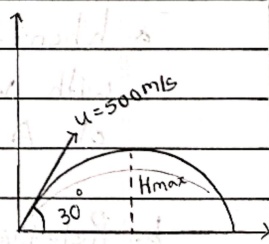
Also, \( H_{max} = \frac{u^{2} \sin^{2} \theta}{2g} \)
\( = \frac{500^{2} \cdot (\sin 30)^{2}}{2 \times 10} \)
Also,
Time of flight (T) = \( \frac{2 u\sin\theta}{g} \)
\( = \frac{2 \times 500 \times \sin 30}{10} \) = 50 s? (OCR shows 250; with g=20: \( \frac{2\times500\times0.5}{20}=25 \))
Here, time to reach maximum height \( t = \frac{T}{2} \)
Relative velocity
Relative velocity is the time rate of change of position of one object with respect to the another object. Basic rules to determine the relative velocity;
When two bodies A and B are moving in the same direction with velocity, \( V_{A} \) and \( V_{B} \) respectively. Then relative velocity of A over B is \( V_{AB} = V_{A} - V_{B} \).
b. Relative velocity of A with respect to the B if they are moving in the opposite direction is given by \( \overrightarrow{V}_{AB} = \overrightarrow{V}_{A} - (-\overrightarrow{V}_{B}) \)
\( = \overrightarrow{V}_{A} + \overrightarrow{V}_{B} \)
If A and B moves making an angle \( \theta \), then \( \overrightarrow{V}_{AB} \) is calculated as follows:
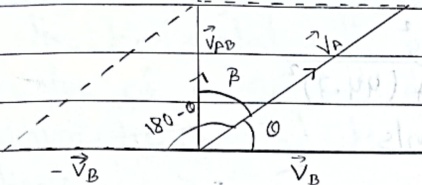
\( V_{AB} = \sqrt{V_{A}^{2} + V_{B}^{2} + 2V_{A}V_{B} \cos(180-\theta)} \)
Now, Direction of \( V_{AB} = \tan\beta \)
Horizontal projection from a tower
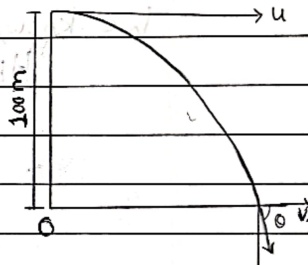
1. A body is projected horizontally from the top of a tower 100m high with a velocity of 9.8 m/s. Find the velocity with which it hits the ground.
Solution:
Height of tower, \( (H) = 100m \)
Initial velocity \( (u) = 9.8 \, m/s \)
Final velocity \( (v) = ? \)
We know,
\( S = H = ut + \frac{1}{2}gt^{2} \)
or, \( h = \frac{1}{2}gt^{2} \) \( [\because Uy = 0] \)
\( t^{2} = \frac{2H}{g} \)
or, \( t^{2} = \frac{2 \times 100}{9.8} \)
\( \therefore t = 4.47 \, sec \)
Also,
\( V_{y} = U_{y} + a_{y}t \)
\( = 0 + gt \) \( [\because Uy = 0] \)
\( = 9.8 \times 4.47 \)
\( = 44.7 \, m/s \)
$$ \begin{array}{l} V=\sqrt{V_{x}^{2}+V_{y}^{2}}\\=\sqrt{(9.8)^{2}+(44.7)^{2}}\\=45.78\ m/s \end{array} $$
Bullet fired at 60°
A bullet is fired with a velocity of 200 m/s from the ground at an angle of \( 60^{\circ} \) with the horizontal, Calculate the horizontal range Covered by the bullet. Also, Calculate the max. height attained.
Solution:
Initial velocity (u) = 100 m/s (OCR; problem states 200 m/s)
Angle of projection (α) = 60°
Horizontal Range (HR) = ?
Maximum height (Hmax) = ?
Acceleration due to gravity (g) = 10 m/s²
We know,
\( HR = \frac{u^{2} \sin 2\theta}{g} \)
\( = \frac{(100)^{2} \cdot \sin 120^{\circ}}{10} \)
\( = 866 \, m \)
Again,
\( H_{max} = \frac{u^{2} \sin^{2}\theta}{2g} \)
\( = \frac{(100)^{2} (\sin 60)^{2}}{2 \times 10} \)
\( = 375 \, m \)
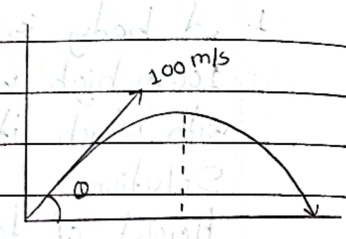
Hence, the horizontal range covered by the bullet and the max. height attained is 866 m and 375 m respectively.
Maximum horizontal range angle
A body is projected upward making an angle of \( \theta \) with the horizontal with a velocity of 300 m/s. Find the value of \( \theta \), so that the horizontal range will be maximum. Hence, find its range and time of flight.
Initial Velocity (u) = 300 m/s
Angle of projection for HRmax (θ) = ?
Horizontal Range (HR) = ?
Time of Flight (T) = ?
Acceleration due to gravity (g) = 10 m/s²
We know,
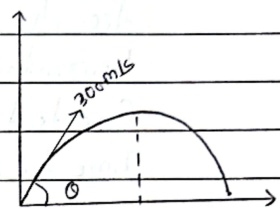
$$ HR_{\max} = \frac{u^{2} \sin 2 \theta}{g} $$
For HR to be max the value of \( \sin2\theta \) should be equal to 1.
So, \( \sin2\theta = 1 \)
or, \( 2\theta = \sin^{-1}(1) \)
or, \( 2\theta = 90^{\circ} \)
\( \therefore \theta = 45^{\circ} \)
Also,
Time of flight \( (T) = \frac{2u\sin\theta}{g} \)
\( = \frac{2 \times 300 \times \sin 45^\circ}{10} \)
= 42.426 sec.
Projectile 500 m/s at 30°
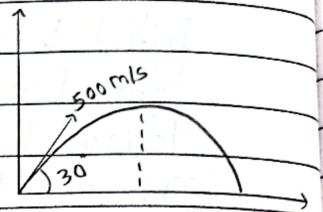
A projectile is fired from the ground level with a velocity 500 m/s at 30° to horizontal. Find range, greatest height and time to reach greatest height.
Solution:
Initial Velocity (\( u \)) = 500 m/s
Angle of projection (\( \theta \)) = \( 30^{\circ} \)
Acc. due to gravity (\( g \)) = \( 10 \, \text{m/s}^{2} \)
Horizontal Range (\( R \)) = ?
Greatest height (\( H_{\text{max}} \)) = ?
Time to reach \( H_{\text{max}} \) (\( t \)) = ?
We know,
\( R = \frac{u^{2} \sin 2\theta}{g} \)
\( = \frac{500^{2} \cdot \sin 60^{\circ}}{10} \)
= 21650.6 m
Also,
\( H_{\text{max}} = \frac{U^{2} \sin^{2}\theta}{2g} \)
\( = \frac{500^{2} \cdot (\sin 30^{\circ})^{2}}{2 \times 10} \)
= 3125 m
Also,
\( t = \frac{T}{2} = \frac{u \sin \theta}{g} \)
\( = \frac{500 \times \sin 30}{10} \)
\( = 25 \, \text{sec} \)
Swimmer in a river
A swimmer's speed in the direction of flow of a river is 12 km/hr. Against the direction of flow of the river the swimmer's speed is 6 km/hr. Calculate the swimmer's speed in still water and the velocity of the river flow.
Solution:
let \( V_{S} \) and \( V_{r} \) represent the velocities of the swimmer and river respectively with respect to ground.
According to question:
\( V_{S} + V_{r} = 12 \, km/hr \) — (i)
\( V_{S}-V_{r}=6\ km/hr \) — (ii)
From equation (i) and (ii)
\( 2V_{S}=12+6 \)
\( V_{S}=\frac{18}{2} \)
\( \therefore V_{S}=9\ km/hr \)
putting the Value of Vs in equation (i)
\( 9+V_{r}=12 \)
\( V_{r}=12-9 \)
\( V_{r}=3\ km/hr \)
Give Reason
-
Is it possible that the displacement is zero but not the distance?
Yes. For example, a body which is thrown upward from the ground returns after attaining height \( h' \). Displacement of the body will be zero but the distance travelled will be twice the height i.e. '2h'.
-
Can speed be negative?
The rate of change of distance per unit time is called speed. It is a scalar quantity i.e. it has only magnitude. It can be positive or zero but can never be negative because a negative sign shows a direction and speed doesn't represent direction.
-
Can a body have a constant speed but changing velocity? Explain with example.
Ans: Yes, when a body is moving in a circular path. In circular path the speed is constant at each point but the direction of velocity is changing at each point.
-
A projectile moves in a parabolic path without air resistance. Is there any point at which its acceleration is perpendicular to the velocity?
Ans: Yes. At the maximum height, the velocity and acceleration are perpendicular to each, where velocity is horizontal and acceleration is downward.
-
Rain drops hitting the side windows of a car in motion often leave diagonal streaks. Why?
It is due to relative velocity. The relative velocity of rain with respect to the car in motion (i.e. the resultant \( \overrightarrow{R} \)) isn't vertical, but inclined to the vertical with angle \( \theta \). Due to this reason, rain drops hitting the side windows of a car often leaves diagonal streaks.
-
A ball is projected horizontally from the top of a building and another is dropped gently from the same point at the same time, which one will hit the ground first?
Both will hit the ground at the same time because time of descent of a freely falling body or a horizontally launched projectile is \( T=\sqrt{\frac{2h}{g}} \). It means, the time of descent depends only on the height 'h' of fall and the acceleration due to gravity 'g' and is independent with the horizontal velocity 'v'.
-
From a flying aeroplane, a body should be dropped in advance to hit the target, why?
Ans: A body dropped from a flying aeroplane is an example of a projectile. When a bomb is dropped from a flying aeroplane, it moves in parabolic path. So, to hit the target by the body, it should be dropped before reaching above the target.
-
Can an object have eastward velocity while experiencing a westward acceleration?
Ans: Yes, on the application of brakes on a moving vehicle, the direction of acceleration of its it is opposite to that of its velocity. Similarly, for an a body executing, simple harmonic motion if we consider a moment when the body is moving towards east from its mean position, the direction of its velocity will be eastward but the direction of acceleration is always directed towards the mean position.
-
Can a body be considered to be at rest and motion at the same time?
This is definitely possible. For example, the passengers inside the moving bus are at rest with respect to each other but they are in motion with respect to an observer standing on the ground outside the bus.
-
A projectile moves in a parabolic path without air resistances. Is there any point at which acceleration is parallel to velocity?
No, there is not any point at which acceleration is parallel to velocity. The acceleration at every point on the path of the projectile acts in vertical direction and only vertical component of velocity is along the vertical direction.
Additional numerical problems
Projectile 320 m/s at 30°
1. A projectile is fired with a velocity of 320 m/s at an angle of \( 30^{\circ} \) to the horizontal. Find (i) Time to reach its greatest height (ii) It's horizontal range (iii) with the same velocity what is the maximum possible range.
Solution:
Initial velocity (u) = 320 m/s
Angle of projection (\( \theta \)) = \( 30^{\circ} \)
Time taken to reach highest height (T)?
Horizontal Range (R)?
Maximum Range (Rmax)?
\( T = \frac{u\sin\theta}{g} \)
\( = \frac{320 \times \sin 30}{10} \)
\( = 16 \) Sec.
Also,
Horizontal Range \( R \) = \( \frac{u^{2}\sin2\theta}{g} \)
\( = \frac{(320)^{2} \sin 60^{\circ}}{10} \)
\( =8868.1 \) m
Also,
for maximum possible range, the value of \( \sin2\theta \) must be equal to 1 i.e. \( \theta=45^{\circ} \)
Now, \( R_{max}=\frac{u^{2}}{g} \)
\( = \frac{(320)^2 \cdot \sin 90}{10} \)
= 10240 meter
Ball thrown from cliff
2. A ball is thrown forward from the top of the tree with a velocity of 10m/s. The height of the cliff above the ground is 45m. Calculate (i) time of flight (ii) Horizontal Range (iii) Angle at which it strike on the ground.
Solution:
Initial velocity (u) = 20 m/s (OCR)
Time taken (t) = ?
$$ T=\sqrt{\frac{2h}{g}}=\sqrt{\frac{2\times45}{10}}=3\text{sec} $$
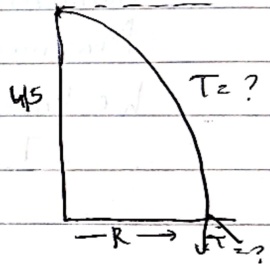
\( R = u \cdot T = 20 \times 3 = 60 \, m \)
Now, \( V_{y} = U_{y} + gt \)
\( = 0 + 10 \times 3 \) (OCR shows \( 20 + 20 \times 3 \))
\( = 50 \, m/s \) (OCR value)
Now,
Angle to made while striking \( (\theta) \) = \( \tan^{-1}\frac{V_{y}}{V_{x}} \)
\( =\tan^{-1}\left(\frac{50}{20}\right) \) (OCR: \( \frac{50}{45} \))
Projection down from building
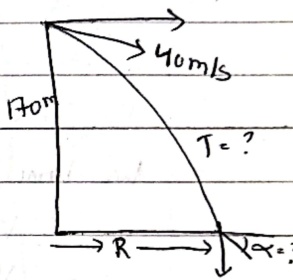
A body is projected down of an angle of 30° with the horizontal from the top of the building 170 m high. Its initial speed is 40 m/s. How long will it take before striking the ground? How far from the foot of the building the body will strike and at what angle with the horizontal.
Solution:
Angle of projection \( (\theta) = 30^{\circ} \)
Initial speed \( (u) = 40 \, \text{m/s} \)
Height of the building \( (h) = 170 \, \text{m} \) (OCR page also shows 17 m)
Time of flight \( (T) = ? \)
Horizontal Range \( (R) = ? \)
Angle made while striking \( (\alpha) = ? \)
We know,
Initial horizontal velocity \( (u_{x}) = u \cos \theta \)
\( = 40 \cos 30^{\circ} \)
\( = 34.64 \, m/s \)
Also
Initial Vertical Velocity (\( u_{y} \)) = \( u \sin \theta \)
\( = 40 \sin 30^\circ \)
\( = 20 \, m/s \)
\( V_{x}=U_{x}=34.64\,m/s \)
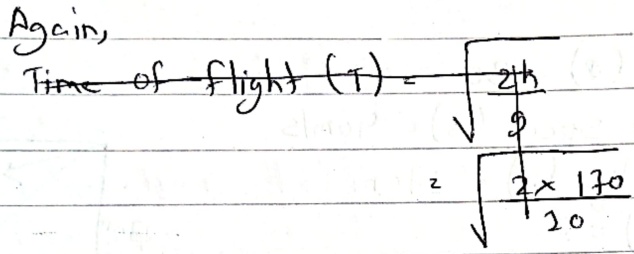
We know,
$$ \text{Range}(R)=U_{x} T $$
$$ V_{y}^{2}=U_{y}^{2}+2g h $$
$$ or,\quad V_{y}^{2}=400+2\times10\times170 $$
$$ \begin{array}{c} or, V_{y} = \sqrt{3800} \\ \therefore V_{y} = 61.64 \, m/s \end{array} $$
Again,
$$ V_{y}=U_{y}+gt $$
$$ or, 61.64=20+10t $$
$$ or, t=\frac{61.64-20}{10} $$
$$ \therefore t=4.16\ sec $$
$$ R = 34.64 \times 4.16 \approx 143.93\,m $$
Now,
$$ \tan \alpha = \frac{V_{y}}{V_{x}} $$
$$ or, \alpha=\tan^{-1}\frac{61.64}{34.64}=60.6^{\circ} $$
Projectile 320 m/s (time and range)
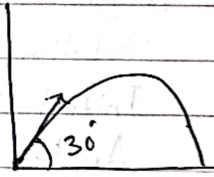
4. A projectile is fired with a velocity of 320 m/s at an angle of \( 30^{\circ} \) to the horizontal. Find (a) the time to reach its greatest height. With the same velocity, what is the range:
Solution:
Initial velocity \( (u) = 320 \, ms^{-1} \)
Angle of projection \( (\theta) = 30^\circ \)
Time taken \( (t) = ? \)
horizontal range \( (R) = ? \)
Maximum height \( (H_{max}) = ? \)
We know,
Time taken \( (T) = \frac{2u\sin\theta}{g} \)
\( = \frac{2 \times 320 \times \sin 30^\circ}{10} \)
\( = 32 \, sec \)
Now, Time taken to reach greatest height is given by;
\( \frac{T}{2} = \frac{32}{2} = 16 \, sec. \)
Again,
Horizontal Range (R) = \( \frac{u^{2}\sin2\theta}{g} \)
\( =\frac{(320)^{2}\cdot\sin2\times30}{10} \)
= 8868 m
$$ \begin{align*}\text{Maximum Range}(R_{\max})&=\frac{u^2}{g}\\&=\frac{(320)^2\times1}{10}\\&=10240\ m\end{align*} $$
Ball thrown vertically upward
5. A ball is thrown vertically upward with an initial speed of \( 20 \, m/s \). Calculate (a) The time taken to return to the thrower (b) its horizontal range. The maximum height reached.
Solution:
Initial Velocity \( (u) = 20 \, \text{m/s} \)
Angle of projection \( (\theta) = 90^\circ \)
Time of flight \( (T) = ? \)
Maximum height \( (H_{\text{max}}) = ? \)
We know.
T = \( \frac{2u\sin\theta}{g} \)
\( = \frac{2 \times 20 \times \sin 90^{\circ}}{10} \)
= 4sec.
Also,
\( H_{\max} = \frac{U^{2}\sin^{2}\theta}{2g} \)
\( = \frac{(20)^{2}\sin^{2}90^{\circ}}{2\times10} \)
= 20m
Rock thrown from roof
6. A man stands on the roof of a 25.0 m tall building and throws a rock with a velocity of magnitude 30 m/s at an angle of \( 33^{\circ} \) above the horizontal. You can ignore the air resistance. Calculate (a) the maximum height above the roof reached by the rock.
b. The magnitude of the velocity of the rock just before it strike the ground
c. The horizontal distance from the base of the building to the point where the rock strikes the ground.