Calorimetry
Calorimetry is a branch of physics which deals with the experimental techniques for quantitative measurement of heat exchange.
Principle of Calorimetry
It states that, the amount of heat lost by a hot body must be equal to amount of heat gained by a cold body.
i.e. Heat loss = Heat gain
Heat Equation
We know the amount of heat energy Q transferred to or by a body of mass 'm' to change in temperature by \( \Delta\Phi \) is:
- directly proportional to its mass, i.e. \( g \propto m^{-1} \)
- directly proportional to the change in temperature of the body i.e. \( Q \propto \Delta\Phi \) —(ii)
Combining eq. (i) and (ii) we get:
$$ Q \propto m \cdot D $$
or \( Q = S \cdot m \Delta\Phi \)
or, \( Q = mS \Delta\Phi \) [∵s = Proportional Constant]
$$ Q = mS \Delta\Phi $$
One calorie heat
It is defined as the amount of heat needed to raise the temperature of 1 gram of pure water by \( 1^{\circ} \)C.
1 cal = 4.2 Joule
Specific heat capacity
It is defined as the amount of heat needed to raise the temperature of 1 gram unit mass of substance by unity. It is given by:
Specific heat capacity depends on nature of substance and system of unit used.
Water Equivalent
It is the mass of water that will be gained or lost by the same heat as the substance for the same change in temperature.
let us suppose a substance of mass (m) and specific heat capacity s then,
$$ g = m s \Delta Q $$ for change in temperature, \( \Delta Q = Q - Q_{0}, -1 \)
Again, let water of mass (W) that absorbs Q, amount of heat for same change in temperature ( \( D_{0} < Q_{2} - Q_{1} \)) then
$$ Q = W_{Sw} \Delta Q, S_{w} = \text{Specific heat capacity of water} - 11 $$
Equating ① and ①
$$ W_{Sw} \Delta Q = M_{SW} \Delta Q - M_{SD} Q $$
$$ Q_{1}, W = \frac{M_{2}}{S_{w}} - \frac{M_{3}}{S_{w}} $$
$$ \therefore W = \frac{M_{3}}{S_{w}} $$
Specific Heat Capacity of a Solid by Mixture Method
\( m_{1} \) = mass of a solid
\( S_{1} \) = Specific heat capacity of solid
\( 0.02 \) = Initial temperature of solid
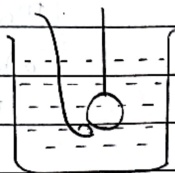
\( m_{2} = \text{mass of calorimeter with stirrer} \)
\( S_{2} = \text{Specific heat capacity of calorimeter} \)
\( O_{2}^{\circ}C = \) Temperature of Calorimeter with striver
Again
\( m_{3} = mass of water \)
\( S_{3} = temperature \ of \ Specific\ heat \ capacity\ of\ water \)
\( O_{2}^{\circ}C = temperature\ of\ water \)
\( O_{3} = Temperature\ of\ mixture \)
We know,
Heat loss = Heat loss by solid body
$$ Q_{lost} = m_{1}s_{1}(Q_{1} - Q) - (i) $$
$$ Q_{gain} = m_{2}s_{2}(Q - Q_{2}) + m_{3}s_{3}(Q - Q_{2}) $$
$$ Q_{y}Q_{gain} = (m_{2}s_{2} + m_{3}s_{3})(Q - Q_{2}) - (ii) $$
Now, By principal of Calorimetry
$$ Q_{lost} = Q_{gain} $$
$$ Q_{r}, m_{1}s_{1}(Q_{1} - Q) = (m_{2}s_{2} + m_{3}s_{3})(Q - Q_{2}) $$
$$ \therefore S_{1} = \frac{(m_{2}s_{2} + m_{3}s_{3})(Q - Q_{2})}{(Q_{1} - Q)} $$
Newton's Law of Cooling
It states that, "The rate at which of loss of heat of a liquid is directly proportional to the difference in temperature between the liquid and the surroundings.
let, -dq be the rate of loss of heat by a liquid of dt mass'm at a temperature '0' to the surrounding at temperature (0). Then,
By Newton's law of Cooling, we have,
$$ -\frac{dQ}{dt}\propto(0-Q_{0}) $$
$$ o_{1}-\frac{dQ}{dt}=k(0-Q_{0}) $$, k = Constant of proportion
Then, -ms \( \frac{dQ}{dt} \) = k \( (Q - Q_{0}) \)
Integrating both side we get,
$$ \int \frac{d\theta}{(\theta-\theta_{0})} = \int \left( \frac{-k}{ms} \right) dt $$
or, \( \log_{e} (\theta - \theta_{0}) = \frac{-k}{ms} t + c \)
Q. A newly born baby is wrapped with cotton clothes, why?
Ans: We know,
$$ \log e(0-0_{0})=-\frac{kt}{m}t+c_{0}(0)=0 $$
where k = proportional constant, depends upon;
- open surface area of a matter
- Nature of material
Also, mass of the liquid is directly proportional to the tic volume of the liquid.
Here, log ( \( \Phi-0 \)) represent change in temperature of body.
Therefore, change in temperature is inversely proportional to the length of material. i.e. change in temp. \( \alpha \)
According to the Newton's law of Cooling, change in temperature is inversely proportional to the dimension of a body or a matter. That's why a newly born babies are wrapped with cotton cloth to prevent excess heat loss.
Q. Match stick catches fire fast. Why?
Ans: According to the Newton's law of Cooling, Change in temperature is inversely proportional to the size of a substance that's why small wooden stick catches fire quickly.
Determination of Specific heat Capacity of liquid by the method of Cooling
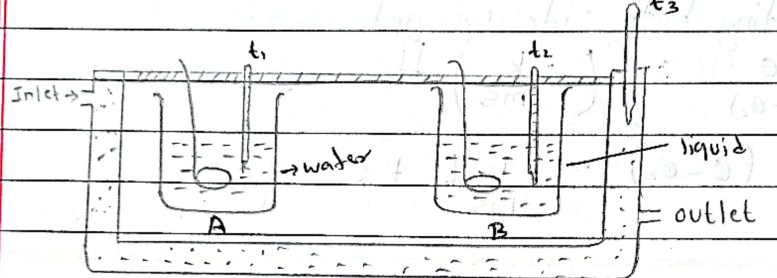
Here, let us suppose;
Mass of Calorimeter A = M_{CA}
Specific heat capacity of Calorimeter, \( A = S_{CA} \)
Mass of Water = M_{w}
Specific heat capacity of Water = S_{w}
Also
Mass of Calorimeter B = M_{CB}
Specific heat capacity of Calorimeter B < S_{CB} S_{CA}
Mass of liquid = M_{L}, Sp. heat capacity = S_{L}
Initial temperature of Calorimeter A, B, water and liquid = \( \Phi_{j}^{\circ}C \)
Also,
Time taken by calorimeter A to cool from \( 0^{\circ}C \) to \( 0_{2}^{\circ}C \) \( = t_{2} \)
Time taken by calorimeter B to cool from \( 0^{\circ}C \) to \( 0_{2}^{\circ}C \) \( = t_{2} \)
Rate of heat loss by Calorimeters A and Water
$$ = M_{CA} + S_{CA}(O_{1}-O_{2}) + M_{W}S_{W}(O_{1}-O_{2}) $$
$$ t_{1} $$
$$ Al_{SO_{4}} = (M_{CA}S_{CA} + M_{W}S_{W})(O_{1}-O_{2}) $$
$$ t_{1} $$
Again,
Rate of heat lost by Calorimeter B and liquid
$$ = M_{CB} S_{CA} (O_{1}-O_{2}) + M_{1} S_{1} (O_{1}-O_{2}) $$
$$ t_{2} $$
$$ = (M_{CB}S_{CA} + M_{1}S_{1})(O_{1}-O_{2}) $$
$$ t_{2} $$
By Newton's law of Cooling
$$ (M_{Ca}S_{Ca} + M_{WSW}) (O_{1} - O_{2}) = (M_{CB}S_{CA} + M_{ISL}) (O_{1} - O_{2}) $$
$$ t_{1} = t_{2} $$
or, \( (M_{Ca}S_{Ca} + M_{WSW}) \cdot t_{2} = M_{CB}S_{CA} + M_{ISL}M_{CS} \)
$$ t_{1} $$
or, \( M_{ISL} = t_{2} \) \( (M_{Ca}S_{Ca} + M_{WSW}) - M_{CB}S_{CA} \)
$$ t_{1} $$
$$ \therefore S_{L} = \frac{t_{2}}{t_{1}} = \frac{(M_{Ca}S_{Ca} + M_{WSW}) - M_{CB}S_{CA}}{M_{1}} $$
Here \( S_{L} \) is Specific heat capacity of liquid
Determination of Specific Latent Heat of Fusion of Ice by the method of Mixture
The amount of heat required to change the state of Substance at constant temperature is called Latent heat.
Here, Let vs suppose;
Mass of water = m_{w}
Specific heat capacity of water = S_{w}
Mass of Calorimeter = M_{c}
Specific heat capacity of Calorimeter = S_{c}
Mass of ice = m_{i}
Specific heat capacity of ice = S_{w}
Initial temp. of water, calorimeter = 0°C
Initial temp. of Ice = 0°C
Final temp. of mixture = 0°C
We know, from principal of calorimetry;
Heat lost = Heat gained
or, \( m_{w}S_{w}(Q_{1}-Q_{2}) + m_{sc}(Q_{2}-Q_{1}) = m_{c}S_{w}(Q_{2}-Q) + m_{i}L \)
or, \( (m_{w}S_{w} + m_{c}S_{c})(Q_{1}-Q_{2}) - m_{c}S_{w}(Q_{2}) = m_{i}L \)
or, \( L = (m_{w}S_{w} + m_{c}S_{c})(Q_{1}-Q_{2}) - m_{c}S_{w}Q_{2} \)
or, \( L = \frac{(m_{w}S_{w} + m_{c}S_{c})(Q_{1}-Q_{2}) - S_{w}Q_{2}}{M_{i}} \)
Here, L is the specific latent heat of fusion of ice.
Determination of Specific Latent Heat of Steam by the Method of Mixture
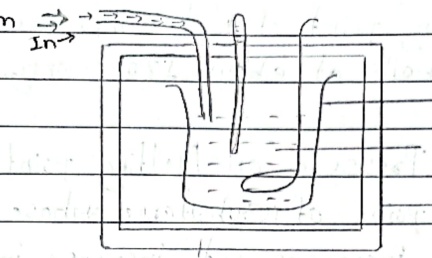
Here, let vs Suppose;
Mass of water = \(M_{w}\)
Specific heat capacity of water = \(S_{w}\)
Initial temp. of water, stirrer, calorimeter = \(0.1^{\circ}C\)
Mass of Calorimeter = \(M_{c}\)
Specific capacity of calorimeter = \(S_{c}\)
Mass of Steam = \(M_{s}\)
Specific heat capacity of steam = \(S_{w}\)
Initial temperature of steam = \(0.2^{\circ}C\)
Final temperature of mixture = \(0.2^{\circ}C\)
from principal of Calorimetry;
Heat loss = Heat gain
$$ M_{S}S_{S}\left(\Phi_{2}-\Phi_{3}\right)+M_{S}L=M_{w}S_{w}\left(\Phi_{3}-\Phi_{1}\right)+M_{c}S_{c}\left(\Phi_{3}-\Phi_{1}\right) $$
$$ \alpha_{r},M_{S}L=\left(\Phi_{3}-\Phi_{1}\right)\left(M_{w}S_{w}+M_{c}S_{c}\right)-M_{s}S_{w}\left(\Phi_{2}-\Phi_{3}\right) $$
$$ L=\frac{\left(\Phi_{3}-\Phi_{1}\right)\left(M_{w}S_{w}+M_{c}S_{c}\right)-M_{s}S_{w}\left(\Phi_{2}-\Phi_{3}\right)}{M_{s}} $$
$$ L=\frac{\left(\Phi_{3}-\Phi_{1}\right)\left(M_{w}S_{w}+M_{c}S_{c}\right)-S_{w}\left(\Phi_{2}-\Phi_{3}\right)}{M_{s}} $$
Here, L is the specific heat capacity tangent latent heat of the steam.
Effect of Pressure on Boiling Point
Boiling point increases when pressure is increased on a Substance.
Eg: Boiling point of water increases on pressure pressure Cooker: It boils at about 120°C only.
Effect of Pressure on Melting Point
The melting point of substance whose volume decreases on liquefaction, decreases with increase in pressure.
Eg: A large iceberg melts at the base but not at the top.
The melting point increases when pressure is increased on a substance whose volume increases on liquefaction.
Walking on ice surface is difficult, why?
Volume of water increases when it solidifies. In this case, melting point is inversely proportional to pressure. That's why walking on ice surface is difficult.
Walking on the ice surface was surface is easy, Why?
Volume of wax decreases when it solidifies. In this case, melting point is directly proportional to pressure. That's why walking on wax surface is "easy."
Numerical Problems
1. Copper pot and iron block
A copper pot with mass 0.5 kg contains 0.170 kg of water at \( 20^{\circ} \)C. A 0.250 kg block of iron at \( 85^{\circ} \)C is dropped into the pot. Find the final temperature of the mixture assuming no heat loss to the surrounding. (Sp. heat capacity of copper = 390 J/kg \( ^{\circ} \)C, Water = 4190 J/kg \( ^{\circ} \)C \( ^{-1} \), iron = 470 J/kg \( ^{\circ} \)C \( ^{-1} \))
Mass of Copper (M_{c}) = 0.5 kg
Mass of Water (M_{w}) = 0.170 kg
Initial temperature of water ( \( Q_{1} \)) = 20°C
Mass of iron (M_{i}) = 0.250 kg
Initial temperature of iron ( \( Q_{2} \)) = 85°C
Final temperature ( \( Q \)) = ?
We know, from principal of Calorimeter,
Heat lost by iron = Heat gained by water + Calorimeter
$$ (MS\Delta\Phi)_{iron} = (MS\Delta\Phi)_{water} + (MS\Delta\Phi)_{calorimeter} $$
or, \( 0.250 \times 470 \times (85 - \Phi) = 0.170 \times 4190 \times (0 - 20) + 0.5 \times 390 \)
$$ x(0 - 20) $$
or, \( \frac{117.5(85 - \Phi)}{117.5\Phi} = (0 - 20)(712.3 + 195) \)
$$ 0.7, \frac{9987 - 117.5\Phi}{117.5\Phi} = 907.3\Phi - 18146 $$
2. Ice cube tray
An ice cube tray of negligible mass contains 0.35 kg of water at 18°C. How much heat must be removed to cool the water to 0°C and freeze it? (Latent heat of fusion of ice is \( 3.36 \times 10^{5} \) J kg \( ^{-1} \))
Solution:
Mass of water \( (M_w) = 0.35 \, kg \)
Sp. heat of water \( (S_w) = 4200 \, \text{kg}^{-1} \, \text{K}^{-1} \)
Latent heat of fusion of ice \( (Li) = 3.36 \times 10^{5} \, \text{kg}^{-1} \)
Initial temperature \( (O_1) = 18^\circ C \)
Final temperature \( (O_2) = 0^\circ C \)
Heat to be released = ?
Now Heat removed by water while cooling from 18°C to 0°C
$$ M_{w}S_{w}(O_{1}, O_{2}) + M_{w}L_{1} $$
$$ 0.35 \times 4200 \times 18 + 0.35 \times 3.36 \times 10^{5} $$
$$ 26460 + 117600 $$
144060 J
Hence from water, \( 144060 J = 2.4 \times 10^{5} \) heat must be removed.
3. Aluminium and iron engine part
An engineer is working on a new engine design one of the moving parts contains 1.6 kg of aluminium and 0.3 kg of iron and is designed to operate at 210°C. How much heat is required to raise its temperature from 20°C to 210°C? (Sp. heat capacity of Al = 910 J kg⁻¹ k⁻¹ and Sp. of heat of Fe = 470 J kg⁻¹ k⁻¹)
Solution:
Mass of Al ( \( m_{2} \)) = 1.6 kg
Mass of Fe ( \( m_{2} \)) = 0.3 kg
Sp. heat of Al ( \( S_{1} \)) = 920 J kg⁻¹ k⁻¹
Sp. heat of Fe ( \( S_{2} \)) = 470 J kg⁻¹ k⁻¹
Initial temperature ( \( θ_{i} \)) = 20°C
Final temperature ( \( θ_{f} \)) = 210°C
Required amount of heat = Heat required to raise the temperature of Al and Fe from 20°C to 210°C
$$ m_{1}S_{1}(O_{2}-O_{1}) + m_{2}S_{2}(O_{2}-O_{1}) = (m_{1}S_{1} + m_{2}S_{2})(O_{2}-O_{1}) $$
$$ (1.6 \times 910)^{2} + 0.3 \times 470)(210 - 20) $$
303430J
3.03 \( \times 10^{5} \) J
4. Aluminium tea kettle
An aluminium tea kettle with mass 1.50 kg and containing 1.80 kg of water is placed on a stove. If no heat is lost to the surrounding how much heat must be added to raise the temperature from 20°C to 85°C [Sp. heat of \( Al = 0.20 \, \text{J} \, \text{kg}^{-1} \, \text{k}^{-1} \), Sp. heat of water = 4200 \, \text{J} \, \text{kg}^{-1} \, \text{k}^{-1}]
Solution:
Mass of Aluminium kettle (m) = 1.50 kg
Sp. of heat of aluminium (Si) = 910 J kg^{-1} k^{-1}
Mass of water (m_w) = 1.80 kg
Sp. heat of water (S_w) = 4200 J kg^{-1} k^{-1}
Initial temperature ( \( θ_i \)) = 20°C
Final temperature ( \( θ_f \)) = 85°C
Required amount of heat to raise the temperature of kettle and water from 20°C to 85°C
$$ m_s(θ_2-θ_1) + m_w S_w(θ_2-θ_1) = (m_s_1 + m_w S_w)(θ_2-θ_1) $$
$$ (1.5 \times 910 + 1.8 \times 4200) = (85-20) $$
$$ (1365 + 7560) = 65 $$
580125 J
$$ 5.8 \times 10^{5} $$ J
5. Mixing water and ice
What is the result of mixing 20g of water at 60°C with 10g of ice at -20°C. [Sp. heat of ice = 0.5 Cal g m^{-1}°C^{-1}]
Sp. heat of water = 2 Cal g m^{-1}°C^{-1}, Latent heat of ice = 80 Cal g m^{-1}°C^{-1}
Solution:
Given SP heat capacity of ice ( \( S_{i} \)) = 0.5 Cal g \( ^{-1} \)°C \( ^{-1} \)
Sp. heat capacity of water ( \( S_{w} \)) = 1 Cal g m \( ^{-1} \)°C \( ^{-1} \)
Latent heat of ice ( \( L_{i} \)) = 80 Cal g m^{-1}°C^{-1}
Temperature of ice ( \( Q_{i} \)) = -20°C
Temperature of water ( \( Q_{0} \)) = 90°C
Mass of ice ( \( M_{i} \)) = 20g
Mass of water ( \( M_{w} \)) = 20g
Here,
\( Q_{lost} \) (To reach 0°C) = \( M_{w}S_{w} \) (90 - 0)
$$ 20 \times 1 \times 90 $$
= 1800 cal
Also,
\( Q_{gain} \) (To reach 0°C) = \( M_{i}S_{i} \) [0 - (-10)]
$$ 20 \times 0.5 \times 10 + 10 \times 80 $$
$$ 50 + 800 $$
850 cal
Here, \( \mathcal{G}_{gain} = \mathcal{G}_{lost} + \mathcal{G}_{gain} \) is smaller than \( \mathcal{G}_{lost} \). So, it attains temperature of mixture \( (0^{\circ}C) \)
Now,
$$ \mathcal{G}_{lost} = M_{w} S_{w} (g_{0} - \theta) $$
$$ 20 \times 1 (g_{0} - \theta) $$
$$ 20 (g_{0} - \theta) - 1 $$
Also,
$$ \mathcal{G}_{gain} = M_{i} S_{i} [0 - (-10)] + M_{i} S_{w} (0 - 0) + M_{i} L_{i} $$
$$ 20 \times 0.5 \times 20 + 10 \times 80 + 10 \times 1 \times 0 $$
$$ 2850 + 200 - 11 $$
Now, Using principal of calorimetry;
$$ \mathcal{G}_{gain} = \mathcal{G}_{lost} $$
$$ 0r, 850 + 200 = 20 (g_{0} - \theta) $$
$$ 0r, 850 + 200 = 1800 - 200 $$
$$ 0r, 300 = 1800 - 850 $$
$$ \therefore \theta = 31.667^{\circ}C $$
Mixing ice, water and iron vessel
What is the result of mixing 100g of ice at 0°C into 100g of water at 20°C in an iron vessel of mass 100g.
[SP heat of iron = 0.1 cal g⁻¹·°C⁻¹], SP heat of latent heat of ice = 80 cal g⁻¹]
Solution:
Given, Mass of ice \( M_{ic} = 100g \)
Mass of Water \( M_{w} = 100g \)
Mass of Iron \( M_{i} = 100g \)
Specific heat of iron (s) = 0.1 cal g⁻¹·°C⁻¹
Specific latent heat of ice (L) = 80 cal g⁻¹
Result of mixing = ?
Amount of heat given by water and iron vessel from \( 20^{\circ}C \) to \( 0^{\circ}C \)
$$ M_{w}S_{w}(20-0) + M_{i}S(20-0) $$
$$ 20 \times 20 + 10 \times 0.1 \times 20 $$
2200 cal
Amount of heat required to change sec from 0°C to water at 0°C
Mic L
100×80
8000 Cal
This means amount of heat given is less than the amount of heat required. So, 2200 calorie heat can melt (m' gram of ice. So, we can write,
$$ m = 27.5 \times 10^{-3} kg $$
The amount of ice melt is 27.5g, and the final temperature of the mixture is 0°C.
S.1 Copper ball in water
S.1 A ball of copper (specific heat capacity = 400 J/kg·K) weighing 400 gram is transport from a furnace to 1 kg of water at 20°C. The temperature of water rises to 50°C. What is the original temperature of ball.
(Sp. heat capacity of water = 4200 J·kg⁻¹·K⁻¹)
Solution:
Given,
Mass of Copper \( M_{c} = 400 \, g \)
Sp. heat capacity of copper \( (S_{c}) = 400 \, J \, kg^{-1} \, K^{-1} \)
Temperature of copper ball \( (\Phi_{c}) = ? \)
Mass of water \( (M_{w}) = 2 \, kg \)
Sp. of heat capacity of water \( (S_{w}) = 4200 \, J \, kg^{-1} \, K^{-1} \)
Initial temperature of water \( (\Phi_{1}) = 20^{\circ}C \)
Final temperature of water \( (\Phi_{2}) = 50^{\circ}C \)
from principal of calorimetry;
Heat lost by copper ball = Heat gained by water
$$ M_{e}S_{e}(O_{c}-O_{2}) = M_{w}S_{w}(O_{2}-O_{1}) $$
or, \( 0.4 \times 400 (O_{c}-50) = 1 \times 4200 (50-20) \)
or, \( 160 O_{c} - 8000 = 126000 \)
$$ \therefore O_{C} = 837.5^{\circ}C $$
∴ the original temperature of ball is \( 837.5^{\circ}C \)
2. Cooling of a substance (Newton)
A substance takes 3 minutes in cooling from 50°C to 45°C and takes 5 minutes from 45°C in cooling from 45°C to 40°C. What is the temperature of its surrounding? How much time will it take to cool this substance from 40°C to 35°C?
Solution:
Given; Let \( O_{0} \) be the temperature of surrounding.
Average temperature of \( 50^{\circ}C \) and \( 45^{\circ}C = 47.5^{\circ}C \)
Average temperature of \( 45^{\circ}C \) and \( 40^{\circ}C = 42.5^{\circ}C \)
Average temperature of \( 40^{\circ}C \) and \( 35^{\circ}C = 37.5^{\circ}C \)
Time taken to cool from \( 50^{\circ}C \) to \( 45^{\circ}C = 3\ min = 180 sec \)
Time taken to cool from \( 45^{\circ}C \) to \( 40^{\circ}C = 5\ min = 300 sec \)
Time taken to cool from \( 40^{\circ}C \) to \( 35^{\circ}C \) ( \( t_{3} \)) = ?
Now,
\( 1^{st} \) Case — When Substance cools from 50°C to 45°C
from Newton's law of cooling
$$ m_{s}\left(\frac{d\theta}{dt}\right)_{1} = -k(47.5 - \theta_{0}) $$
$$ m_{s}\left(\frac{5}{180}\right) = -k(47.5 - \theta_{0}) $$ —①
Also \( 2^{nd} \) Case — When Substance cools from 45°C to 40°C
$$ m_{s}\left(\frac{d\theta}{dt}\right)_{2} = -k(42.5 - \theta_{0}) $$
on Ms \( \left(\frac{45-40}{300}\right) = -k(42.5 - \theta_{0}) \) —②
Dividing equation ① by ②
$$ Ms\left(\frac{5}{180}\right) = -k(47.5 - \theta_{0}) $$
$$ Ms\left(\frac{5}{300}\right) = -k(42.5 - \theta_{0}) $$
$$ a_{1} = \frac{5}{180} \times \frac{300}{5} = \frac{47.5 - \theta_{0}}{42.5 - \theta_{0}} $$
$$ \therefore \theta_{0} = 35^{\circ}C $$
Also, \( 30^{\circ}Case \) When substance cools from \( 40^{\circ}C \) to \( 35^{\circ}C \)
$$ Ms\left(\frac{d\theta}{dt}\right) = -k(37.5 - \theta_{0}) $$
$$ o_{1}Ms\left(\frac{40-35}{t_{3}}\right) = -k(37.5 - \theta_{0}) $$ —③
Dividing eq. (iii) by ①
$$ Ms\left(\frac{5}{t_{3}}\right) = \frac{-k(37.5 - \theta_{0})}{47.5 - \theta_{0}} $$
$$ Ms\left(\frac{5}{180}\right) $$
$$ o_{1}\frac{5}{t_{3}} \times \frac{180}{5} = \frac{37.5 - 35}{47.5 - 35} $$
$$ t_{3} = 900 $$ Sec = 15 min.
3. Liquid cooling
A liquid takes 2.5 minutes in cooling from 60°C to 55°C and takes 3 minutes in cooling from 55°C to 50°C. What is the temperature of the surrounding? How much time will it take to cool from 50°C to 45°C.
Solution:
Let \( O_{0} \) be the surrounding temperature.
Case-I
Time taken to cool from \( 60^{\circ}C \) to \( 55^{\circ}C \) = 2.5 minutes
Temperature of Substance ( \( \Omega_{0} \)) = \( \frac{60 + 55}{2} \) = 57.5°C
Change in temperature ( \( d\Omega_{2} \) = 5°C
Using Newton law of cooling
$$ m s\left(\frac{d\theta}{dt}\right)_{1} = -k\left(\theta_{1} - \theta_{0}\right) $$
$$ m s\frac{5}{2.5} = -k(57.5 - \theta_{0}) $$ — ①
Case-II
Time taken to cool from \( 55^{\circ}C \) to \( 50^{\circ}C \) ( \( t_{2} \)) = 3 min.
Temperature of Substance \( C_{2} \) = \( \frac{55 + 50}{2} \) = 52.5°C
Change in temperature ( \( d\theta)_{2}=5^{\circ}C \) from Newton law of cooling
$$ M_{S}\left(\frac{d\theta}{dt}\right)_{2}=-k(O_{2}-O_{0}) $$
$$ m M_{S}\frac{5}{3}=-k(52.5-G_{0}) $$ —②
Solving equation ① and ② by dividing
$$ \frac{ms}{\frac{2.5}{ms}\left(\frac{5}{3}\right)} = \frac{-k(57.5 - \theta_0)}{-k(52.5 - \theta_0)} $$
$$ 0.1 \frac{5}{2.5} \times \frac{3}{5} = \frac{57.5 - \theta_0}{52.5 - \theta_0} $$
$$ 0.11157.5 - 3\theta_0 = 243.75 - 2.5\theta_0 $$
$$ \theta_0 = 27.5^\circ C $$
Again, Case -III
Temperature of Surrounding \( (0_{0}) = 270^{\circ}C \)
Time taken to cool from \( 50^{\circ}C \) to \( 45^{\circ}C \) \( (t_{3}) = ? \)
Temperature of Substance \( (0_{3}) = 47.5^{\circ}C \)
Using Newton law of cooling;
$$ Ms\left(\frac{d\theta}{dt}\right)_{3} = -k(Q_{3} - Q_{0}) $$
$$ 0_{3} Ms\frac{5}{t_{3}} = -k(30) $$ — ③
Dividing equation ③ by ② we get
$$ \frac{5}{t_{3}} \times \frac{3}{5} = \frac{20}{25} $$
$$ 0_{3} 3 = 1.2t_{3} 0.8t_{3} $$
$$ t_{3} = 2.5\min 3.75\ min $$
4. Electric heater
An electric heater of power 1000 W raises the temperature of 5 kg of liquid from 25°C to 31°C in 2 minute. Calculate the heat capacity of liquid and its specific heat. Solution:
Mass of liquid (M) = 5 kg
Time taken (t) = 2 min = 120 sec
Change in temperature ( \( \Delta\theta \)) = 6°C
Heat Capacity (Ms) = ?
Specific heat (s) = ?
We know,
$$ P = \frac{W}{t} $$
$$ W = P \times t $$
$$ 2 \times 1000 \times 120 $$
$$ 2120000 $$
$$ 9 = MS\Delta O $$
$$ 120000 = 5 \times 5 \times 6 $$
$$ S = \frac{120000}{30} $$
Also,
Heat capacity / Thermal capacity = m×s
$$ 25 \times 4000 $$
$$ 20000 J k^{-1} $$
5. Specific heat of metal
A metal of mass 25g at a temperature of 100°C is dropped into a calorimeter containing 200g of water initially at 20°C. The final temperature is 22°C. Compute the specific heat capacity of the metal if the water equivalent of the calorimeter is 10g.
Let S be the specific heat capacity of metal.
Mass of metal \( m_{2} = 25 \, g \)
Water equivalent of calorimeter \( m_{2} = 10 \, g \)
Mass of water \( m_{3} = 200 \, g \)
Final Initial temperature of metal \( (\omega_{0}) = 20 \, ^{\circ}C \)
Final temperature of mixture \( (\omega) = 22 \, ^{\circ}C \)
Initial temperature of water + calorimeter \( (\omega_{2}) = 20 \, ^{\circ}C \)
Specific heat capacity of water \( S_{w} = 1 \, Cal \, g m^{-1} o^{-1} \)
Specific heat capacity of metal \( S \)
Using Principal of Calorimetry;
Heat lost by metal = Heat gained by water + Calorimetry
or \( M_{1}S\Delta O_{1} = M_{3}S_{w}\Delta O_{2} + M_{2}S_{w}\Delta O_{3} \)
or \( M_{1}S(25 \times S \times 78 = 200 \times 1 \times 2 + 10 \times 1 \times 2 \)
or \( 1950S = 410 \)
$$ \therefore S = 0.21 \operatorname{Cal} g m^{-1} o c^{-1} $$
Aluminium bucket and iron block
An aluminium bucket of mass 0.5kg contains 0.2kg of water at 20°C. A block of iron of mass 0.2kg at 100°C is gently put into the water. Find the equilibrium temperature of the mixture. [sp. of heat Al = 910Jkg⁻¹] and of iron = 470Jkg⁻¹
Solution:
Mass of iron \( (M_{i}) = 0.2 \, kg \)
Mass of Aluminium bucket \( (Ma) = 0.5 \, kg \)
Mass of Water \( (Mw) = 0.2 \, kg \)
Initial temp. of Al bucket and water \( (O_{1}) = 20 \, ^\circ C \)
Initial temp. of iron block \( (O_{2}) = 100 \, ^\circ C \)
Sp. heat of Al(sa)g10 Jkg^{-1}k^{-1}
Sp. heat of iron(si)=470 Jkg^{-1}k^{-1}
Sp. heat of water(su)=4200 Jkg^{-1}k^{-1}
Final temperature of mixture (O)=?
from Principal of Calorimetry;
Heat lost by iron ball = Heat gain by water + bucket
or, \( M_{i}Si \Delta\Phi_{i} = M_{w}S_{w} \Delta\Phi_{2} + M_{A}S_{A} \Delta\Phi_{3} \)
or, \( 0.2 \times 470 \times (0 - 100 - \Phi) = 0.2 \times 4200 (0 - 20) + 0.5 \times 910 (0 - 20) \)
or, \( 94 (100 - \Phi) = (0 - 20) (840 + 455) \)
or \( 9400 - 940 = 12950 - 25900 \)
or \( \frac{35300}{1380} = \Phi \)
$$ 0.0 = 25.41^{\circ}K $$
$$ O=25.41^{\circ}K $$
The final temperature of mixture is \( 25.41K \)
Solid melting ice
A solid mass of mass 200g is heated to temperature at 8 and is found to melt just 40g of ice. (sp.Latent) heat of ice = 3.36×10^5 Jkg^-1]. Calculate specific heat of ice-Solid
Solution:
Mass of Solid \( (M_{0}) = 200\text{gm} = 0.2\text{kg} \)
Mass of Ice \( (M_{i}) = 40\text{gm} = 0.04\text{kg} \)
Latent heat of fusion \( (Lf) = 3.36 \times 10^5\text{Jkg}^{-1} \)
Specific heat capacity of Solid(s) = ?
Change in temp. \( (D\theta) = 80^\circ\text{C} \)
We know,
Heat Supplied by Solid = Heat required to melt ice
on \( M_{0}S\Delta D\theta = M_{0}Lf \)
on \( 0.2 \times S \times 80 = 0.04 \times 3.36 \times 10^5 \)
$$ S = 840\text{Jkg}^{-1} $$
Hence, the specific heat capacity of Solid is \( 840\text{Jkg}^{-1} \).
8. Mixing water and ice at −10°C
What is the result of mixing 20 gm of water at 80°C of ice at -10°C. [sp. heat of ice = 0.5 calgm⁻¹]
Solution:
Mass of water \( M_{1} \) = 20 gm
Initial temp. of water \( (\phi_{1}) = 80^{\circ} \)C
Sp. heat capacity of water \( S_{1} \) = 1 calgm⁻¹°C⁻¹
Mass of ice \( M_{2} \) = 40 gm
Tempt. of ice \( (\phi_{2}) = -10^{\circ} \)C
Sp. heat capacity of ice \( S_{2} \) = 0.5 calgm⁻¹°C⁻¹
Latent heat of fusion of ice \( Lf \) = 80 calgm⁻¹
Heat supplied by water when it changes its temperature from \( 80^{\circ} \)C to \( 0^{\circ} \)C
$$ M_{1}S, D\Phi $$
$$ 20 \times 2 \times (80 - 0) $$
2600 cal.
Heat required by ice to change its temperature from -10°C to 0°C is
$$ M_{2}S_{2}\Delta O_{2} $$
$$ 40 \times 0.5 \times [0 - (-10)] $$
$$ 40 \times 0.5 \times 10 $$
= 200 cal.
Heat req. by ice at 0°C to change its state to water at 0°C is
$$ m_{2}l f $$
3200 cal.
Hence, the heat supplied by water at 80°C is not enough to melt all ice.
Let Mi be the mass of ice which is melted by the Supplied heat is;
Mi Lf = (1600 - 200)
on Mix80 = 1400
Mi = 17.5 gm
Now, Mass of water = (20 gm + 17.5 gm) = 37.5 gm
Rest mass of ice = (40 - 17.5) gm = 22.5 gm
9. Ice into water in iron vessel
What is the result of mixing 100 gm of ice at 0°C into 100°C of water at 20°C in a iron vessel of mass 100 gm.
[sp. heat capacity of iron = 0.1 cal g m^{-1} o^{-1}], [Latent heat of fusion of ice = 80 cal g m^{-1}].
Mass of ice \((M_{i})\) = 100 g
Initial temp. of ice \((0_{i}) = 0^{\circ}C\)
Latent heat of fusion of ice \((L_{f}) = 80 \, \text{cal} \, \text{g} \, \text{m}^{-1}\)
Mass of water \((M_{w}) = 100 \, \text{g} \, \text{m}^{-1}\)
Mass of iron vessel \((M_{w}) = 100 \, \text{g} \, \text{m}^{-1}\)
Sp. heat capacity of water \((S_{1}) = 1 \, \text{cal} \, \text{g}^{-1} \, \text{°C}^{-1}\)
Sp. heat capacity of iron \((S_{2}) = 0.1 \, \text{cal} \, \text{g}^{-1} \, \text{°C}^{-1}\)
Initial temp. of iron vessel and water \((0_{2}) = 20^{\circ}C\)
heat lost by water and vessel at \( 20^{\circ}C \) to reach \( 0^{\circ}C \).
$$ M_{w}S_{1}\Delta O_{1} + M_{v}S_{2}\Delta O_{2} $$
$$ 200 \times 2 \times 20 + 200 \times 0.2 \times 20 $$
2 2200 cal.
Heat required by ice to change its state at 0°C.
Mills
= 200 \times 80
28000 cal
Heat lost is less than heat required by ice to melt. Let M be the mass of ice melt by supplied heat i.e. MLf = 2200
or, \( M \times 80 = 2200 \)
$$ \therefore M = 27.5 \, gm $$
Here,
Mass of ice left over = 100 - 27.5
272.5 g/mol
Mass of water = 200 + 27.5
2127.5 g/mol
Temperature of mixture = 0°C.
10. Steam into ice and water
10 gm of steam at 100°C is passed into a mixture of 100 gm of water and 5 gm of ice at 0°C. Find the resulting temperature of the mixture.
Solution:
Mass of Steam \( M_{1} \) = 10 gm
Latent heat of Vaporization \( L_{V} \) = 540 cal g \( ^{-1} \)
Mass of Water \( M_{2} \) = 100 g
Sp. heat Capacity of Water \( S_{w} \) = 1 cal g \( ^{-1} \)
Mass of ice \( M_{3} \) = 5 gm
Latent heat of fusion \( L_{f} \) = 80 cal g \( ^{-1} \)
Temperature of Steam \( O_{1} \) = 100°C
Temperature of Water \( T_{ice} \) \( O_{2} \) = 0°C
Let final temperature of mixture be 0°C.
We know,
Heat lost by steam at 100°C, when it changes at to water at 0°C is;
$$ M_{1}L_{v} + M_{2}S_{w}(100 - \phi) $$
$$ 200 \times 10 \times 540 + 10 \times (100 - \phi) $$ — ①
Heat loss by gained by water at \( 0^{\circ}C \) to change its temperature to \( 0^{\circ}C \) is;
$$ M_{2}S_{w}(0-0) $$
$$ 100 \times 10.1 \times 0 $$
$$ 100 \odot -11 $$
Heat gained by ice at \( 0^{\circ}C \) to change into \( 0^{\circ}C \) water;
$$ M_{3}L_{F} + M_{3}S_{W} (Q - Q) $$
$$ 2.5 \times 80 + 5 \times 6 $$
$$ 2.400 + 50 $$ — (III)
we know,
Heat loss = Heat gain
$$ 10 \times 540 + 10(100 - @) = 100 @ + 400 + 5 @ $$
or, \( 5400 + 1000 - 10 @ = 105 @ + 400 \)
on \( 6000 = 5 @ 125 @ 115 @ \)
∴ \( 6 = 52.17^{\circ}C \)
Calorimeter with steam
A calorimeter of mass 500 g m^2 contains 200 g m^2 of water and 40 g m^2 of ice. 2 g m^2 of steam at 100°C is passed into it. What is the final result? [Sp. heat of calorimeter = 400 J kg^-1 kJ/mol]
[Latent heat of fusion = 3.36 × 10^5 J kg^-1, Latent heat of steam = 2.268 × 10^6 J kg^-1]
Solution:
Mass of Calorimeter \( M_c = 500 \, \text{g} \, \text{m}^{-2} = 0.5 \, \text{kg} \)
Mass of Water \( M_w = 200 \, \text{g} \, \text{m}^{-2} = 0.2 \, \text{kg} \)
Mass of ice \( M_i = 40 \, \text{g} \, \text{m}^{-2} = 0.04 \, \text{kg} \)
Mass of Steam \( M_{s} \) = 2 g m = 0.002 kg
Temperatures of Steam \( (Q_{1}) \) = 100°C
Sp. heat capacity of water \( (S_{w}) \) = 4200 J kg \( ^{-1} \) k \( ^{-1} \)
Sp. heat of Calorimeter \( (S_{c}) \) = 400 J kg \( ^{-1} \) k \( ^{-1} \)
Latent heat of fusion \( (L_{f}) \) = 3.36 × 10 \( ^{5} \) J kg \( ^{-1} \)
Latent heat of Vaporization \( (L_{v}) \) = 2.26 × 10 \( ^{6} \) J kg \( ^{-1} \)
Now
Heat lost by steam to change in 0°C water is;
$$ M_{s}L_{v} + M_{s}S_{w}\Delta Q_{1} $$
$$ 0.002 \times 2.268 \times 10^{6} + 0.002 \times 4200 \times 100 $$
5360 J 5376 Joule
Heat gained by ice at \( 0^{\circ}C \) to form water of \( 0^{\circ}C \)
2 Mwt Mif
2 0.04 \( \times \) 3.36 \( \times \) 10 \( ^{5} \)
2 13440 Joule
Heat is not sufficient to melt all the ice. Now, let M be the mass of water that melt ice that melts by the applied heat. Then;
MLf = 5376
$$ M \times 3.36 \times 10^{5} = 5376 $$
$$ \therefore M = 0.016 \, g/kg $$
$$ = 26 \, g/m $$
Now,
Weight of ice left over = 40 - 16
= 24 g m
Weight of Water = 200 g + 16 g m + 2 g m = 218 g m
12. Height for ice to melt
From what height a block of ice be dropped in order that it may completely melt. It is assumed that 20% of energy of fall is retained by ice. [Latent heat of fusion = \( 3.36 \times 10^{5} \) J kg \( ^{-1} \)]
Mass of ice (m) be (m)
Latent heat of fusion (Lf) = 3.36 × 10^{5} J kg^{-1}
Let the required height be'h'
According to question:
or, \( \frac{3.36 \times 10^{-5} \times 100}{20 \times 10} \) = h
$$ \therefore h=268000m $$
13. Specific heat of liquid by cooling
A copper calorimeter weighing 53.2 g is first filled with water then with a liquid. Time taken to cool from \( 40^{\circ} \)C to \( 32^{\circ} \)C in both cases is 4 min and 3 min, respectively. The mass of water is 25 g and that of liquid is 30 g. Calculate the specific heat capacity of the liquid.
[Sp. heat of copper = 0.094 calg m \( ^{-1} \) \( c^{-1} \)]
Solution:
Mass of Copper \( M_{c} = 53.2 \, gm \)
Mass of water \( M_{w} = 25 \, gm \)
Mass of liquid \( M_{l} = 30 \, gm \)
Change in temp. \( (\Delta \phi) = 8^{\circ}C \)
Time taken by water to cool \( t_{1} = 4 \, min = 240 \, sec \)
Time taken by liquid to cool \( t_{2} = 3 \, min = 180 \, sec \)
Sp. heat of calorimeter \( S_{c} = 0.094 \, cal \, g m^{-1} \, o C^{-1} \)
Sp. heat of water \( S_{w} = 1 \, cal \, g m^{-1} \, o C^{-1} \)
Sp. heat capacity of liquid \( S_{l} = ? \)
We know,
Rate of heat lost by water = Rate of heat lost by and calorimeter liquid + calorimeter
$$ o_{1} \left( \frac{d\phi}{dt} \right)^{w} = \left( \frac{d\phi}{dt} \right)^{L} $$
$$ o_{1} \left( \frac{m_{w} S_{w} + m_{c} S_{c} \right) \left( \theta_{2} \Delta \phi \right) = \left( M_{c} S_{c} + M_{c} S_{L} \right) \Delta \phi $$
$$ t_{1} = t_{2} $$
$$ o_{1} \left( 25 \times 1 + 53.2 \times 0.094 \right) = (53.2 \times 0.094 + 30 \times 5) \delta $$
$$ 240 $$
$$ o_{1} \left( 25 + 5.0008 \right) 18 = 120.0192 + 720 \, SL $$
$$ o_{1} \frac{419.9952}{720} = SL $$
$$ \therefore SL = 0.58 \, Cal \, g m^{-1} \cdot K^{-1} $$
$$ \therefore $$ The specific heat capacity of liquid is \( 0.58 \, cal \, g m^{-1} \cdot °C^{-1} \).
14. Ice dropped into water
So gm of ice at -6°C is dropped into at 0°C water at 0°C. How many gram of water freezes. (sp. heat capacity of ice = 2000 J kg⁻¹°C⁻¹, Latent heat of ice = \( 3.36 \times 10^{-5} \) J kg⁻¹)
Solution:
Mass of ice ( \( m_{i} \)) = 50 g m = 0.05 kg
Initial temperature of ice ( \( c_{0} \)) = -6°C
Initial temperature of water ( \( c_{0} \)) = 0°C
Specific heat capacity of ice ( \( S_{i} \)) = 2000 J kg⁻¹°C⁻¹
Latent heat of fusion ( \( L_{f} \)) = \( 3.36 \times 10^{5} \) J kg⁻¹
Mass of water freezed ( \( M \)) = ?
Now,
Amount of heat gained by ice at -6°C to change in 0°C is given by:
$$ M_{i}S_{i}\Delta\phi = \phi_{1} $$
$$ 0.05 \times 2000 \times 6 = \phi_{1} $$
Let 'm' be the mass of water that freezes, then amount
Now, Q = M l f of heat lost by water at 0°C to change its it \( \rightarrow \) to ice at 0°C is given by;
$$ Q_{2} = M l f $$ —②
from eq (i) and (ii)
on \( 600 = 0.05 M \times 3.36 \times 10^{5} \)
or, \( M = 2.79 \times 10^{-3} kg \)
Hence, the amount of ice water that freezes is \( 2.79 \times 10^{-3} kg \).