Prism
Prism is a wedge shaped transparent refracting medium bounded by two plane surfaces inclined to each other at some angle. The angle
Prism is a wedge shaped under by two plane. Some angle. The angle between refracting faces of prism is called angle of prism. It is denoted by 'A'.
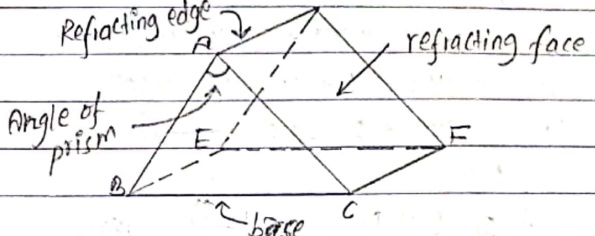
refracting face
Fig: A glass prism
Refraction through prism
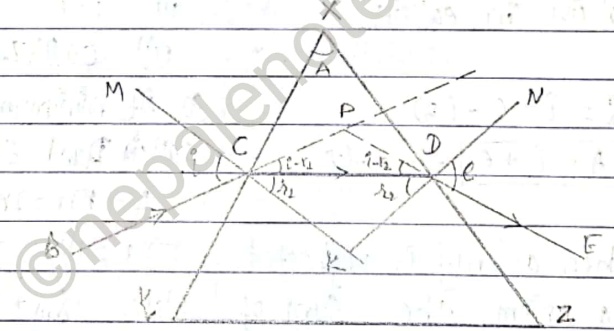
FIG. Refraction through prism
Let us consider a glass prism having angle of prism'A'. Suppose a ray of light 'Be' incident on face 'xx' of the prism at an angle of incident 'i' and get refracted inside the glass along CD at angle 'ri' and incident on other face xz at angle 'r'.
Which finally emerged out along DE at angle of emergence 'e'. Also Let 'δ' be the angle of deviation.
From figure
$$ PCD = 1 - x_{1} $$
and, $$ x_{pDC} = e - x_{2} $$
Again, In $$\Delta PCD$$,
$$\delta = \overrightarrow{l} - r_{1} + e - \lambda_{2}$$
$$\Rightarrow \delta = \overrightarrow{l} + e - (\lambda_{2} + \lambda_{1}) - \overrightarrow{l}$$
Also, In quadrilateral $$x(KD)$$;
$$x(KD) + x(CD) + x(ck + x(x))k = 360^{\circ}$$
$$x(KD) + A + 90^{\circ} + 90^{\circ} = 360^{\circ}$$
$$x(KD) + A = \perp 80^{\circ} - \overrightarrow{(ii)}$$
Also,
In $$\Delta CKD$$;
$$x(KD) + r_{1} + r_{2} = 180^{\circ} - (\overrightarrow{l} \cdot \Delta = 180^{\circ})$$
From $$eq^{n}$$ (iii) & (iii)
$$\Rightarrow A = r_{1} + r_{2} - \cdots - (\overrightarrow{iv})$$
Using $$eq^{n}$$ (iv) in $$eq^{n}$$(i);
We get,
$$\delta = \overrightarrow{l} + e - (A)$$
$$\Rightarrow [\delta + A = \overrightarrow{l} + e] \rightarrow \cdots \rightarrow (v)$$
Thus, when a ray is refracted through a prism, the sum of angle of incidence and angle of emergence is equal to sum of angle of deviation and angle of that prism.
Minimum Deviation
When angle of incidence δ is increase generally the angle of deviation δ first decreases and become minimum at particular angle
Fig: Plot between δi
Called Minimum deviation (δm) as shown in figure.
Condition for minimum deviation:
- $$ r_{1} = r_{2} = r $$ (say)
- i = e
- CD//xz
So, At minimum deviation condition, eq(iv) and eq(v) becomes
$$ A = r + r = 2r $$
$$ \Rightarrow r = A_{2} - (N_{i}) $$
Now, $$ \delta_{m} + A = i + i $$
$$ \Rightarrow i = \frac{\delta_{m} + A}{2} - (N_{i}) $$
Again, Refractive index of prism be,
$$ a \parallel g = \frac{\sin i}{\sin x} $$
$$ \Rightarrow a \parallel g = \frac{\sin \left( \frac{\delta_{m} + A}{2} \right)}{\sin A_{2}} $$
Which required relation.
Deviation produced by small angled prism
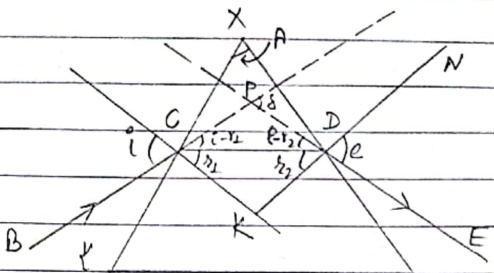
$$ \text{In}\Delta P C D $$
$$ \delta = i - r_{1} + e - r_{2} $$
$$ \Rightarrow S=\mathrm{t}+\mathrm{e}-(x_{1}+r_{2}) $$
$$ Fig1: Refraction through \rho_{lim} $$
In the figure,
At face x, Refractive index of glass,
$$ u = \frac{\sin i}{\sin x} $$
For small angle prism, $$ \sin i \approx i \Delta \sin r_{1} \approx r_{1} \Rightarrow u = r_{1} $$
$$ \Rightarrow i = \mu r_{1} - (i \overrightarrow{r}) $$
Also, At face xZ, Refractive index of Glass.
$$ u = \frac{\sin e}{\sin a} $$
For small angle prism,
$$ \sin e \approx e $$ & $$ \sin r_{2} \approx r_{2} $$
$$ U\sin\beta\ e q(ii)\&(iii) $$ in $$ eg^{\prime}(i) $$
$$ \Rightarrow u = \frac{e}{k_{2}} $$
$$ \Rightarrow e = \mu r_{2} - (11i) $$
$$ \begin{aligned} \delta & = \mu (r_{1} + \mu (r_{2} - (\lambda_{1} + \lambda_{2})) \\ & = \mu (r_{1} + \lambda_{2}) - (\lambda_{1} + \lambda_{2}) \\ & = (\lambda_{1} - 1) (\lambda_{2} + \lambda_{2}) \end{aligned} $$
$$ \sin\theta\text{ce,}A=\text{+}\pi_{2} $$
$$ \rightarrow\delta=(u-1)A $$
$$ \Rightarrow \sqrt{\delta = A(\mu - 1)} \longrightarrow (iv) $$
which is required relation for deviation produced by small angled prism.
Cases of grazing
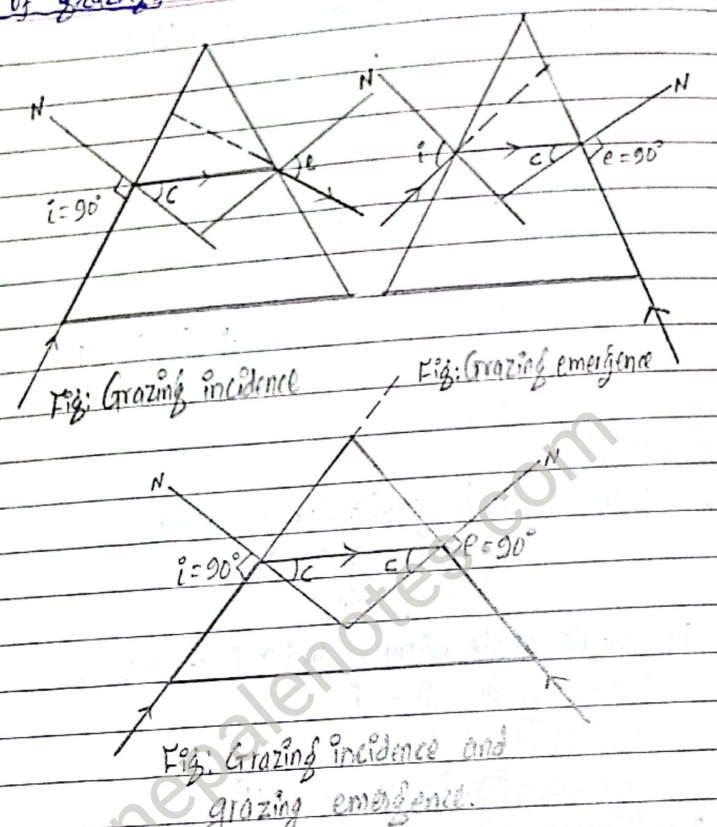
Fig: Grazing incidence
Fig: Grazing emergence
Fig. Grazing incidence and grazing emergence.