Nuclear physics
Nuclear physics: The branch of physics which deals about nucleus of an atom, its constituent, its properties, its function, etc.
Nucleus: The highly concentrated positively charged mass situated at the centre of an atom is known as nucleus. It was first discovered by Rutherford.
Nucleons: The particles found inside the nucleus is called nucleons. These are protons and neutrons.
Representation of a Nucleus
It is represented as:
Where, x is the representation of element.
- \(Z\) = atomic no. = proton no.
- \(A\) = mass no.
Atomic no. (\(Z\)) = The no. of protons present in the nucleus is the atomic no. of the nucleus. It is denoted by \(Z\).
Mass no. (\(A\)) = The total no. of protons and neutrons present in the nucleus gives the mass no. of that nucleus. It is denoted by \(A\). The mass no. of nucleus is the total no. of nucleons present in the nucleus.
\(\therefore\) no. of neutrons = mass no. − atomic no.
\(\therefore\) no. of neutrons = \(A - Z\)
Properties of nucleus
- Shape and Size: It is spherical in shape and its diameter is nearly equal to \(10^{-15}\,m\) (\(10^{-14}\,m\) to \(10^{-15}\)).
Note: \(1\,\text{fermi} = 10^{-15}\,m\) - Charge: Since protons and neutrons are present in the nucleus where neutrons are chargeless (Neutron) particles and protons are positively charged particles. So, Nucleus becomes positively charged particles.
- Mass (\(M_{N}\)): Mass of a nucleus is equal to the sum of masses of protons and neutrons present in that nucleus.
\(m_{n}\) be the mass of neutron,
\(M\) be the mass of protons and \(N\) be the no. of neutrons.
Then, in a nucleus,
→ Mass of all protons = \(M m_{p}\)
→ Mass of all neutrons = \(N m_{n}\)
\(\therefore\) Mass of nucleus \(M_{N} = M m_{p} + N m_{n}\)
If mass of protons and mass of neutrons are equal and let, denoted by \(m_{p}\) then mass of nucleus becomes,
\(M_{N} = (M + N)m_{p}\)
$$M_{N} = A m_{P}$$
where, \(A\) = mass number - Volume: Since, Nucleus is spherical in shape. It's volume can be determined as:
\(V = \frac{4}{3} \pi R^{3}\)
Where, \(R\) = radius of nucleus
It is found that the radius (\(R\)) of nucleus depends upon mass no. of the nuclei with an empirical relation given as,
$$R = R_{0} A^{\frac{1}{3}}$$
$$R_{0} = 1.2 \times 10^{-15} m$$
$$\text{Note:- atomic radius} \approx 10^{-10} m$$
$$V=\frac{4}{3}\pi(R_{0}A^{1/3})^{3}$$
$$\therefore V = \frac{4}{3} \pi R_{0}^{3} A$$
from above relation, it is cleared that volume of nucleus is directly proportional to the mass no. of the nucleus. i.e. with the increase in mass no. the volume of nucleus increases. - Density (\(S_{N}\)): The density of nucleus is caused by nuclear density and given as:
Nuclear density \(S_{N} = \frac{mass}{volume}\)
$$\text{or, } S_{N} = \frac{A \, m_{p}}{\frac{4}{3} \pi R_{0}^{3} A}$$
$$S_{N} = \frac{3 m_{P}}{4 \pi R_{0}^{3}}$$
From above relation, it is clear that nuclear density is a constant quantity that is doesn't depend upon mass no. of the nucleus.
Calculation for nuclear density
We know,
\(S_{N}=\frac{3M_{P}}{4\pi R_{0}^{3}}\)
\(\text{ex, } S_{N} = \frac{3 \times 1.67 \times 10^{-27}}{4 \times \frac{22}{7} \times (1.2 \times 10^{-15})^{3}}\)
\(R_{0}=1.2\times10^{-15}\)
\(S_{N}=2.30626\times10^{17}kg/m^{3}\) — ①
The value of eq.(1) is same for all nucleus.
We know that the density of iron = 7800 kg/m³. Now, it is found that the density of nucleus is \(2.95 \times 10^{13}\) times greater.
Nuclear force
→ Although nucleus contains some charge particles, they stick together irrespective of coulomb repulsive force between them. A new kind of force found inside the nucleus called nuclear force. Therefore these force is one of the strongest forces in the nature. It is attractive force. There is a demerit of this force i.e. it is a short range force.
Isotopes
→ The nucleus having same atomic number but different mass no. are called isotopes.
eg: \(_{92}U^{235}\), \(_{92}U^{238}\)
\(_{6}C^{11}\), \(_{6}C^{12}\), \(_{6}C^{14}\), \(_{6}C^{15}\)
Atomic mass unit (amu)
- To measure the mass of very small particles (microscopic particles), a new kind of unit for mass is introduced called atomic mass unit (amu).
- The amu is defined as the mass of \(\left( \frac{1}{12} \right)^{th}\) part of \(C^{12}\) carbon atom.
\(1\,\text{amu} = \frac{1}{12} \times\) mass of one \(C^{12}\) atom
We know, from Avogadro's hypothesis.
\(12 \, g \, of \, C^{12} \, atom \, contains = 6.023 \times 10^{23} \, no. \, of \, C^{12} \, atoms.\)
\(6.023 \times 10^{23} \, C^{12} \, atom \, have \, mass \, 12 \, g\)
\(1 \, C^{12} \, atom \, have \, mass \, \frac{12}{6.023 \times 10^{23}} \, g\)
$$\frac{1}{12} \text{ of } C^{12} \text{ atom have mass } = \frac{1}{12} \times \frac{12}{6.023 \times 10^{23}}$$
We know, \(1 \text{ amu} = 1.66 \times 10^{-27} \text{kg}\)
So, \(1 \text{ amu} = \frac{1}{12} \text{ C}^{12} \text{ atom}\).
Mass defect and binding energy packing fraction
→ It is found that the mass of a nucleus is slightly less than the sum of masses of their constituents. This difference in mass is called mass defect. Which can be written as:
\(\therefore\) mass defect (\(\Delta m\)) = (mass of all protons + mass of all neutrons) − mass of nucleus.
→ The mass defect per nucleon is known as packing fraction.
\(\therefore P.F = \frac{\Delta m}{A}\)
where \(A\) = mass no.
Binding energy
The minimum energy required to break up a nucleus into its constituent is called binding energy.
Binding energy per nucleon is called average binding energy. Which gives the stability of nucleus. It is found that binding energy of a nucleus is numerically equal to the energy equivalent of mass defect.
average binding energy = \(\frac{\text{binding energy (B.E)}}{\text{mass number (A)}}\)
Mass energy equivalent
Einstein suggested that mass and radiation are the two basic form of energy exists in the nature and energy neither be created nor be destroyed that means one form of energy can be changed into another form. According to him, the change in mass leads to change in energy and further equivalent energy of given change of mass, he gave a formula given as:
Here, \(\Delta m = 1 \, \text{amu} = 1.66 \times 10^{-27} kg\) → Energy equivalent for amu, \(C = 3 \times 10^{8} m/s\)
\(\therefore \Delta E = 1.66 \times 10^{-27} \times (3 \times 10^{8})^{2}\)
\(\Delta E = 1.49 \times 10^{-10}\) joule.
charge of electron = \(1.602 \times 10^{-19}\) coulomb.
\(\frac{\Delta E}{e} = \frac{1.49 \times 10^{-10}}{1.602 \times 10^{-19}} eV\)
= 930087390.8 eV
= 930.087 MeV
1 amu ≈ 931 MeV
Note: \(1\,\text{MeV} = 10^{6} eV\)
Joule lai eV maa convert garna \(1.6 \times 10^{-19}\) le divide garne
Stability of nucleus according to binding energy per nucleon
Important Features:
- B.E per nucleon maximum around mass no. 60 correspond to the most stable nuclei. An isotopes of Nickel \(^{62}\) has the maximum binding energy per nucleon. Then, Fe\(^{56}\), Fe\(^{56}\).
- Nuclei with very low or very high mass no. have lesser binding energy per nucleon and are less stable.
- The smaller the B.E per nucleon, the easier it to disrupt the nucleus into nucleons.
- Nuclei with low mass no. may undergo nuclear fusion reaction.
- Nuclei with high mass no. may undergo nuclear fission reaction.
Example
Calculate the mass defect, binding energy and binding energy per nucleon of \(He^{4}\). Given as, \(M_{p}=1.007276\) amu, \(M_{n}=1.008665\) amu, mass of \(He^{4}\) is 4.001506 amu.
Solution.
$$\therefore B \cdot E \text{ per nucleon} = \frac{B \cdot E}{A} = \frac{28.28}{4} = 7.07 \text{ MeV/nucleon.}$$
$$\therefore B.E \text{ per nucleon} = 7.07\ \text{MeV/nucleon}$$
Nuclear Reaction
The formation of new nuclei by the process of splitting of a single nuclei into two or more or by the combination of different types of nuclei to form new types of nuclei is called nuclear reaction.
It is found that huge amount of energy liberated during nuclear reaction. This is due to conversion of mass into energy during the reaction. So, some mass of products from reactants becomes differs. There are two types of nuclear reactions:
① Nuclear fission reaction
The formation of new nuclei by the process of splitting of a single nucleus into two or more nuclei is called nuclear fission reaction. During the fission reaction, huge amount of energy released. This reaction occurs when a bombarding particle generally neutron hit the nucleus having high mass number.
Why neutrons used as bombarding particles for nuclear fission reaction?
Protons and electrons are charge carriers and the neutrons are chargeless particles. If a proton or electron is used as a bombarding particle, it is deflected by applied field but if a neutron is used, it reaches to the targeted place without any deflection and the proton-neutron ratio causing instability of nucleus. So neutron is considered as the most effective bombarding particles for nuclear fission reaction.
For example: Calculation of liberated energy
- mass of neutron \(M_{n}\) = 1.008665 amu
- mass of Uranium nucleus \(_{92}U^{235} = 235.045933\) amu
- mass of Barium nucleus = 140.9177 amu
- mass of Krypton nucleus = 91.8854 amu
Reaction involved in this process.
\(n + U \rightarrow Ba + Kr + 3n + Q\) energy Liberated
$$\begin{array}{l} \text{mass of reactant} = \text{mass of neutron}+\text{mass of Uranium}\\=1.008665+235.045933\\=236.054598\, \text{amu}\end{array}$$
$$\begin{aligned} \text{Mass of product}&=\text{mass of Barium}+\text{mass of Krypton}+3\times \text{mass of neutron}+Q\\&=140.9177+91.8854+3\times1.008665+Q\\&=235.829095\text{ amu}+Q\end{aligned}$$
$$\therefore Q=0.225503\,\text{amu}$$
$$\therefore Q=0.225503\times931\,\text{MeV}$$
$$\therefore Q = 209.943293\,\mathrm{MeV}$$
Hence, The amount of energy liberated out is about 209.99 MeV.
Chain reaction
A fission reaction which once started continues until all the fissionable material is disintegrated is known as chain reaction. For eg:
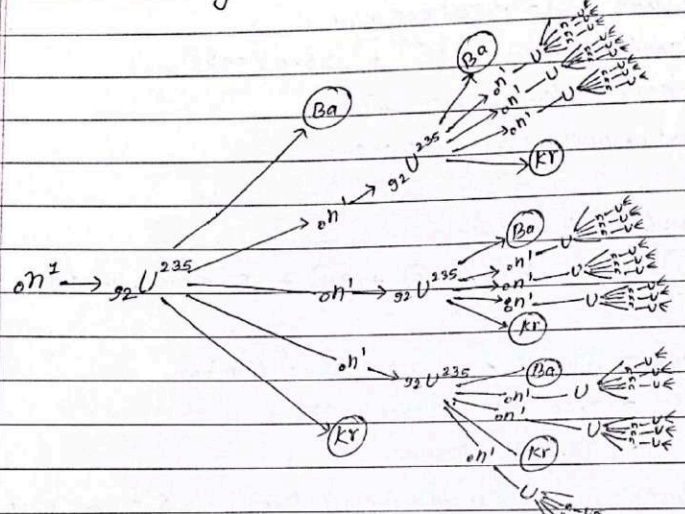
Fig: - Uncontrolled chain reaction
→ In above example, a bombarding particle neutron hits a Uranium nucleus which breaks into two small stable nuclei of Barium and krypton with 3 neutron which further hits the other three Uranium nuclei. In this way, when the reaction started, it completes when all the nuclei present in the sample are disintegrated. This is called chain reaction.
There are two types of nuclear chain reaction:
- Uncontrolled chain reaction
- Controlled chain reaction
1) Uncontrolled chain reaction
When nuclear reaction once started and goes through undefined direction and completes with the reaction of all nuclei present in the sample and huge amount of energy releases in small interval of time is called uncontrolled nuclear chain reaction. For eg: nuclear bomb.
2) Controlled chain reaction
When fission reaction started, the produced excess neutrons are captured and only desired neutron allowed to complete chain reaction is called controlled nuclear chain reaction. Here, continuous energy releases for long time at desire amount. For eg: It is used in nuclear power plants, propulsion of ships and sub-marines, etc. Here, a substance called moderator is used to capture excess neutron from during the reaction.
k-factor (multiplication factor)
→ The k-factor or neutron reproduction of a chain reaction is defined as the ratio of the production of the neutrons to the rate of loss of neutrons due to leakage or absorption.
It is also defined as. The ratio of no. of neutrons present at the beginning of particular generation to the no. of neutrons present at the beginning of the previous generation. It is denoted by \(k\).
$$K = \frac{\text{no. of neutrons present at the beginning of one generation}}{\text{no. of neutrons present at the beginning of the previous generation}}$$
The physical meaning of \(k\):
- If \(k > 1\), then the reaction is said to be growing or building. If the chain reaction started for \(k > 1\), whole the source is exploded within a few seconds. Explosion of atom bomb is the example of this.
- If \(k=1\), then, the chain reactions remains steady. This type of chain reaction is controlled by means of machinery (moderator). This principle is used in nuclear power plant.
- If \(k < 1\), then the chain reaction gradually dies out or decreasing. Due to lack of necessary no. of neutrons, the rate of fission is decreases and is terminated.
Critical size and critical mass
If the size of Uranium source is too small, a neutron is likely to escape through the surface before it finds another nucleus. Therefore, for the sustained chain reaction, the size and mass of Uranium source must have at least a critical value. This size and mass of source is called critical size and critical mass. It is also defined as the amount of mass in fission source for which each fission event produces additional fission event is called critical mass and the corresponding size of source is called critical size.
The minimum amount of fissionable material that will support a self-sustaining chain reaction.
Nuclear fusion reaction
The combination of two or more than two lighter nuclei to form a heavy nucleus with the release of huge energy is called nuclear fusion reaction. When two light nuclei fuse, the mass of the product nucleus is less than the total mass of the nuclei being fused. The difference in mass is called mass defect appears as energy of the product nucleus. Hence, energy is released from fusion reaction as well.
For eg:- Calculation for energy released
$$\text{mass of } _{1}H^{1} = 1.007825 \text{ amu }(\text{amu} = u)$$
Total Mass of reactant = mass of \(_{1}H^{1}\) + mass of neutron
=(1.007825 + 1.008665) amu
= 2.01649 amu
Total mass of product = mass of \(\mathrm{H}^{2}\) + γ-radiation (\(Q\))
\(= 2.01402 \, \mathrm{amu} + Q\)
$$\therefore Q = 2.47 \times 10^{-3} \text{ amu}$$
$$\therefore Q=2.47\times10^{-3}\times931$$
$$\therefore Q=2.29957\,\mathrm{MeV}$$
Hence, the energy released in form of γ-radiation is 2.29957 MeV.
Other example of nuclear fusion reaction are:
\(_{1}H^{2} + _{1}H^{2} \rightarrow _{2}He^{3} + n + 3.27\,\text{MeV}\) (as OCR: \(H^{2} + xH^{2} \rightarrow 2He^{4} + 22MeV\))
\(H^{2} + xH^{2} \rightarrow 2He^{4} + 22MeV\)
\(2H^{1} + 2H^{1} + 2H^{1} + 2H^{1} \rightarrow 2He^{4} + 2, e^{+} + 27.6 MeV\)
\(2H^{2} + 3H^{3} \rightarrow 2He^{4} + n^{1} + 17.5MeV\)
Condition for nuclear fusion reaction?
Two nuclei can be fused only if they can be brought close enough to the order of about \(10^{-14}\) m.
Comparison between fission and fusion
Nuclear fission
- It is the process of splitting of a heavy nucleus into two nuclei of much lower masses.
- It takes place at ordinary temperature.
- During this process, lower amount of energy per nucleon which is about 200 MeV per fission, is released.
- The rate of energy releases is less in comparison to fusion.
- Uranium, plutonium, thorium, etc are the fuels used for fission reaction these are quite costly and limited in quantity.
- Fission products are generally radioactive and are harmful. Thus, their disposal is a problem.
- Controlled fission reactions are used to generate electricity for peaceful purpose.
- Chain reaction occurs only when the mass is greater than the critical mass.
- Fission can be used to manufacture atom bomb.
Nuclear fusion
- In fusion, two light nuclei fuse together to form a single heavier nucleus.
- It takes place at high temperature of the order of \(10^{7}\) degree.
- In fusion, extraordinary huge amount of energy per nucleon is released.
- The rate of energy release is times more in comparison to fission.
- \(_{1}H^{2}\), \(_{1}H^{3}\), etc are the fuel listed for fusion reaction. These are cheap and available in plenty.
- Fusion products are mostly non radioactive being almost harmless, they can be disposed easily.
- Fusion reaction are yet to be controlled.
- For chain reaction to occur, attaining a critical mass is not necessary.
- Fusion can be used to manufacture hydrogen bomb.
Note!
In a fission reaction:
\(_{92}U^{238} \rightarrow _{90}Th^{234} + \alpha + Q\)
\(\alpha=_{2}He^{4}\)
and the K.E of the \(\alpha' = \frac{M_{Th}}{M_{Th} + m_{\alpha}} \times Q\)
Numerical problems
A city requires \(10^{7}\) watt of electrical power on the average. If this is to be supplied by a nuclear reactor efficiency 20% using Uranium \(_{92}U^{235}\) as the fuel source. Calculate the amount of fuel required per day.
energy released per fission of \(_{92}U^{235}\) nucleus = 200 MeV
Total power required = \(10^{7}\) watt
$$\therefore \text{power}=\frac{\text{work done}}{\text{Time taken}}$$
\(10^{7}= \frac{\text{output energy from reaction}}{86400}\)
Output energy = \(8.64 \times 10^{11} J\)
Here, \(8.64 \times 10^{11}\) is the 20% output energy of total energy.
So, let \(n\) be the total energy. Then,
$$\frac{20}{100}\times n=8.64\times10^{11}J$$
$$\therefore n=4.32\times10^{12}J$$
\(\therefore\) Total energy need to be released by nuclear fission = \(4.32 \times 10^{12}\) J
\(= 2.7 \times 10^{31} \text{ eV}\)
\(= 2.7 \times 10^{25} \text{ MeV}\)
Here, 200 MeV energy is released by 1 fission of \(_{92}U^{235}\) nucleus
1 MeV energy is released by \(\frac{1}{200}\) fission of \(_{92}U^{235}\) nucleus
\(2.7\times10^{25}\) MeV energy is released by \(\frac{1}{200} \times 2.7 \times 10^{25}\) fission of \(_{92}U^{235}\) nucleus
\(= 1.35 \times 10^{23}\) fission of \(_{92}U^{235}\) nucleus.
Total Uranium atom required = \(1.35 \times 10^{23}\) no. of U atom.
from Avogadro's hypothesis,
235 g of Uranium = \(6.023 \times 10^{23}\) no. of Uranium \(_{92}U^{235}\) atom
\(\frac{235}{6.023 \times 10^{23}}\) g of Uranium = 1 no. of Uranium \(_{92}U^{235}\) atom
\(1.35 \times 10^{23}\) no. of Uranium \(_{92}U^{235}\) atom = \(\frac{235 \times 1.35 \times 10^{23}}{6.023 \times 10^{23}}\) g of Uranium
= 52.6730865 g of Uranium
= 0.0526730865 kg of Uranium.
Power production
Find the power production corresponding to \(2g\) of \(_{92}U^{235}\) consumed per day in a nuclear reactor. Energy released per fission of \(_{92}U^{235}\) is about 200 MeV. Solution!
Energy released per fission of \(_{92}U^{235} = 200 \, MeV\)
\(= 200 \times 10^{6} \times 1.6 \times 10^{-19} \, J\)
\(= 3.2 \times 10^{-11} \, J\)
Here, 1 Uranium atom produced = \(3.2 \times 10^{-11}\) J
from Avogadro's hypothesis,
235 g of Uranium = \(6.023 \times 10^{23}\) no. of Uranium atom
2 g of Uranium = \(\frac{6.023 \times 10^{23}}{235} \times 2\) no. of Uranium atom
\(\therefore\) 2gm of Uranium = \(5.1259574\times10^{21}\) no. of Uranium atom.
1 Uranium atom produced = \(3.2\times10^{-11}\) J
\(5.1259574\times10^{21}\) Uranium atom produced = \(1.640306\times10^{11}\) J
\(\therefore\) In one day, \(T\) = 24 hours = 86400 sec.
Then, power production in one day = \(\frac{1.640306 \times 10^{11} J}{86400 sec}\)
= \(1.8985 \times 10^{6}\) Watt