Thermal Expansion
Thermal expansion is the tendency of matter to change its shape, area, volume and density in response to a change in temperature, usually not including phase transitions.
Examples:
- Railways tracks are provided with gaps
- Electric wires kept sat sagging between poles during summer
- Tight lid of bottle can be loosening by running hot water over it
Laws of Theoretical Expansion
There are mainly 3 laws of expansion. They are;
Linear Expansion
If increase in size is considered in one dimension, expansion is called linear expansion.
Let a metal rod having length \( l_{1} \) at temp. \( \theta_{1}^{\circ} \), when it is heated to \( 0_{2}^{\circ} \)C then its corresponding length will be \( l_{2} \) here,
$$ \Delta L = L_{2} - L_{1} $$
$$ \Delta Q = Q_{2} - Q_{1} $$
We know,
$$ \Delta L \propto L_{1} $$
$$ \Delta L \propto \Delta Q $$
Combining equation ① and ②
$$ \Delta L \propto L_{1} \Delta Q $$
or, $$ \Delta L = \alpha L_{1} \Delta Q $$
Where \( \alpha \) is the coefficient of linear expansion.
$$ \alpha = \frac{\Delta L}{L_{1} \Delta Q} $$
\( \alpha \) is defined as the ratio of change in length per unit degree in rise in temperature.
$$ \Delta L = \alpha L_{1} \Delta Q $$
$$ L_{2} - L_{1} = \alpha L_{1} \Delta Q $$
$$ L_{2} = L_{1} + \alpha L_{1} \Delta Q $$
$$ \therefore L_{2} = L_{1} (1 + \alpha \Delta Q) $$
Law of Superficial Expansion
law of Superficial expansion state that change in area is directly proportional to;
i) Original Area (\( A_{1} \))
i.e. \( \Delta A \propto A_{1} \), — ①
ii) Change in temperature
i.e. \( \Delta A \propto \Delta \theta \), \( \Delta \theta = \theta_{2} - \theta_{1} \), — ②
Now, combining equation (i) and (ii), we get,
$$ \Delta A \propto A_{1} \Delta \theta $$
or, $$ \Delta A = \beta A_{1} \Delta \theta $$ — (iii)
where \( \beta = \) Coefficient of Superficial expansion
$$ \beta = \frac{\Delta A}{A_{1} \Delta \theta} $$
from equation (iii)
$$ \Delta A = A_{2} - A_{1} $$
$$ \therefore A_{2} - A_{1} = \beta A_{1} \Delta \theta $$
or $$ A_{2} = A_{1} + \beta A_{1} \Delta \theta $$
$$ \text{Or}, A_{2}=A_{1}(1+\beta\Delta\theta) $$
Let us suppose a metallic sheet having area \( A_{1}^{\prime} \) at \( 0^{\circ}C \). When temperature reaches \( O_{2} \) its corresponding area will be \( A_{2}^{\prime} \).
Experiment shows that;
$$ (A_{2}-A_{1}) \propto A_{1} $$
$$ (A_{2}-A_{1}) \propto \Delta \theta $$
Combining equation ① and ②
$$ (A_{2}-A_{1}) \propto A_{1} \Delta \theta $$
or, $$ (A_{2}-A_{1}) = \beta A_{1} \Delta \theta $$
$$ A_{2} = A_{1} + \beta A_{1} \Delta \theta $$
$$ \therefore A_{2} = A_{1} (1 + \beta \Delta \theta) $$
Law of Cubical Expansion
Law of Cubical Expansion state that change in Volume is directly proportional to:
i) Original Volume \( (v_{1}) \)
i.e. \( \Delta V \propto v_{1} \) — ①
ii) Change in temperature
i.e. \( \Delta V \propto (\theta_{2} - \theta_{1}) \) — ②
Combining equation ① and ②
$$ \Delta V \propto v_{1} (\theta_{2}-\theta_{1}) $$
or, $$ \Delta V = \gamma V_{1} (\theta_{2} - \theta_{1}) $$ — (iii)
When,
$$ \gamma = \text{coefficient of cubical expansion} $$
$$ \gamma = \frac{\Delta V}{v_{1} \Delta \theta} $$
From equation (iii), we get
$$ \Delta V = V_{2} - V_{1} $$
$$ V_{2} - V_{1} = \gamma V_{1} \cdot \Delta \theta $$
or, $$ V_{2} = V_{1} + \gamma V_{1} \Delta \theta $$
$$ V_{2} = V_{1} (1 + \gamma \Delta \theta) $$
Let us suppose a metallic cube of volume \( V_{1} \) at \( 0^{\circ}C \) and when it is heated to \( \theta_{2}^{\circ}C \) its corresponding volume is \( V_{2} \).
Experiment shows that;
$$ (V_{2}-V_{1}) \propto V_{1} $$
$$ (V_{2}-V_{1}) \propto (\theta_{2}-\theta_{1}) $$
Combining ① and ②
$$ (V_{2}-V_{1}) \propto V_{1} (\theta_{2}-\theta_{1}) $$
$$ (V_{2}-V_{1}) = \gamma V_{1} (\theta_{2}-\theta_{1}) $$
$$ V_{2} = V_{1} + \gamma V_{1} (\theta_{2}-\theta_{1}) $$
$$ \therefore V_{2} = V_{1} (1 + \gamma \Delta \theta) $$
Worked example — aluminium square plate
Q. An aluminium square plate of length 1 m at 10°C is heated to temperature 50°C. Find its final length and area. Given coefficient of linear expansion \( \alpha_{a}=2.4\times10^{-5} \)
Solution:
Given, Initial length \( l_{1}=1m \)
Initial temperature \( \left(\theta_{1}\right)=10^{\circ}C \)
Final temperature \( \left(\theta_{2}\right)=50^{\circ}C \)
Linear expansion of aluminium \( \left(\alpha_{a}\right)=2.4\times10^{-5}\,^{\circ}C^{-1} \)
Final length \( \left(l_{2}\right)=? \)
Area (A)=?
We know,
$$ \alpha = \frac{l_2 - l_1}{l_1(\theta_2 - \theta_1)} $$
$$ 2.4 \times 10^{-5} = \frac{l_2 - 1}{1(50 - 10)} $$
$$ 2.4 \times 10^{-5} = \frac{l_2 - 1}{40} $$
$$ 0.96 \times 10^{-3} + 1 = l_2 $$
$$ l_2 = 1.00096 \, m $$
Also,
$$ Area(A) = l_2^{2} = (1.00096)^2 \, m^{2} $$
$$ = 1.001920922 \, m^{2} $$
Relation between \(\alpha\) and \(\gamma\)
Consider a cube of side \(l_{1}\) and volume \(V_{1}\) at \(\theta_{1}^{\circ}C\). Let \(l_{2}\) and \(V_{2}\) be the length and volume at \(\theta_{2}^{\circ}C\).
we have,
$$ l_{2}=l_{1}(1+\alpha\Delta\theta) $$ —① [\(\Delta\theta=\theta_{2}-\theta_{1}\)]
$$ V_{2}=V_{1}(1+\gamma\Delta\theta) $$ —②
Again,
we have, $$ V_{2}=l_{2}^{3}=\left\{l_{1}(1+\alpha\Delta\theta)\right\}^{3} $$
$$ =l_{1}^{3}(1+\alpha\Delta\theta)^{3} $$
$$ =V_{1}\left\{1+3\alpha\Delta\theta+3(\alpha\Delta\theta)^{2}+(\alpha\Delta\theta)^{3}\right\} $$
Neglecting higher order terms of \(\alpha\),
$$ V_{2}=V_{1}(1+3\alpha\Delta\theta) $$ —③
Now, Comparing ① and ② we get
$$ V_{2}=V_{1}(1+3\alpha\Delta\theta) $$
$$ \gamma = 3\alpha $$
Relation between \(\alpha\) and \(\beta\)
Consider a square of length \(l_{1}\) and area \(A_{1}\) at \(\theta_{1}^{\circ}C\) and \(l_{2}\) and \(A_{2}\) be the length and area at \(\theta_{2}^{\circ}C\).
we have,
$$ l_{2}=l_{1}(1+\alpha\Delta\theta) $$ —①
$$ A_{2}=A_{1}(1+\beta\Delta\theta) $$ —②
Again we have,
$$ A_{2}=l_{2}^{2}=\{l_{1}(1+\alpha\Delta\theta)\}^{2} $$
$$ =l_{1}^{2}(1+\alpha\Delta\theta)^{2} $$
$$ =A_{1}(1+2\alpha\Delta\theta+\alpha^{2}\Delta\theta^{2}) $$
Neglecting higher order term of \(\alpha\)
or, $$ A_{2}=A_{1}(1+2\alpha\Delta\theta) $$ —③
Now, Comparing equation (ii) and (iii):
$$ \beta = 2\alpha $$
Worked example — brass and steel rods
A brass rod of length 0.40 metre and steel rod of length 0.60 metre. Both are initially at 0°C are heated to 85°C. If the increase in length is the same for both the rods. Calculate the linear expansivity of brass. The linear expansivity of steel is \( 12 \times 10^{-6} \, ^\circ C^{-1} \).
Solution:
Initial length of brass rod (\( l_{1}^{b} \)) = 0.40 m
Initial length of Steel rod (\( l_{1}^{s} \)) = 0.60 m
Initial temperature (\( \theta_{1} \)) = 0°C = 273 K
Final temperature (\( \theta_{2} \)) = 85°C = 358 K
Linear expansion of brass (\( \alpha^{b} \)) = ?
Linear expansion of Steel (\( \alpha^{s} \)) = \( 12 \times 10^{-6} \, ^\circ C^{-1} \)
Change in length \( (\ell_{2}^{b}-\ell_{1}^{b}=\Delta\ell^{b}) \) or \( (\ell_{2}^{s}-\ell_{1}^{s}=\Delta\ell^{s})=\Delta\ell \)
i.e. \( \Delta\ell^{b}=\Delta\ell^{s}=\Delta\ell \) (let)
we have,
$$ \Delta\ell^{b}=\Delta\ell^{s} $$ \([\therefore \Delta\ell=\alpha l_{1}\Delta\theta]\)
or, $$ \alpha_{b} l_{1}^{b}\Delta\theta^{b}=\alpha_{s} l_{1}^{s}\Delta\theta^{s} $$
or, $$ \alpha_{b}=\frac{\alpha_{s} l_{1}^{s}\Delta\theta^{s}}{l_{1}^{b}\Delta\theta^{b}} $$ \([\therefore \Delta\theta^{s}=\Delta\theta^{b}]\)
$$ =\frac{12\times10^{-6}\times0.60}{0.40} $$
$$ =18\times10^{-6}k^{-1} $$
Hence, the coefficient of linear expansivity of brass is \( 18 \times 10^{-6} \, k^{-1} \).
Worked example — iron rod measured by brass scale
The length of an iron rod is measured by a brass scale. When both of them are at \( 20^{\circ} \), the measured length is 50 cm. What is the length of the rod at \( 40^{\circ} \) when measured by the brass scale at \( 40^{\circ}C \) (\(\alpha\) for brass = \( 24 \times 10^{-6} C^{-1} \), \(\alpha\) for iron = \( 16 \times 10^{-6} C^{-1} \))
Solution:
Initial temperature (\( \theta_{1} \)) = \( 10^{\circ}C \)
Final temperature (\( \theta_{2} \)) = \( 40^{\circ}C \)
Linear expansivity of brass (\( \alpha_{b} \)) = \( 24 \times 10^{-6} C^{-1} \)
Linear expansivity of iron (\( \alpha_{i} \)) = \( 16 \times 10^{-6} C^{-1} \)
We have,
Initial length of brass = Initial length of iron (\( l_{1} \)) = 50 cm
Final length of iron rod (\( l_{2} \)) = ?
we know,
$$ l_{2} = l_{1} [ 1 + \alpha_{i} ( \theta_{2}-\theta_{1} )] $$
= 50 [ \( 1 + 16 \times 10^{-6} \) ( \( 40-10 \))]
= 50.024 cm
length of 1 cm division of brass scale at \( 40^{\circ}C \)
= 1 \( [1 + 24 \times 10^{-6}(40 - 10)] \)
= 1.00072 cm
Now,
length of the rod measured by brass scale at \( 40^{\circ}C \)
$$ = \frac{50.024}{1.00072} $$
= 49.988 cm
The length of iron rod at \( 40^{\circ}C \) is 49.988 cm.
Force set up due to Expansion or Contraction and Thermal Stress
Consider a metallic rod of length \( l_{1} \) and CSA 'A' is fixed between two rigid supports.
Let
$$ l_{1} = \text{Length of rod at } \theta_{1}^{\circ}C $$
$$ l_{2} = \text{Length of rod at } \theta_{2}^{\circ}C $$
$$ \alpha = \frac{\Delta l}{l_{1} \Delta \theta} $$
$$ \therefore \Delta l = \alpha l_{1} \Delta \theta $$ —①
Also,
$$ Y = \frac{\text{Stress}}{\text{Strain}} = \frac{F/A}{\Delta l/l_{1}} $$
$$ Y = \frac{F}{A} \times \frac{l_{1}}{\Delta l} $$
$$ F = \frac{Y A \Delta l}{l_{1}} $$ —②
from equation ① and ②
$$ F = Y A \alpha \Delta \theta $$
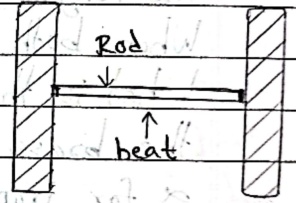
Let us consider a metallic rod (\( L_{1} \)) at temperature \( T_{1} \) which is fixed between two rigid supports \( S_{1} \) and \( S_{2} \) as shown in figure.
When it is heated to \( T_{2} \) its final length will be \( L_{2} \)
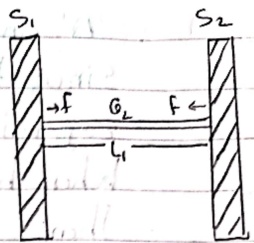
from linear expansion
$$ L_{2}=L_{1}(1+\alpha\Delta\theta) $$
$$ \therefore L_{2}=L_{1}+L_{1}\alpha\Delta\theta $$
To prevent the linear expansion of the rod, the rigid support apply certain force which is equal to force setup due to expansion of rod. The corresponding stress is called thermal stress. We have,
from Young's Modulus;
$$ Y = \frac{\text{Normal Stress}}{\text{Longitudinal Strain}} $$
or, $$ Y = \frac{F/A}{(L_2 - L_1)/L_1} $$
or, $$ Y = \frac{F}{A} \times \frac{L_1}{L_2 - L_1} $$
or, $$ Y = \frac{F}{A} \times \frac{L_1}{L_1 \alpha \Delta \theta} $$ \([\therefore L_2 - L_1 = L_1 \alpha \Delta \theta]\)
or, $$ Y \cdot A \cdot \alpha \Delta \theta = F $$
$$ \therefore F = Y A \alpha \Delta \theta $$
Worked example — wire thermal expansion and stress
A wire that is 1.5 m long at 20°C is found to increase in length by 1.9 cm when warmed to 420°C (a) compute its average coefficient of linear expansion for this temperature range. (b) The wire is stretched just taut (zero tension) at 420°C. Find the stress in the wire if it is cooled to 20°C without being allowed to contract (Young's modulus for the wire is \( 2 \times 10^{11} \) Pa).
Solution:
Initial length (\( l_{1} \)) = 1.5 m
Change in length (\( \Delta l \)) = 1.9 cm
Change in temperature (\( \Delta\theta \)) = (420°C - 20°C) = 400°C
Coefficient of linear expansion (\( \alpha \)) = ?
The thermal stress = ?
We know,
$$ \alpha = \frac{\Delta l}{l_1 \Delta \theta} $$
$$ = \frac{1.9 \times 10^{-2}}{1.5 \times 400} $$
$$ = 3.17 \times 10^{-5} k^{-1} $$
Also,
Young's Modulus (\( Y \)) = \( 2 \times 10^{11} \) Pascal
Then,
Stress = \( Y \alpha \Delta \theta \)
$$ = 2 \times 10^{11} \times 3.17 \times 10^{-5} \times 400 $$
$$ = 2.54 \times 10^{9} N/m^{2} $$
Hence, the coefficient of linear expansion and thermal stress are \( 3.17 \times 10^{-5} k^{-1} \) and \( 2.54 \times 10^{9} N/m^{2} \) respectively.
Expansion of liquid (Real and Apparent expansion)
Let \( v_{1} \) = Initial volume of liquid
$$ BC = AB + AC $$
BC = Real change in volume
AB = change in volume of glass vessel.
AC = Apparent change in volume
Again, Assume,
BC = \( \Delta V_{r} \) = Real change in volume
i.e. $$ \Delta V_{r} = \gamma_{r} V_{1} \Delta \theta $$
\( \gamma_{r} \) = Coefficient of real expansion of volume of liquid.
AC = \( \Delta V_{a} \) = Apparent change in volume
i.e. $$ \Delta V_{a} = \gamma_{a} V_{1} \Delta \theta $$
\( \Delta V_{g} \) = Change in Volume of glass vessel
i.e. $$ \Delta V_{g} = \gamma_{g} V_{1} \Delta \theta = 3 \alpha_{g} V_{1} \Delta \theta $$
$$ \therefore \gamma_{g} = 3 \alpha_{g} $$
we have,
BC = AB + AC
$$ \therefore \Delta V_{r} = \Delta V_{g} + \Delta V_{a} $$
$$ \therefore \gamma_{r} V_{1} \Delta \theta = \gamma_{g} V_{1} \Delta \theta + \gamma_{a} V_{1} \Delta \theta $$
$$ \therefore \gamma_{r} = \gamma_{g} + \gamma_{a} $$
Variation of density with temperature
Let us consider a substance of mass \(m\).
Let \(V_{1}\) be the volume of that given substance at temperature \( \theta_{1} \). Then it's density (\( \rho_{1} \)) is given by;
$$ \rho_{1}=\frac{m}{V_{1}} $$ —①
Let the given substance is heated to \( \theta_{2} \) temperature. Then its corresponding volume will be \( V_{2} \) and its density \( \rho_{2} \) is given by;
$$ \rho_{2} = \frac{m}{V_{2}} $$ —②
from cubical expansion,
$$ V_{2}=V_{1}(1+\gamma\Delta\theta) $$ —③
Now, Using equation ③ in ② we get;
$$ \rho_{2} = \frac{m}{V_{1}(1 + \gamma\Delta\theta)} $$
$$ \therefore \rho_{2} = \frac{\rho_{1}}{1 + \gamma\Delta\theta} $$
Hence, density decreases with increase in temperature.
Determination of Linear Expansivity of a Solid by Pullinger's Apparatus
For this experiment a metallic rod is kept inside a hollow cylinder having three openings. One for keeping thermometer and other two for steam in and out. An electric circuit containing battery and galvanometer is connected in the terminals along with a Spherometer.
Let, \( L_{1} \) = Original length of rod
\( \theta_{1} \) = Initial temperature of rod
\( S_{1} \) = Initial reading of Spherometer
\( \theta_{2} \) = Final temperature of rod
\( S_{2} \) = final reading of Spherometer
We know,
Change in length of rod, $$ \Delta L = S_2 - S_1 $$
Change in temperature, $$ \Delta \theta = \theta_2 - \theta_1 $$
Since, \(L_{1}\) is the initial/original length of rod then its linear expansivity is given by;
$$ \alpha = \frac{\Delta L}{L_1 \Delta \theta} $$
or $$ \alpha = \frac{S_2 - S_1}{L_1 \Delta \theta} $$
or $$ \alpha = \frac{S_{2} - S_{1}}{L_{1}(\theta_{2} - \theta_{1})} $$