Dispersion of light
The phenomenon of splitting of white light into its constituent colours is called dispersion of light. It can be remembered by the word VIBGYOR.
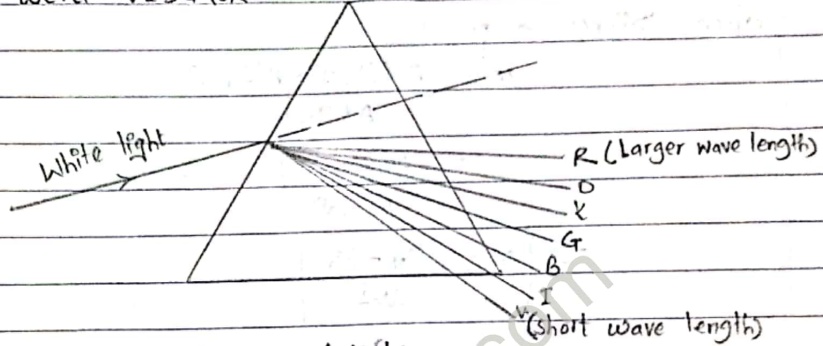
Fig: Dispersion of light
Angular Dispersion
The angular dispersion for two different colours of light is defined as the difference between angle of deviation for them.
For example: Angular dispersion between red light and violet light through a prism. i.e., δv−δr
For Small angled prism.
$$ \delta_{V}=A(\mu_{V}-1) $$
$$ \delta_{r}=A(\mu_{r}-1) $$
$$ \therefore \delta_{V}-\delta_{r}=A(\mu_{V}-1)-A(\mu_{r}-1) $$
$$ \Rightarrow \delta_{V}-\delta_{r}=A(\mu_{V}-\mu_{r}) $$
this is angular dispersion between red & violet light through prism.
Dispersive power
the dispersive power of prism is defined as the ratio of angular dispersion for red & violet light to the deviation for mean light.
i.e. dispersive power (ω) = $$ \frac{\delta v - \delta r}{\delta} $$
Since, for small angled prism,
$$ \delta_{V}=A(\mu_{V}-1) $$
$$ \delta_{r}=A(\mu_{r}-1) $$
$$ \delta=A(\mu-1) $$
then, Dispersive power.
$$ \omega = \frac{A(\mu_{V}-1)-A(\mu_{r}-1)}{A(\mu-1)} = \frac{\mu_{V}-\mu_{r}}{\mu-1} $$
$$ \Rightarrow \omega = \frac{\mu_{v} - \mu_{r}}{\mu - 1} $$
Chromatic Aberration in lenses
The lens can be supposed to be made up of large numbers of small angle prism. When white light is incident on it, due to the prism action of the lens it disperses light & different colours are focused at different points. This inability of lens to focus all colours at a single point is called chromatic aberration.
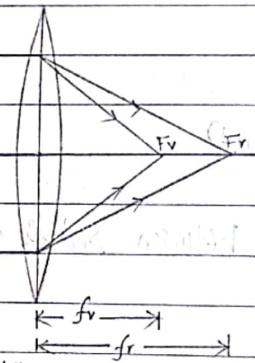
Fig.1 Chromatic aberration in (a) Convex lens (b) Concave lens
Let us Consider a white light is incident on a Convex/concave lens parallel to the principal axis, the Violet Colour is focused near than red Colour and other Colours are focused in between them as shown in figure. Let fv, fr & f are the focal length for Violet, red & mean Colour of light then by lens maker's formula.
$$ \frac{1}{f_{V}}=(\mu_{V}-1)\left[\frac{1}{R_{1}}+\frac{1}{R_{2}}\right] \cdots \cdots (i) $$
$$ \frac{1}{f_{r}}=(\mu_{r}-1)\left[\frac{1}{R_{1}}+\frac{1}{R_{2}}\right] \cdots \cdots (ii) $$
$$ \frac{1}{f}=(\mu-1)\left[\frac{1}{R_{1}}+\frac{1}{R_{2}}\right] \cdots \cdots (iii) $$
From eq(iii)
$$ \frac{1}{R_{1}}+\frac{1}{R_{2}}=\frac{1}{f(\mu-1)} \cdots (iv) $$
Also, $$ \sqrt{f_{v}f_{r}} = f $$ [focal length of mean light]
$$ f_{r} - f_{V} = \frac{\mu_{V} - \mu_{r}}{(\mu-1)} f $$
$$ =\left[\frac{\mu_{v}-\mu_{r}}{\mu-1}\right]f $$
$$ \Rightarrow f_{r}-f_{V}=\omega f \rightarrow(1) $$ $$ \left[\therefore \omega=\frac{\mu_{V}-\mu_{r}}{\mu-1}\right] $$
Hence, Chromatic aberration is the product of dispersive power & focal length for mean colour of light.
Achromatic Combination of lenses
The combination of two thin lenses in which their combination is free from chromatic aberration is called the achromatic Combination of lenses.
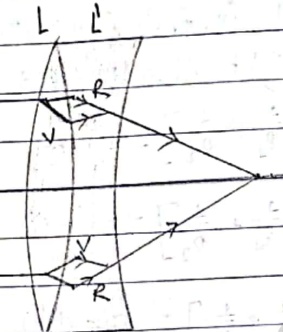
Fig. Achromatic combination of lenses
Let us consider two thin lenses L and L′ of respective dispersive power ω & ω′ respectively placed in Contact with each other as shown in figure. Also, let μv, μw & μr are the refractive index of L for violet, mean & red colour respectively. and fv, fw & fr are the focal lengths of respective colours. Similarly μ′v, μ′w, μ′r & f′v, f′w, f′r are corresponding quantities of L′. Then,
We have for lens L,
$$ \frac{1}{f} = (\mu - 1) \left[ \frac{1}{R_{1}} + \frac{1}{R_{2}} \right] $$
$$ \frac{1}{R_{1}} + \frac{1}{R_{2}} = \frac{1}{f(\mu-1)} $$
Similarly, For lens L′,
$$ \frac{1}{R_{1}'} + \frac{1}{R_{2}'} = \frac{1}{f'(\mu'-1)} \rightarrow (ii) $$
Now, focal length for Violet colour due to each lenses L and L′ are:
$$ \frac{1}{f_{V}} = (\mu_{V} - 1)\left[\frac{1}{R_{1}} + \frac{1}{R_{2}}\right] $$
$$ \Rightarrow \frac{1}{f_{v}}=\frac{\mu_{V}-1}{f(\mu-1)} $$ [using eqn]
$$ \frac{1}{f_{v}'}=(\mu_{v}'-1)\left[\frac{1}{R_{1}'}+\frac{1}{R_{2}'}\right] $$
$$ \Rightarrow \frac{1}{f_{v}'} = \frac{\mu_{v}'-1}{f'(\mu'-1)} $$ — (iv) [using eq(ii)]
Again, Combined focal length for Violet Colour.
$$ \frac{1}{F_{v}}=\frac{1}{f_{v}}+\frac{1}{f_{v}'} $$
$$ \frac{1}{F_{v}}=\frac{\mu_{v}-1}{f(\mu-1)}+\frac{\mu_{v}'-1}{f'(\mu'-1)} $$
Similarly, Combined focal length for red colour.
$$ \frac{1}{F_{r}}=\frac{\mu_{r}-1}{f(\mu-1)}+\frac{\mu_{r}'-1}{f'(\mu'-1)} $$
For, Achromatic Combination, We have $$ F_{v} = F_{r} $$
$$ \Rightarrow\frac{1}{F_{v}}=\frac{1}{F_{r}} $$
$$ \Rightarrow \frac{\mu_{V} - 1}{f(\mu - 1)} + \frac{\mu_{V}' - 1}{f'(\mu' - 1)} = \frac{\mu_{r} - 1}{f(\mu - 1)} + \frac{\mu_{r}' - 1}{f'(\mu' - 1)} $$
$$ \frac{\mu_{V} - \mu_{r}}{f(\mu - 1)} + \frac{\mu_{V}' - \mu_{r}'}{f'(\mu' - 1)} = 0 $$
$$ \text{or,}\quad\frac{\omega}{f}+\frac{\omega'}{f'}=0 $$
$$ \Rightarrow\left[\frac{\omega}{f} = -\frac{\omega'}{f'}\right] $$
Which is the required condition for achromatic combination of two lenses.
$$ \Rightarrow \frac{\omega}{\omega'} = \frac{-f}{f'} $$