Linear Momentum
Linear Momentum is the quantity of motion contained in a body, it is measured by the product of mass and velocity. It is a vector quantity and denoted by P. It is given by:
\( \overrightarrow{P} = M \overrightarrow{v} \)
Dimension formula of \(P = \lfloor M L T^{-1} \rfloor\)
SI unit of \(P = kg m s^{-1}\)
The force of in terms of linear momentum is given by the rate of change of linear momentum with respect to time.
i.e. \(F = \frac{dp}{dt}\)
\(\therefore F = \frac{d(Mv)}{dt}\)
Note: \(V = \frac{dx}{dt}\), \(\therefore F = m \frac{dv}{dt}\), \(\therefore \frac{dv}{dt} = a\)
$$ \therefore F = m a $$
Now, or, \(dp = Fdt\)
Change in momentum = Force \(\times\) time
Impulse
If a large force acts on a body for a very short interval of time then the force is called impulse force. The product of impulsive force and the time interval for which it acts is called impulse.
Give Reasons
a. A cricketer lower his hand while catching cricket ball. Why?
Ans: The impulse of a force is, Impulse = f × t = Change in linear momentum which remains constant. Lowering the hands helps to increase time due to which reaction force decreases. Hence, hands are not hurt severely.
b. China Wares or glass wares are wrapped with straws or foams. Why?
China wares or glass wares are wrapped with straws or for foams because straws and foams absorbs force by increasing the time in case of event of fall. Because of increase in time, force is reduced as we know, Impulse \( = f \times t \).
c. A man get hurt while jumping on the cemented floor but not mud or straw heap. Why?
The impulse of a force is, Impulse = f×t = change in linear momentum which remains constant. Jumping on the cemented floor takes very short time due to which reactional force is increased but jumping on sand increases time which helps to decrease reactional force. Hence, person is not hurt while jumping on the mud.
Principle of Conservation of Linear Momentum
It states that, "If the vector sum of external forces acting on a system is zero, then its total linear momentum remains conserved or constant."
Derivation

During collision / After collision
Let two particles A and B having respective masses \(m_{1}\) and \(m_{2}\) are moving with respective velocities \(u_{1}\) and \(u_{2}\) in a straight line before collision such that \(u_{1} > u_{2}\) as shown in the figure.
Let \(v_{1}\) and \(v_{2}\) be their respective velocities after collision. Let \(\Delta t = \text{small time of collision}\).
Before collision: Momentum of \(A = m_{1} u_{1}\); Momentum of \(B = m_{2} u_{2}\); Total momentum \(= m_{1} u_{1} + m_{2} u_{2}\)
After collision: Momentum of \(A = m_{1}v_{1}\); Momentum of \(B = m_{2}v_{2}\); Total momentum \(= m_{1}v_{1} + m_{2}v_{2}\)
Change in momentum of \(A = m_{1}V_{1} - m_{1}U_{1}\)
Change in momentum of \(B = m_{2}V_{2} - m_{2}U_{2}\)
From Newton's \(3^{rd}\) Law of Motion: \(F_{AB} = -F_{BA}\)
or, Change in momentum of A / time of collision = − change in momentum of B / time of collision
$$ \text{or} \quad \frac{m_{1}v_{1} - m_{1}u_{1}}{\Delta t} = -\left( \frac{m_{2}v_{2} - m_{2}u_{2}}{\Delta t} \right) $$
or, \(m_{1}V_{1} + m_{2}V_{2} = m_{2}U_{2} + m_{1}U_{1}\)
∴ Initial momentum = final momentum
Free Body Diagram
A diagram showing all the forces acting on a body is called free body diagram.
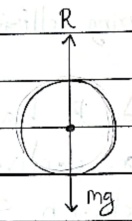
Elevator (Lift)
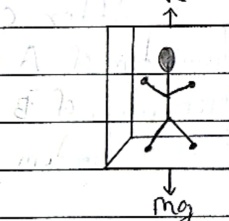
Lift is at rest
Equation: \(R - mg = ma\)
or, \(R - mg = 0\) (\(\therefore a = 0\))
\(\therefore R = Mg\)
Lift moves upwards uniformly
for upward motion: \(R \geq mg\)
Equation: \(R - mg = ma\)
\(R - mg = m \cdot 0\) [\(a = 0\), as \(v = u =\) uniform]
\(R = mg\)
Lift moves downwards uniformly
For downward motion: \(mg > R\)
Equation: \(Mg - R = ma\)
\(\therefore R = m g\) [\(\therefore a = 0\)]
Lift is accelerating upwards
for upward motion: \(R > mg\)
Equation: \(R - mg = ma\)
or \(R = ma + mg\)
\(R = m(a + g)\)
Lift is accelerating downward
For downward: \(Mg > R\)
Equation: \(Mg - R = ma\)
or \(Mg - ma = R\)
\(\therefore R = m(g - a)\)
Mass and Pulley
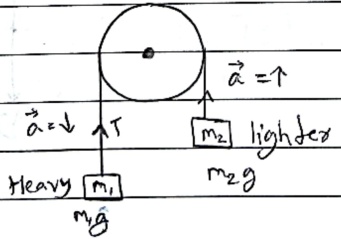
Note:
- Weight is directed towards centre of earth.
- Tension in a string or rope is always directed towards the point of Suspense.
- Tension in a string single string always equals.
- Magnitude of acceleration in a single string always equals.
Equation of heavy mass body
for downward motion of \(M_{1}\), \((\because M_{1}g > T)\)
\(M_{1}g - T = M_{1}a\)
\(\therefore T = M_{1}(g - a)\) — (i)
Equation of motion of light mass body
for upward motion of \(M_{2}\), \(T > M_{2}g\)
\(T - M_{2}g = M_{2}a\)
\(\therefore T = M_{2}(a + g)\) — (ii)
Numericals — Elevator and Tension
a. A lift moves (i) Up and (ii) Down with an acceleration of \(2\,m/s^{2}\) in each case. Calculate the reaction of the floor on a man of mass 50 kg standing in the lift
Solution: Mass (m) = 50 kg; Acceleration (a) = \(2\,m/s^{2}\)
1. for upward motion; \(R > mg\); \(R - mg = ma\); \(R = m(a + g) = 50(2 + 10) = 600N\)
for downward motion; \(mg > R\); \(mg - R = ma\); \(R = m(g - a) = 50(10 - 2) = 400N\)
A box of mass 50 kg is pulled up from a hold of a ship with an acceleration of \(1 m/s^{2}\) by a vertical rope attached to it. Find the tension in the rope and find tension when the box moves up with an uniform velocity.
When box moves upward, \((T > mg)\): \(T - mg = ma\); \(T = m(a + g) = 50(1 + 10) = 550 N\)
If the box moves up with a uniform velocity: \(T' - mg = 0\) [\(\therefore a = 0\)]; \(T' = mg = 50 \times 10 = 500N\)
Moment of Force
The product of force and perpendicular distance acting on a body such that it produces rotational effect on the body is called moment of force or torque.
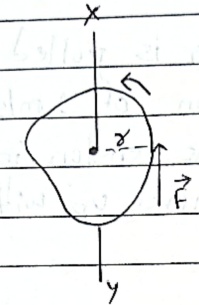
Moment of force = \(\overrightarrow{r} \times \overrightarrow{f}\)
\(\tau = \overrightarrow{r} \times \overrightarrow{f}\) [=Tau]
Unit of \(\tau = Nm = J\)
Principle of Moment
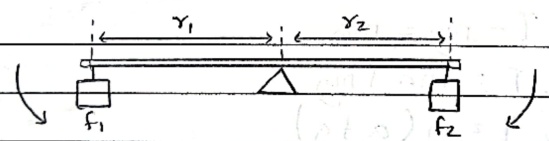
Anticlockwise moment = clockwise moment = \(r_{1} \times f_{1} = r_{2} \times f_{2}\)
Principle of moment = Sum of clockwise moment = Sum of anticlockwise moment for balance condition.
Torque due to couple of force
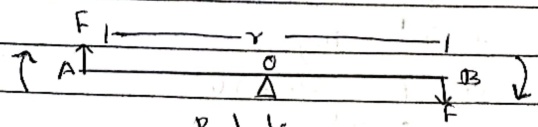
\(\tau = (OA + OB) \times F = AB \times F\)
Two unequal and unlike parallel force with different lines of action produces couple.
Equilibrium
A body is said to be equilibrium if net force or net torque acting on a body is equal to zero.
1. Translation Equilibrium
A body is said to be in translation equilibrium if net force acting on a body is equal to zero.
i.e. \(\sum F = 0\); i.e. acceleration = 0; i.e. body is at rest or moving with constant velocity
If \(\sum F = 0\) and body is at rest, it is called or said to be static translation equilibrium.
If \(\sum F = 0\) and body is moving with constant velocity, it is said to be dynamic translation equilibrium.
2. Rotational Equilibrium
A body is said to be in rotational equilibrium if net torque acting on a body is equal to zero.
i.e. \(\sum \tau = 0\); i.e. angular acceleration (\(\alpha\)) = 0; i.e. body is at rest or moving with uniform angular velocity.
Friction
The force which comes between two surface in contact and tends to oppose the relative motion between them is called Frictional Force.
Types of friction
a. Static friction — The force of friction acting between two surface when they are at rest is called static friction. The maximum value of static friction is called limiting friction.
b. Kinetic or dynamic friction — The force of friction acting between two surface when they are at motion is called kinetic or dynamic friction.
Laws of friction
- The force of friction between two surface depends upon the nature of surface.
- The force of limiting friction is directly proportional to the normal reaction i.e \(F \propto R\)
- The force of limiting friction is independent of the area of contact between two surface.
- The kinetic friction is independent to the relative velocity of two surfaces.
Sliding friction — The force of friction which is developed between the surfaces in contact when body is sliding over another is called sliding friction.
Rolling friction — Rolling friction is the force of friction developed between two bodies surface when one body is rolling on the surface of another body.
Classical View
According to this, the main cause of friction is the interlocking of projections of surface.
Modern View
Intermolecular force of attraction between the surface in Contact is the cause of friction.
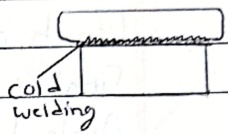
There is interatomic or intermolecular force of attraction which comes into play on two contact surface. There is cold welding between two surfaces due to this force of attraction.
Give reasons
a. Why kinetic friction is less than limiting friction?
Ans: kinetic friction is less than limiting friction because kinetic friction is the friction that occurs when two surfaces are already in motion whereas limiting friction is the maximum amount of friction that can be generated between two surfaces that are not yet in motion (static)
b. Why rolling is easier than sliding?
Frictional force depends on the area of contact between two surfaces. As the area of contact is less in the case of rolling than in sliding. Due to this, rolling is easier than sliding.
Numericals — Friction and Inclined Plane
1. An ice block of 8kg, released from rest at the top of a 2.5m long frictionless ramp, sliding downhill, reaching a speed of 2.5m/s at the bottom. What is the angle between the ramp and the horizontal?
Mass of block (m) = 8 kg; Initial Velocity (u) = 0; Length of the ramp (s) = 1.5 m; Final velocity (v) = 2.5 m/s
for frictionless ramp, \(f_{f} = 0\)
Using \(V^{2} = u^{2} + 2as\); \((2.5)^{2} = 0 + 2a(1.5)\); \(a = \frac{6.25}{3} = 2.08\)
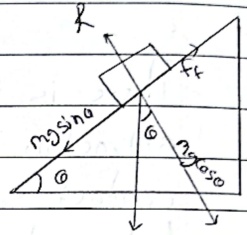
For the downhill motion: \(mg\sin\theta - f_{f} = ma\)
\(8 \times 10 \times \sin\theta - 0 = 8 \times 2.08\); \(\sin\theta = \frac{16.64}{80} = 0.208\); \(\theta = \sin^{-1}(0.208) = 12.02^{\circ}\)
An iron block of mass 20 kg rests on a wooden plane inclined at \(30^{\circ}\) to the horizontal. It is found that the least force parallel to the plane which causes the block to slide up the plane is 100N. Calculate the Coefficient of friction between the two surfaces.
Solution: Mass (m) = 20 kg; \(\theta = 30°\); \(F = 100N\); \(\mu = ?\)
\(F = F_{f} + Mg\sin\theta\) — (i); And, \(R = m g \cos \theta\) — (ii)
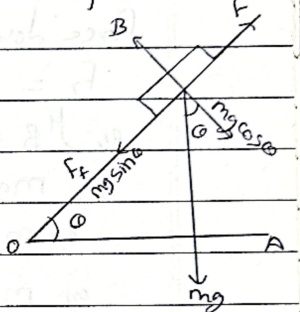
\(\mu = \frac{f_{f}}{R} = \frac{F - mg\sin\theta}{mg\cos\theta} = \frac{100 - 20 \times 10 \times \sin30^{\circ}}{20 \times 10 \times \cos30^{\circ}} = \frac{50}{86.60} = 0.577\)
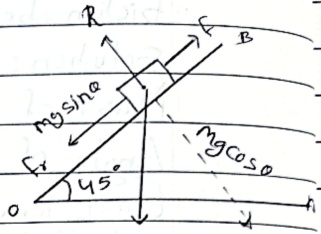
3. What would be the acceleration of a block sliding down an inclined plane that makes an angle of \(45^{\circ}\) with the horizontal if the coefficient of sliding friction between two surfaces is 0.3?
\(ma = mg\sin\theta - \mu (mg\cos\theta)\); \(a = g(\sin\theta - \mu\cos\theta) = 10(\sin45 - 0.3 \times \cos45) = 4.95 \, m/s^{2}\)
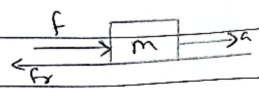
A box rests on a frozen pond, which serves as a frictionless horizontal surface. If a fisherman applies a horizontal force with magnitude \(48N\) to the box and produces an acceleration of magnitude \(3m/s^{2}\), what is the mass of the box?
For a frictionless surface, \((f_{f})=0\); from Newton's Second Law: \(f-f_{f}=ma\); \(48=m\times3\); \(\therefore m=16kg\)
A box of mass 15 kg placed on horizontal floor is pulled by a horizontal force. What will be the work done by the force if the coefficient of sliding friction between the box and the surface of the floor is 0.3 and body moves a unit distance.
\(ma = F - f_{f}\); \(m \times 0 = F - f_{f}\); \(F = f_{f} = \mu mg = 0.3 \times 15 \times 10 = 45N\)
Work done (w) = F.d = \(45 \times 1 = 45\) Joule
In the physics lab experiment, a 6kg box is pushed across a flat table by a horizontal force (f).
If the box is moving at a constant speed of 0.35m/s and the coefficient of kinetic friction is 0.12. What is the magnitude of f?
If the box is speeding up with a constant acceleration of \(0.18 \, m/s^{2}\), what will be the magnitude of f?
Solution: Mass = 6 kg; \(\mu = 0.12\); \(a = 0\) [Speed is constant]
\(ma = F - f_{f}\); \(0 = F - \mu mg\); \(F = 0.12 \times 6 \times 10 = 7.2 N\)
If speeding up with \(0.18 \, m/s^{2}\): \(6 \times 0.18 = F - 0.12 \times 6 \times 10\); \(1.08 = F - 7.2\); \(\therefore F = 8.28 N\)
More Numerical Problems
1. A car of mass 1000kg is accelerating at \(2m/s^{2}\). What resultant force acts on the car, if the resistance to the motion is 1000N. What is the force due to engine.
Mass \(=1000kg\); \(a=2m/s^{2}\); \(F_{r}=1000N\)
Resultant force \(F = ma = 1000 \times 2 = 2000N\)
\(F_e = F + F_{r} = 2000 + 1000 = 3000 N\)
2. A lift moves (i) up and (ii) down with an acceleration \(2 \, m/s^{2}\). In each case calculate the reaction of the floor on a man of mass 50 kg standing in the lift.
1st case: \(R - mg = ma\); \(R = 50(10+2) = 600 N\)
2nd Case: \(R = m(g - a) = 50(10 - 2) = 400N\)
3. A box of mass 50 kg is pulled up from the hold of a ship with an acceleration \(1m/s^{2}\) by a vertical rope attached to it. Find the tension in the rope. What is the tension in the rope when the box moves up with an uniform velocity of \(1m/s\)?
\(T = m(g + a) = 50(10 + 1) = 550N\)
2nd Case: \(a = 0\); \(T' = mg = 500 \, N\)
4. A 550N physics student stands on the bathroom scale in an elevator. As the elevator starts moving, the scale reads 450N. Draw a free body diagram and find the magnitude and direction of the acceleration of the elevator.
Weight (w) = 550 N; Reactional force (R) = 450 N
\(W = mg\); \(550 = m \times 10\); \(\therefore m = 55 kg\)
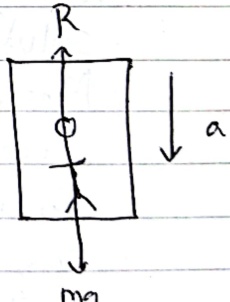
Since, R < W then the elevator is moving downward with acceleration \(a\).
\(mg - R = ma\); \(55 \times 10 - 450 = 55 \times a\); \(a = \frac{100}{55} \approx 1.82\,m/s^{2}\) (notes also show \(2.8\,m/s^{2}\))
5. A light rope is attached to a block with mass 4 kg that rests on a frictionless horizontal surface. The horizontal rope passes over a frictionless pulley and a block with mass m is suspended from the other end. When the block is released the tension in the rope is 10N. Calculate the acceleration of either block and the mass m of the hanging block.
For 4 kg mass: \(T = 4a\); \(10 = 4a\); \(a = 2.5 \, m/s^{2}\)
For hanging block: \(mg - T = ma\); \(m(10 - 2.5) = 10\); \(\therefore m = 1.33 \, kg\)
A 15 kg load of a brick hangs from one end of a rope that passes over a frictionless pulley. A 28 kg counter weight is suspended from the other end of the rope as shown in the figure. The system is released from rest. Find the magnitude of upward acc. of the load and the tension in the rope while the load is moving.
For the load of 15 kg: \(T = 15(10 + a) = 150 + 15a\) — (i)
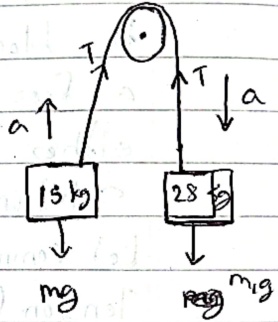
For the load of 28 kg: \(280 - 28a = T\) — (ii)
Equating: \(150 + 15a = 280 - 28a\); \(43a = 130\); \(\therefore a = 3.02 \, m/s^{2}\)
\(T = 150 + 15 \times 3.02 = 195.30 \, N\)
7. Suppose you try to move a crate by tying a rope around it and pulling the rope at angle \(30^{\circ}\) above the horizontal. What is the tension required to keep the crate moving with constant velocity. [Coef. of dynamic friction = 0.40]
Weight of Crate (w) = 500 N; \(\mu = 0.40\); \(\theta = 30°\)
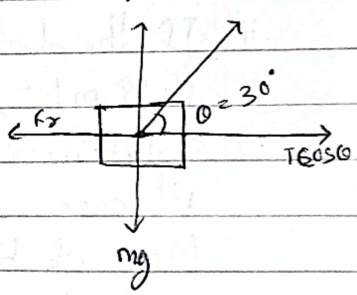
\(0.40=\frac{T\cos\theta}{R}\); \(R = 500 - T\sin\theta\)
\(T\cos30^{\circ}/0.40 - T\sin30^{\circ} = 500\); \(T = 288.6 N\)
8. In a physics lab experiment a 6 kg box is pushed across a flat table by a horizontal force \(F\).
i: If the box is moving at constant speed, 0.35 m/s and the coefficient of kinetic friction is 0.12, find the magnitude of force \(F\).
ii. If the box is speeding up with a constant acceleration of \(0.18 \, m/s^{2}\), what will be the magnitude of force \(F\)
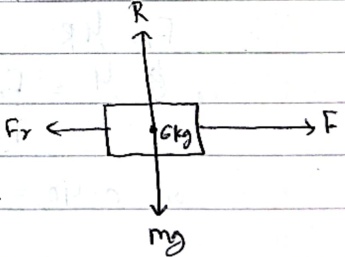
1st case: \(F = \mu R = 0.12 \times 6 \times 10 = 7.2N\)
2nd case: \(F' = 0.12 \times 6 \times 10 + 6 \times 0.18 = 8.28 N\)
9. What would be the acceleration of a block sliding down an inclined plane that makes an angle \(45^{\circ}\) with the horizontal. If the coefficient of sliding friction between two surfaces is 0.3.
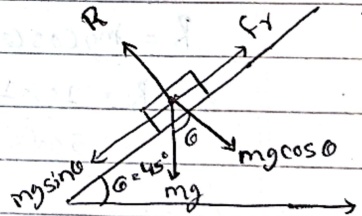
\(a = g(\sin\theta - \mu\cos\theta) = 4.94 \, m/s^2\)
An iron block of mass 20 kg rest on wooden plane inclined at \(30^{\circ}\) to the horizontal. It is found that the least parallel force to the plane which causes the block to slide up the plane is 100 N. Calculate the Coefficient of sliding friction, between wood and iron.
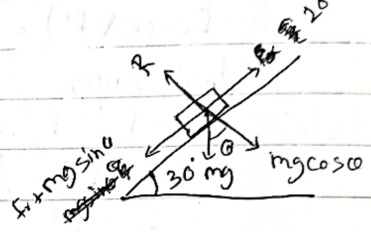
\(\therefore \mu = 0.577\)
11. A block of wood of mass 150 g rest on a inclined plane as in figure. If the coefficient of static friction between the surface in contact is 0.30, find
a. The greatest angle to which the plane may be tilted without the block slipping.
b. The force parallel to the plane necessary to prevent Slipping when the angle of the plane with the horizontal is 30°.
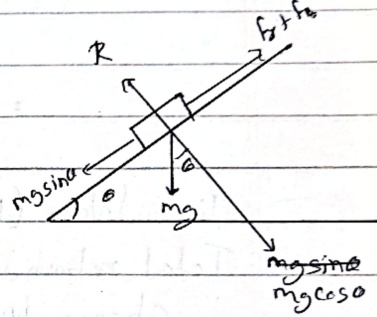
Case 1: \(\mu = \tan\theta\); \(0.30 = \tan\theta\); \(\therefore \theta = 26.6°\)
Case 2: \(F = mg\sin\theta - \mu mg\cos\theta = 0.15 \times 10 \times \sin 30^{\circ} - 0.30 \times 0.15 \times 10 \times \cos 30^{\circ}\)
A ball of mass 0.05 kg strikes a smooth wall normally 4 times in 2 sec. with a velocity of 10 m/s. Each time the ball rebound with a same speed of 10 m/s. Calculate the average force on the wall.
Change in momentum per rebound = \(m[v - (-u)] = 0.05[10-(-10)] = 1\); for 4 rebounds = 4; Average force \(F = 4/2 = 2N\)
A ball of mass 0.2 kg moving with a velocity of 6 m/s collides directly with a ball B of mass 0.2 kg at rest. Calculate their common velocity if both balls move off together. If A had rebound with a velocity 2 m/s in opposite direction after collision, what would be the new velocity of B?
From conservation of linear momentum: Case II gives \(V_{2} = 4 \, m/s\)
A bullet of mass 20 g fired into a suspended stationary wooden block of mass 380 g with a velocity of 200 m/s. What is the common velocity of the bullet and block if the bullet is embedded in the block. If the block and the bullet experience a constant opposing force of 2N, find the time taken by them to come to rest.
\(V = \frac{0.02 \times 200}{0.02 + 0.38} = 10 m/s\); \(a = \frac{2}{0.40} = 5 m/s^{2}\); \(t = \frac{0 - 10}{-5} = 2\) sec.
A bullet of mass 10g travelling horizontally with a velocity of 300 m/s strike a block of wood of mass 290 gm which rests on rough horizontal floor. After impact, the block and the bullet move together and come to rest when the block has travelled the distance of 15 m. Calculate the coefficient of sliding friction between the block and the floor.
\(v = \frac{0.01 \times 300}{0.30} = 10 m/s\); from \(\frac{1}{2}mv^{2}=\mu mg d\); \(\mu = 0.33\)
A 8 kg of ice, released from rest at the top of a 1.50 m long frictionless ramp, reaching a speed of 2.50 m/s at the bottom. What is the angle between the ramp and the horizontal?
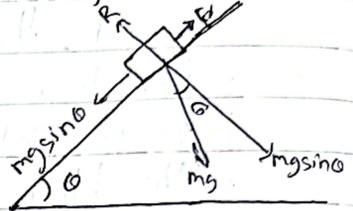
$$ v^{2} = u^{2} + 2a s $$; $$ \therefore a=2.08m/s^{2} $$
\(mg\sin\theta = ma\); \(\sin\theta = 0.208\); \(\therefore \theta = 12.02^{\circ}\)
A 650 kW power engine of a vehicle of mass \(1.5 \times 10^{5}\) kg is rising on an inclined plane of inclination 1 in 100 with a constant speed of 60 km/hr. Find the frictional force between the wheels of the vehicle and plane.
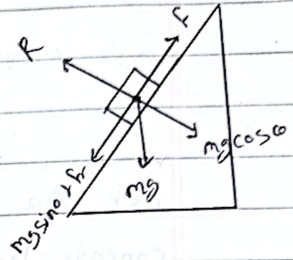
Power (P) = F × V
\(650000 = (mg\sin\theta + f_x) \times V\)
$$ \therefore f_x \approx 23992 N $$