Electrostatic field intensity or field strength (\(\vec{E}\))
The space around the charge particle where the force of discharge particle can be experienced than the space or this region is called electric field.
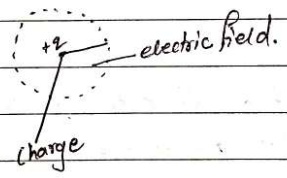
The electric intensity at a point in an electric field is defined as the force experienced by a unit positive test charge kept at that point. It is also known as electric field strength or simply electric field.
Electric field intensity is vector quantity. So, the field in terms of vector notation is:
It is also defined as force per unit charge at a point in the electric field.
Consider a charge \(q'\) placed where the electric field of the charge is shown in the diagram. Let a point A at a distance \(r\) from the charge, a unit positive charge placed at point A then the column's force between these two charges is given as:
$$ F=\frac{1}{4\pi\varepsilon_{0}}\frac{Q q}{r^{2}} $$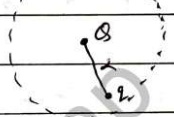
Here, \( q = +1c \)
$$ S_{0}. F = \frac{1}{4\pi\varepsilon_{0}} \frac{\cos}{r^{2}} = \overrightarrow{E} (Intensity) $$ $$ \therefore Hence, \overrightarrow{E} = \frac{1}{4\pi\varepsilon_{0}}\frac{\mathbf{Q}}{r^{2}} $$This is the force exerted by charge Q at point A in the field. It is denoted by \( \overrightarrow{E} \), it is a vector quantity and the SI unit of electric field intensity (\( \overrightarrow{E} \)) is N/columb. The direction of field intensity depends upon the nature of charge.
Electric field due to multiple charges
Electric field intensity due to multiple charges is given by the vector sum of the electric field intensities at that point. If \( \overrightarrow{E}_{1}, \overrightarrow{E}_{2}, \overrightarrow{E}_{3} \ldots \overrightarrow{E}_{n} \) are the intensities at point A then the total intensities at that point can be written as:
\( \overrightarrow{F} = \overrightarrow{F} + \overrightarrow{F} + \overrightarrow{F}_{1} + \ldots + \overrightarrow{F}_{n} \)
It follows vector addition.
Electric lines of force
Electric lines of forces are defined as the imaginary lines along which a unit positive charge moves if it is free to do so. It is also defined as the curve where the tangent at any point gives the direction of the electric field at that point.
Electric lines of forces are not the real lines drawn around the charge. These are the imaginary, infinite number of lines of force can be drawn around a point charge.
Properties of electric lines of force
- The electric lines of force start from positive charge and end to negative charge.
- The electric lines of force do not intersect each other.
- The tangent at any point on an electric lines of force gives the direction of electric field at that point.
- The electric lines of force contract longitudinally due to attraction between unlike charges.
- The lines of force exerted lateral pressure due to repulsion between like charges.
- The lines of force do not pass through charged bodies.
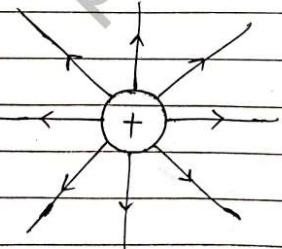
Single isolated positive charge
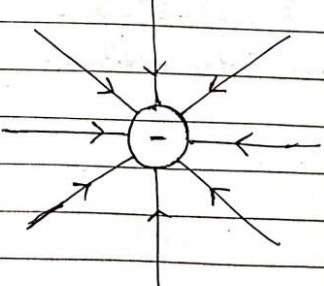
single isolated negative charge.
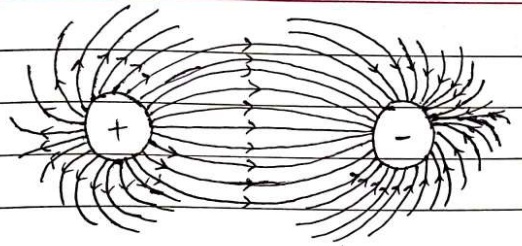
Fig: Attraction between opposite charges.
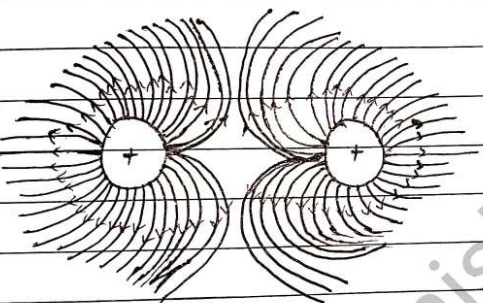
Fig.: Repulsion between same charges
Electric flux
The total number of electric lines of force passing through an area is called electric flux and denoted by \( \phi \).
It has been found that lines of forces are more close to each other in the region where electric field intensity is high. Thus, the number of electric lines of force (flux) passing through an area at a point is called a measure of the electric field intensity at that point.
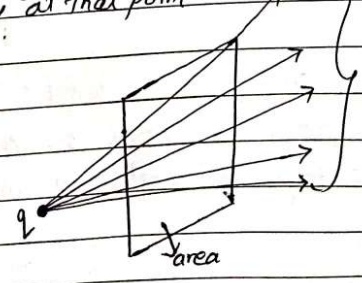
electric lines of force.
On the basis of electric lines of force, electric field intensity can also be defined as number of electric lines of force passing through unit area held perpendicular to the direction of line of force i.e.
$$ \overrightarrow{E}=\frac{\phi}{A} $$\( \Phi=\overrightarrow{E\cdot A} \)
Mathematically, the scalar product of electric field (\( \overrightarrow{E} \)) and area vector (\( \overrightarrow{A} \)) is called electric field flux.
If \( \theta \) be the angle between \( \overrightarrow{E} \) and \( \overrightarrow{A} \), then we have,
\( \therefore \overrightarrow{\phi} = E A \cos \theta \)
The electric flux per unit area is called flux density.
The SI unit of electric flux is \( \sqrt{kgm^{3}s^{-3}A^{-1}} \) or \( \sqrt{Nm^{2}c^{-1}} \).
Gauss's Law in electrostatics
It states that, "the total flux passing through any closed surface is enclosing a charge is equal to the \( \frac{1}{\varepsilon_{0}} \) times the charge enclosed by the closed surface (also called Gaussian's surface)"
i.e. Total electric flux \((\phi) = \frac{1}{3} \times q\)
$$ \therefore \phi = \frac{2}{E_{0}} $$Where, E is the permittivity of vacuum. The closed surface enclosing the charge may be of any shape and such surface are called Gaussian surface.
Flux due to a point charge (Proof of Gauss law)
Consider a point charge +q placed at a point '0'. Also consider a point 'p' at a distance 'r' from the charge and construct a sphere of radius 'r'.
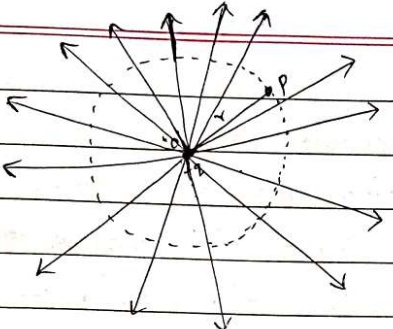
Here, the electric field intensity at point P is given as:
\( \overrightarrow{E} = \frac{1}{4\pi\varepsilon_{0}} \frac{q}{r^{2}} \)
Noo, The total lines of electric force passing through this area is given as:
From eqn(1) and eqn(ii).
\( a_{1} \) \( \Phi = \frac{1}{4\pi\varepsilon_{0}} \frac{q}{r^{2}} \). \( 4\pi r^{2} \) (\( \because A = 4\pi r^{2} \))
$$ \cos\quad\phi=\frac{q}{\varepsilon_{0}} $$ $$ \therefore \phi = \frac{1}{\varepsilon_{0}} \times 2 $$\( E q^{n}(3) \) verifies the Gauss law.
And, \( e q^{n}(3) \) is the flux due to point charge +q placed in vacuum which is \( \frac{1}{E_{0}} \) times of the given charge.
Here, the above relation is for vacuum medium and in SI unit.
Application of Gauss's law
(1) Electric field intensity due to charged sphere
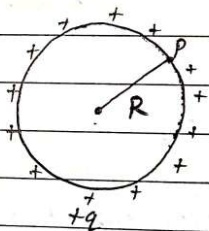
Consider a spherical body having radius R' contains charge +2.
Now, electric field intensity due to this charge, sphere is determined at different points by using Gauss theorem as:
(a) Intensity at point 'p' on the surface of sphere
let the point 'p' lie at the surface of the sphere having radius r' and contains charge +q.
Consider a Gaussian surface passing through the point P' and endizes the charged sphere. Now, the electric flux passing through this Gaussian surface can be written as:
\( \phi = EA \)
\( \therefore \phi = E4\pi R^{2} - (i) \)
Also, From Gauss theorem,
\( \phi = \frac{q}{\varepsilon_{0}} \)
\( E_{1}H\pi R^{2}=\frac{q}{\varepsilon_{0}} \) (from ①)
\( \therefore E=\frac{1}{4\pi R^{2}}\frac{q}{\varepsilon_{0}} \) —(1)
Eqn(ii) is the electric field intensity at point p which lie at the surface of sphere.
Intensity at point 'p' lie outside the sphere
let a point 'p' hit at a distance 'm' from the charged sphere. Now construct a surface through point 'p' of radius (r) = R + m which encloses the charged sphere.
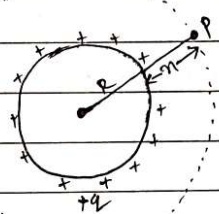
Now, The electric flux passing through this surface can be written as:
\( \Phi = EA \)
\( \therefore \Phi = E4\pi r^{2}-\Phi \) [where, \( r = R + n \)]
Applying laws theorem, The electric flux passing through this surface can be written as:
\( \phi = \frac{q}{\varepsilon_{0}} \)
\( \sigma_{1} \) \( E4\pi r^{2} = \frac{q}{\varepsilon_{0}} \)
\( \sigma_{1} \) \( E = \frac{q}{4\pi r^{2}\varepsilon_{0}} \)
\( \therefore E = \frac{1}{4\pi\varepsilon_{0}}\frac{q}{r^{2}} \) — ①
\( E_{n}(i) \) is the electric field intensity at point 'P' which lie outside the sphere.
Intensity at point p' lie at inside the sphere
Consider a point 'P' inside the sphere at a distance 'm' from the surface of sphere. Now, imagine a surface having radius \( (R-n) \) which contain the point P. The electric flux at this sphere may be:
\( \phi = EA \)
\( \therefore \phi = E4\pi(R-n)^{2} \) —①
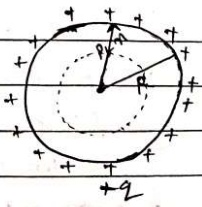
Applying laws theorem for this surface we have,
\( \phi = \frac{O}{\varepsilon_{0}} \)
or, \( E4\pi(R-n)^{2}=\frac{0}{\varepsilon_{0}} \)
\( \therefore E=0 \)
As we know that, the charge of a sphere distributed at the surface of sphere only. So, there is no any charge inside the sphere and the gaussian surface constructed with radius (R-n) donot encloses any charges.
Above relation shows that the electric field intensity inside the charged sphere is zero.
(2) Electric field intensity due to linear charged conductor
Consider a linear charge conductor having uniform charge distribution, its linear charge density (\( \lambda \)) given as:
\( \lambda = \frac{q}{L} \), where L is the length of conductor
Let a point \(P'\) at a distance \(r\) from the conductor where electric field intensity is to be determined.
Consider a imaginary cylindrical surface of small length \(L\) which contains the point \(P'\) Now, the charge encloses throughout this surface can be written as
\(\therefore q = 2L - 1\)
The electric flux passing through this cylindrical surface is given as:
\( \phi = EA \)
\( \therefore \phi = E2\pi r\ell - (ii) \)
According to Gauss's theorem, Electric flux passing through this surface is:
$$ \phi=\frac{q}{\varepsilon_{0}} $$ $$ \alpha_{1} \quad \Phi = \frac{\alpha \ell}{\varepsilon_{0}} \quad (from eq\text{①}) $$ $$ \text{or} \quad E2\pi r \bcancel{\ell } = \lambda \bcancel{\ell } \quad (from eq(ii)) $$ $$ \therefore \text{E} = \frac{\lambda}{2\pi r \varepsilon_{0}} $$∴ This is the relation of electric field intensity at a point near the linear charged conductor.
(3) Electric field intensity due to plane charged conductor
Consider a plane charged conductor having uniform charge distribution and surface charge density (σ) of this plane charged conductor is given as:
\( \therefore \sigma = \frac{q}{2} - \frac{1}{2} \)
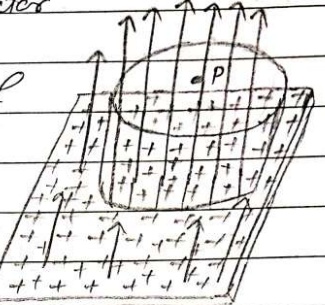
Consider, a point 'P' outside. Fig: showing plane charged conductor with electric lines of force.
the conductor Where electric field intensity is to be determined.
Construct a cylindrical shape having base area 'A' which contains the point 'P'.
The total electric flux passing through the base of cylindrical shape is given as:
\( \Phi = E A \) —(1)
\( \phi = EA \) —(ii)
Now, According to Gauss theorem, the electric flux passing through the cylinder is given as:
\( \phi = \frac{q}{\varepsilon_{0}} \rightarrow (ii) \)
from①, \( q = \sigma A \)
NaO, In eq \( ^{n} \)(iii),
\( \Phi=\frac{q}{\varepsilon_{0}} \)
\( a_{1}EA=\frac{6A}{\varepsilon_{0}} \) (From ① and \( q=\frac{6A}{1} \))
Eq(iv) is the relation for electric field intensity due to plane charged is equal to the \( \frac{1}{E_{0}} \) times of \( \sigma \).
(4) Electric field Intensity due to plane charged sheet
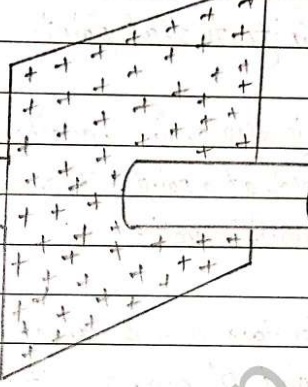
Consider an inhile length plane sheet with a uniform charge density (\( \sigma \)).
Lel, 'p' be a point near to sheet Where electric field intensity is to be determined. For this consider a small area 'A' surrounding point 'P' with its plane parallel to the sheet and construct cylindrical gaussian surface whose walls are perpendicular to the sheet, extending by an equal distance on both sides of the surface.
Fig. Electric field of plane charged Sheet.
Total electrical flux passing through the two end flat faces is given as \( \phi = 2E \times A \xrightarrow{(i)} \)
According to Gauss theorem,
\( \phi = \frac{q}{\varepsilon_{0}} \rightarrow (1) \)
Here, \( q = \sigma A \), so above \( e a^{n} \) becomes,
\( \phi = \frac{\sigma A}{\varepsilon_{0}} \)
or, \( 2EA = \frac{\sigma A}{\varepsilon_{0}} \)
or, \( E = \frac{G A}{2 R E_{0}} \)
\( \therefore \sqrt{E} = \frac{6}{2 E_{0}} \) — (iii)
This is the formula for electric field intensity due to plane charged sheet.