Forces in Nature
- Gravitation (mass dependent)
- Electromagnetic (Charge dependent)
- Short range nuclear force (distance dependent active in \( 10^{-15} \) m)
- Weak force (Active in \( 10^{-17} \) m)
Newton's Law of Gravity
Let us consider the force of attraction between two bodies of mass \( m_{1} \) and \( (m_{2}) \) separated by distance \( d' \) from their centre is directly proportional to the product of their mass and inversely proportional to the square of their separation from their centre.
i.e. \( f \propto m_{1} m_{2} \) — ①
Also, \( f \propto \dfrac{1}{d^{2}} \) — ②
Combining equation ① and ②
\( F \propto \dfrac{m_{1} m_{2}}{d^{2}} \)
or, \( F = G \dfrac{m_{1} m_{2}}{d^{2}} \) — ③
Where \( G \) is proportionality constant called Universal Gravitational Constant and its value is \( 6.67 \times 10^{-11} \, Nm^{2}kg^{-2} \).
Acceleration due to gravity
Let us consider a body of mass \( m \) lies on a surface of the earth having mass \( M \) and radius \( R \).
Then, According to the Newton's Law of gravitation, the force of attraction between earth and body is given by:
\( F = \dfrac{G M m}{R^{2}} \) — ①
If \( g \) be the acceleration due to gravity than according to the Newton's Second law of motion, the force of on the body is given by:
\( F = m g \) — ②
From equation ① and ②, we get:
\( m g = \dfrac{G M m}{R^{2}} \)
or, \( g = \dfrac{G M}{R^{2}} \) — ③
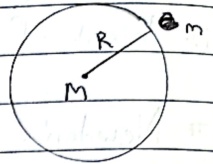
This is the req. expression for acceleration due to gravity and it shows that \( g \) is independent on the mass of the body.
Variation of acceleration due to gravity
1. Due to shape of earth
We know,
$$ g = \dfrac{G M}{R^{2}} $$
$$ \Rightarrow g \propto \dfrac{1}{R^{2}} $$
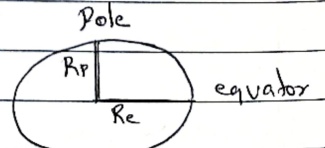
Fig: Variation of \( g \) due to the shape of earth.
Since, Polar radius (\( R_{p} \)) is smaller than equatorial radius (\( R_{e} \)). So, acceleration due to gravity at pole is greater than that of a equator. i.e. \( g_{p} > g_{e} \) when \( R_{e} > R_{p} \)
Due to height (Altitude)
Let \( M \) be the mass of earth and \( R \) be its radius. Also, let P be any point on the earth surface. So acceleration due to gravity at point \( P \) is given by:
\( g = \dfrac{G M}{R^{2}} \) — ①
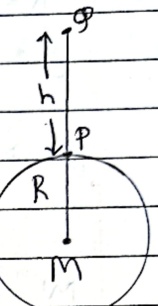
Again, let \( q \) be any point at height \( h \) from the surface of the earth. So, acceleration due to gravity at point \( q \) is given by:
\( g' = \dfrac{G M}{(R + h)^{2}} \)
Dividing eq. (ii) by (i)
\( \dfrac{g'}{g} = \dfrac{R^{2}}{(R + h)^{2}} = \dfrac{1}{\left(1 + \dfrac{h}{R}\right)^{2}} \)
or, \( \dfrac{g'}{g} = \dfrac{1}{\left(1 + \dfrac{h}{R}\right)^{2}} \)
Using binomial expansion and neglecting higher power terms,
\( \dfrac{g'}{g} = 1 - \dfrac{2h}{R} \)
or, \( g' = g \left(1 - \dfrac{2h}{R}\right) \)
Equation (iii) shows that acceleration due to gravity goes on decreasing when height increases.
Variation of \( g' \) due to depth
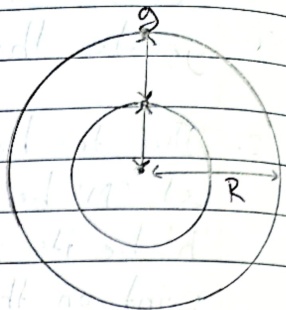
Let \( m \) mass of a body at \( x \) depth from earth's sphere.
- \( M \) mass of earth
- \( R \) radius of earth
- \( g \) acceleration due to gravity on surface of earth.
- \( g' \) acceleration due to gravity at \( x \) depth from earth surface.
- \( M' \) mass of earth of radius \((R-x)\)
Now, At surface
\( g = \dfrac{GM}{R^{2}} \)
\( g' = \dfrac{GM'}{(R-x)^{2}} \)
Now,
\( \dfrac{g'}{g} = \dfrac{R^{2}}{(R-x)^{2}} \cdot \dfrac{M'}{M} \)
\( g' = g \dfrac{R-x}{R} \)
\( g' < g \)
Gravitational field
The space around the earth where a body experiences its force of attraction is called its field. It is represented by \( f \).
Gravitational strength
The gravitational force experienced per unit mass of a body in its field is called gravitational field strength.
\( E = \dfrac{F}{m} = \dfrac{G M m}{R^{2} \cdot m} = \dfrac{G M}{R^{2}} = g = \text{acc. due to gravity} \)
Gravitational Potential Energy
Gravitational Potential energy at a point is defined as "amount of work done on bringing mass \( m \) of any body from infinity to that point."
Let \( M \) mass of earth
\( R = \text{radius of earth} \)
Let P be a point at a distance \( r \) from the centre O of the earth.
\( m = \text{mass of body at infinity} \)
Now,
\( F = \dfrac{G M m}{x^{2}} \) — ①
Work done \( dw \) by this force on moving the body in small displacement \( dx \) from point A to B is,
\( dw = \dfrac{G M m}{x^{2}} dx \) — ② Where, \( G M m = F \)
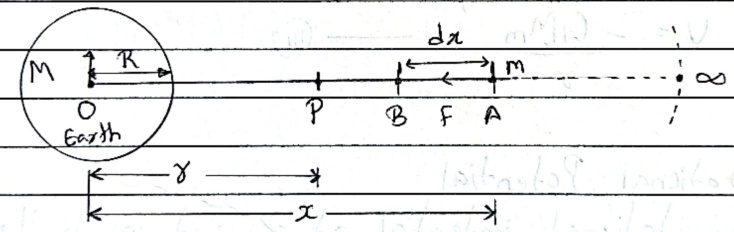
Now, Integrating equation ② from \( \infty \) to \( r \). Therefore,
\( W = \int_{\infty}^{r} dw = \int_{\infty}^{r} \dfrac{G M m}{x^{2}} dx = G M m \int_{\infty}^{r} x^{-2} dx \)
\( = G M m \left[\dfrac{-1}{x}\right]_{\infty}^{r} = -G M m \left[\dfrac{1}{r} - \dfrac{1}{\infty}\right] \)
\( \therefore W = -\dfrac{G M m}{r} \)
This work done is equal to gravitational potential energy \( U \) of mass \( m \) at point P.
\( \therefore U = -\dfrac{G M m}{r} \) — ③
Gravitational Potential
The gravitational potential at a point inside the gravitational field is defined as the amount of work done in bringing a unit mass from infinity to that point without acceleration. It is denoted by \( V \). It's SI unit is Jkg⁻¹.
Escape Velocity
It is the velocity of a body with which if projected from earth surface goes into space.
We know,
\( F = \dfrac{G M m}{x^{2}} \)
\( dW = F \, dx \)
$$ (1)\ dW = G M m\, x^{-2}\, dx $$
Integrating
$$ \begin{aligned} W &= \int_{R}^{\infty} G M m\, x^{-2}\, dx \\ &= G M m\left[\dfrac{x^{-2+1}}{-2+1}\right]_{R}^{\infty} \\ &= G M m\left[\dfrac{-1}{x}\right]_{R}^{\infty} \end{aligned} $$
$$ = -G M m\left[\dfrac{1}{\infty} - \dfrac{1}{R}\right] $$
$$ W = \dfrac{G M m}{R} \longrightarrow \text{①} $$
$$ K.E. = \dfrac{1}{2} m V_{e}^{2} $$
But, \( K.E. = W \)
$$ \dfrac{1}{2} m V_{e}^{2} = \dfrac{G M m}{R} $$
$$ V_{e}^{2} = \dfrac{2 G M}{R} $$
$$ V_{e} = \sqrt{\dfrac{2 G M}{R}} $$
$$ V_{e} = \sqrt{2 g R} $$
$$ \begin{aligned} \text{Note:} &\sqrt{\dfrac{2GM}{R}\cdot\dfrac{R}{R}} \\ &=\sqrt{2\left(\dfrac{GM}{R^{2}}\right)R}=\sqrt{2gR} \end{aligned} $$
Orbital Velocity of Satellite
The Velocity required to keep a Satellite into its orbit is called the orbital velocity of the satellite. It is denoted by \( V_{0} \).
Let \( m = \) mass of satellite
\( M = \) mass of planet
\( r = \) radius of orbit of satellite
\( V_{0} = \) Orbital Velocity of satellite
Now Centripetal Force on Satellite
\( F = \dfrac{m V_{0}^{2}}{r} \) — ①
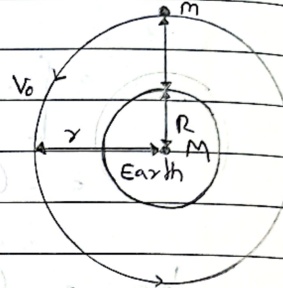
Gravitational force between planet and satellite
\( F = \dfrac{G M m}{r^{2}} \) — ②
From ① and ②
\( V_{0} = \sqrt{\dfrac{G M}{r}} \)
\( V_{0} = \sqrt{\dfrac{G M}{R + h}} \quad [\therefore r = R + h] \)
\( V_{0} = \sqrt{\dfrac{g R^{2}}{R + h}} \quad [\therefore g = \dfrac{G M}{R^{2}}] \)
Now, When satellite is cut close to earth surface, then
\( R + h \rightarrow R \) i.e. \( h \rightarrow 0 \)
from equation (ii), we get
\( V_{0} = \sqrt{\dfrac{g R^{2}}{R}} \)
\( \therefore V_{0} = \sqrt{g R} = 7.2 \, km/s \)
Time Period of Satellite (T)
It is the time taken by the Satellite to make one complete revolution around the Earth.
\( \therefore T = \dfrac{\text{Circumference of orbit}}{\text{orbital Velocity}} \)
or, \( T = \dfrac{2\pi r}{V_{0}} \)
or, \( T = 2\pi r \sqrt{\dfrac{r}{GM}} \) \( \left[ \because V_{0} = \sqrt{\dfrac{GM}{r}} \right] \)
or, \( T = 2\pi \sqrt{\dfrac{r^{3}}{GM}} \)
or, \( T = 2\pi \sqrt{\dfrac{(R+h)^{3}}{gR^{2}}} \) \( \left[ \because r = R + h \ & \ GM = gR^{2} \right] \)
When \( h = 0 \)
\( T = 2\pi \sqrt{\dfrac{R^{3}}{gR^{2}}} = 2\pi \sqrt{\dfrac{R}{g}} = 84 \) minutes
Height of Satellite (h)
We have,
\( T = 2\pi \sqrt{\dfrac{(R+h)^{3}}{GM}} \)
or, \( (R+h)^{3} = \dfrac{T^{2} GM}{4\pi^{2}} \)
or, \( (R+h) = \left[ \dfrac{T^{2} g R^{2}}{4\pi^{2}} \right]^{1/3} \)
or, \( h = \left( \dfrac{T^{2} g R^{2}}{4\pi^{2}} \right)^{1/3} - R \)
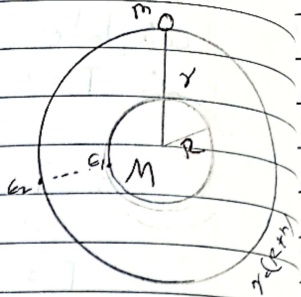
Geostationary Satellite
The Satellite which seems to be stationary when viewed from a point on the earth's surface is called geostationary satellite.
Centre of Gravity (C.G)
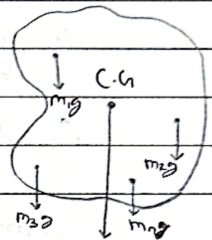
The Centre of gravity of a body is defined as a point at which the algebraic sum of the moments of weights of all the particles constituting the body is zero.
Let us consider a body of mass \( M \) consist of n particles of masses \( m_{1}, m_{2}, m_{3}, \ldots, m_{n} \) resp.
The force due to gravity on these masses are \( m_{1}g, m_{2}g, m_{3}g, \ldots, m_{n}g \) resp. all acting vertically downwards. Then,
\( W = m_{1}g + m_{2}g + m_{3}g + \ldots + m_{n}g \)
\( \therefore W = Mg \)
Where M is the sum of all particle masses
Centre of Mass (C.M)
A point with respect to a body at which the whole mass of the body is supposed to be concentrated, is called centre of mass.
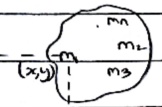
Let us consider a system of n particles of masses \( m_{1}, m_{2}, \ldots, m_{n} \) with coordinate position \( (x_{1}, y_{1}), (x_{2}, y_{2}), (x_{3}, y_{3}), \ldots, (x_{n}, y_{n}) \), respectively.
Let \( (x,y) \) be the coordinate of cm.
The various force masses force acting are \( f_{1} = m_{1}a_{1} \), \( f_{2} = m_{2}a_{2} \), \( \ldots \), \( f_{n} = m_{n}a_{n} \) where \( a_{1}, a_{2}, a_{3} \ldots \) an are acceleration produced on masses \( m_{1}, m_{2}, m_{3} \ldots m_{n} \) resp.
Total force acting on a body,
\( F_{1} + f_{2} + f_{3} + \ldots + f_{n} \)
\( m_{1}a_{1} + m_{2}a_{2} + m_{3}a_{3} + \ldots + m_{n}a_{n} \)
\( or, \Sigma f = \dfrac{d^{2}}{dt^{2}} (m_{1}x_{1} + m_{2}x_{2} + \ldots + m_{n}x_{n}) \)
Total mass \( \Sigma m = m_{1} + m_{2} + \ldots + m_{n} \)
Now, \( \Sigma f = \Sigma m \dfrac{d^{2}}{dt^{2}} \left( \dfrac{m_{1}x_{1} + m_{2}x_{2} + \ldots + m_{n}x_{n}}{\Sigma m} \right) \)
\( \therefore x = \dfrac{m_{1}x_{1} + m_{2}x_{2} + \ldots + m_{n}x_{n}}{m_{1} + m_{2} + \ldots + m_{n}} \)
Similarly,
\( y = \dfrac{m_{1}y_{1} + m_{2}y_{2} + \ldots + m_{n}y_{n}}{m_{1} + m_{2} + m_{3} + \ldots + m_{n}} \)
\( So, (x,y) = \left( \dfrac{m_{1}x_{1} + m_{2}x_{2} + \ldots + m_{n}x_{n}}{m_{1} + m_{2} + \ldots + m_{n}}, \dfrac{m_{1}y_{1} + m_{2}y_{2} + \ldots + m_{n}y_{n}}{m_{1} + m_{2} + \ldots + m_{n}} \right) \)
Condition for a body in stable Equilibrium
- The C.G of the body should lie as low as possible.
- The base of the body should be as large as possible.
- C.G should lie with in the base of the body on displaced position.