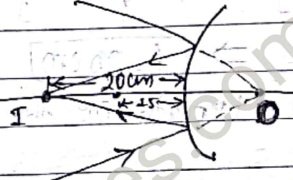
Some terms
[1] Luminous objects
The objects that emit light of their own are known as luminous objects. For e.g.: Sun, Stars, torch light etc.
[2] Non-Luminous Objects
The Objects which do not emit light of their own are known as non-Luminous Objects. For e.g.: moon, wood, water, planets, etc.
[3] Transparent Objects
The objects which allow light through them are known as transparent objects. For e.g. Air, clean water, glass, diamond, etc.
[4] Translucent Objects
The objects which allow light to pass partially from one side to another are known as translucent objects. For e.g. Kerosened paper, white plastic, etc.
[5] Opaque Objects
the objects which do not allow light to pass through them are known as opaque objects. For e.g.: A concrete wall, wooden door, dark plastic, thick curtain, etc.
Fig. 1 Reflection of light.
Reversibility of Light
When the final path of the light is reversed, then it retraces it original initial path. This phenomenon is known as reversibility of light.
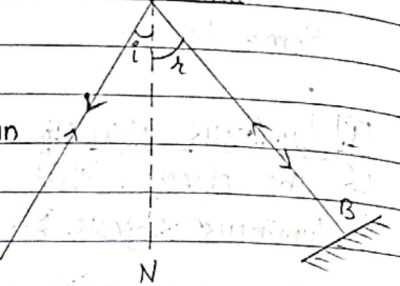
Fig: Reversibility of light
Laws of Reflection
- The incident ray, the reflected ray and the normal at the point of incidence all lie in the same plane.
- The angle of incidence (i) and angle of reflection (r) are equal, i = r.
- A normally incident ray on a surface is reflected back along the same initial path of incidence.
Object distance and Image distance
the distance of Object from the mirror is called Object distance. It is denoted by 'u'.
Similarly, the distance of Image from the mirror is called Image distance. It is denoted by 'V'.
$$ u = -V $$
For plane Mirror.
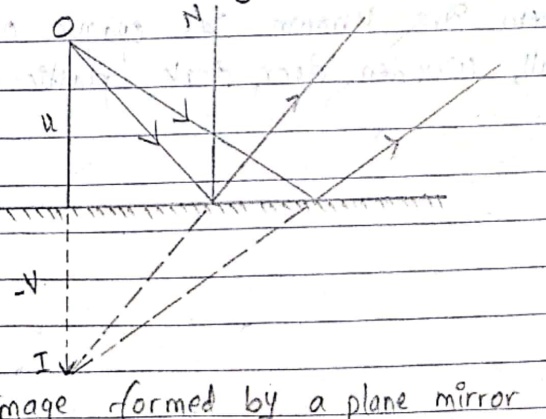
Fig: Image formed by a plane mirror
Real Object and Virtual Object
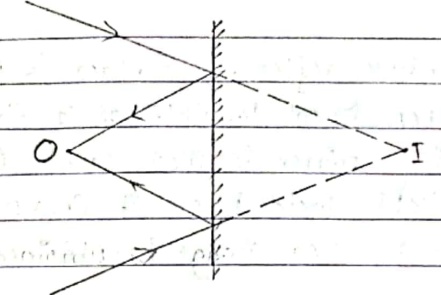
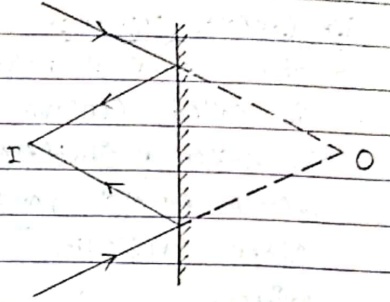
Fig: Virtual Image for Real Object Fig: Real image for Virtual object.
Real Image and Virtual Image
Real Image
- It is formed by the actual intersection of reflected or refracted rays.
- It can be obtained on the screen.
- It is inverted w.r.t. the object.
Virtual image
- It is formed by the virtual intersection of reflected or refracted rays.
- It can't be obtained on the screen.
- It is erect w.r.t. the object.
Reflection at Curved Mirrors
A mirror whose reflecting Surface is curved is called a curved mirror and curved Surface may be either Concave, Convex or cylindrical.
Spherical Mirror
If the reflecting Surface of a mirror is a portion of a hollow Spherical glass, the mirror is called spherical mirror.
It is of two types:
1. Concave Mirror
The Spherical mirror whose reflecting Surface is Curving inward is called Concave mirror. Focal length of a Concave mirror is taken positive(+ve). This mirror is also called Converging mirror because parallel rays of light incident on it Converge at a point after reflection from it. Real image is obtained by Concave mirror.
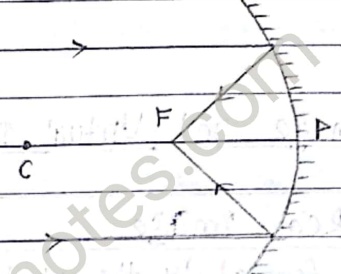
Fig: Reflection through concave mirror
2. Convex Mirror
the spherical mirror whose reflecting Surface is Curving Outward is called Convex mirror. Focal length(s) of a Convex mirror is taken negative (-ve). This mirror is also called diverging mirror because parallel rays of light incident on it diverge and hence appear to converge at a point after reflection from it. Virtual image is obtained by Convex mirror.
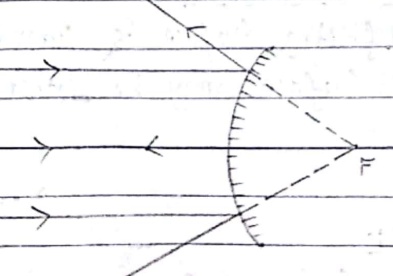
Fig: Reflection through Convex mirror.
Terms in Spherical Mirrors
[1] Aperture
The effective width of a spherical mirror from which reflection can take place is called its aperture. It is the width (breadth) of a mirror.
[2] Pole
The geometric centre of the Spherical mirror is called pole. It is denoted by 'P'.
[3] Centre of Curvature
the centre of sphere, of which the spherical mirror is a part is called Centre of Curvature. It is denoted by 'c'.
[4] Radius of Curvature
A part which is radius of Spherical mirror is called radius of Curvature. It is denoted by \( r' \).
OR,
The distance between 'C' & 'p' is called Radius of Curvature.
[5] Principal axis
The line passing through the p and c is called principal axis.
Focus
The point of principal axis of mirror where the ray of light parallel to it either pass (in concave m) or appear to converge (in convex m) after reflection from it is called focus of the mirror. It is denoted by 'F'.
Focal Length
the distance between pole and principal focus of the mirror is called focal length. It is denoted by 'f'.
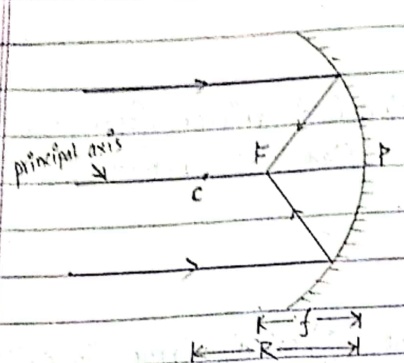
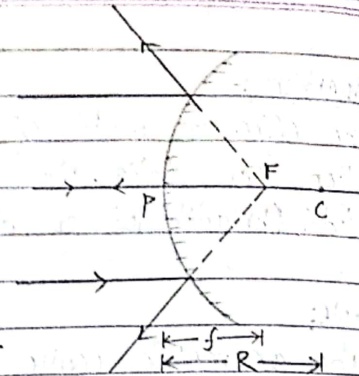
Fig: Reflection from Concave Mirror
Fig: Reflection from Convex Mirror
Relation between \( f' \) & \( R' \)
For a spherical mirror (both Concave & Convex), the f' is half of its R'.
Concave Mirror
From figure 1:
$$ i=r $$ [::law of Reflection]
$$ i=\alpha $$ [:: alternate angles]
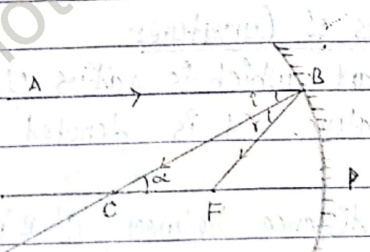
$$ \Rightarrow \begin{bmatrix} i = \alpha = r \end{bmatrix} $$
$$ \Rightarrow CF = BF $$ [∵ r = α]
Since, aperture taken too small,
$$ \Rightarrow BF = FP $$
$$ \therefore CF = FP $$
$$ OR, OP - FP = FP $$
$$ OR, R = 2(f) $$
$$ \Rightarrow R = 2f $$ which shows f is half of R.
Fig. Reflection from Concave mirror
Convex Mirror
★ Similarly like as Concave mirror.
$$ \Rightarrow R = 2f $$
Mirror Formula
The formula which shows the relation between Object distance, image distance and focal length of a mirror is called mirror formula and it is given by:
$$ \frac{1}{f} = \frac{1}{u} + \frac{1}{V} $$ where f = focal length, u = object distance, v = image distance.
Proof
Concave Mirror (Real Image)
$$ A^{p}=u $$
$$ A^{p}=V $$
$$ F_{p}=f $$
$$ C_{D}=2f $$ $$ [\because R=2f] $$
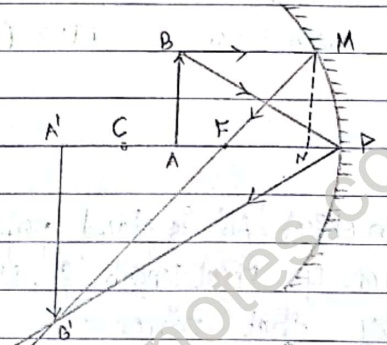
Fig: Real Image formed by Concave mirror
Let us consider an object AB is placed perpendicular to the principal axis of Concave mirror of Focal length f. Also let A'B' be the real image formed by that mirror.
In above figure,
\(\triangle APB\) and \(A^{\prime}BP\) are Similars;
$$ \frac{A^{\prime}B^{\prime}}{A B}=\frac{A^{\prime}P}{A P} $$
or, $$ \frac{A'B}{AB} = \frac{V}{u} \rightarrow (1) $$
Also, $$ \Delta A'B'F \sim \Delta MNF $$
or, $$ \frac{A'B}{MN} = \frac{AF}{FN} $$
$$ \Rightarrow \frac{AB'}{AB} = \frac{AF}{FN} $$ [AB = MN]
If the aperture of the mirror is very small then N lies very close to P. i.e. FN ≈ FP
$$ \therefore \frac{A'B}{AB} = \frac{AF}{FP} = \frac{AP - FP}{FP} = \frac{V - f}{f} \rightarrow (2) $$
From eq(1) and (2)
$$ \frac{V}{u} = \frac{V - f}{f} \Rightarrow Vf = uv - uf $$
$$ \Rightarrow uv = uf + vf \rightarrow (ii) $$
Dividing both sides by $$ uvf $$ of eq(ii)
or, $$ \frac{uv}{uvf} = \frac{vf}{uvf} + \frac{uf}{uvf} $$
$$ \Rightarrow \left[ \frac{1}{f} = \frac{1}{u} + \frac{1}{v} \right] $$ which is mirror formula.
- f for Concave mirror $$ \Rightarrow $$ +ve
- f for Convex mirror $$ \Rightarrow $$ -ve
Concave Mirror [Virtual image]
$$ Ap = u $$
$$ A'p = -V $$
$$ EP = f $$
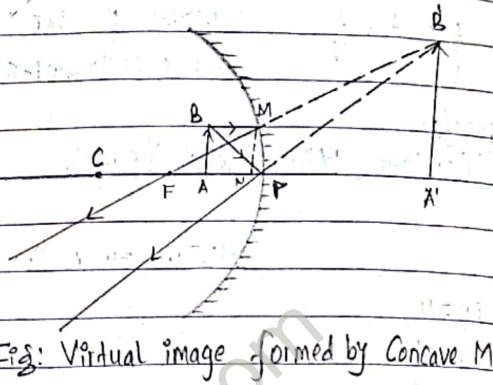
Fig: Virtual image formed by Concave Mirror.
Let us consider, an object 'AB' is placed perpendicular to the principal axis of Concave mirror of Focal length f'. Also Let, A'B' be the virtual image formed by that mirror.
In above figure,
$$ \Delta A B^{\prime}P \sim \Delta A B P $$
$$ So, \frac{A^{\prime}B^{\prime}}{AB}=\frac{A^{\prime}P}{AP}=\frac{-V}{u} $$
Also, $$ \Delta A^{\prime}B^{\prime}F \sim \Delta M N F $$
$$ So, \frac{A^{\prime}B^{\prime}}{MN} = \frac{A^{\prime}F}{FN} $$
$$ \Rightarrow \frac{A^{\prime}B^{\prime}}{AB} = \frac{A^{\prime}F}{FN} \quad [\because AB = MN] $$
$$ A^{\prime}B^{\prime}=A^{\prime}P+P F $$
or, $$ \frac{A^{\prime}B^{\prime}}{AB} = -\frac{V + f}{f} $$
If the aperture of the mirror is too small, then point N lies very close to P, i.e. $$ F_{N} \approx F_{P} $$.
$$ \frac{-v}{u} = \frac{-v + f}{f} $$
Or, $$ -Vf = -uv + uf $$
Or, $$ uv = Vf + uf \rightarrow (iii) $$
From $$ eq^{n}(1) $$ and (2):
$$ \frac{A^{\prime}B^{\prime}}{A B}=\frac{A^{\prime}F}{F P} $$
Dividing both sides of equation (iii);
$$ \text{or} \quad \frac{u v}{u v f}=\frac{v f}{u v f}+\frac{u f}{u v f} $$
$$ \Rightarrow\left|\frac{1}{f} = \frac{1}{u} + \frac{1}{v}\right| $$
which is Mirror formula.
Convex Mirror (Virtual Image)
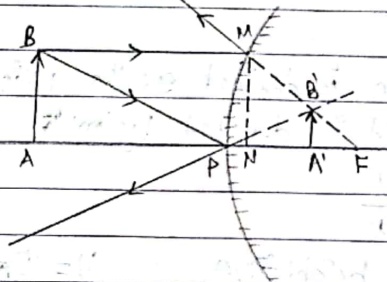
Fig: Virtual image formed by convex mirror
Let us consider, an object AB is placed perpendicular to the principal axis of convex mirror of focal length f. Also let, A'B' be the virtual image formed by the mirror, then,
In above figure, $$ \Delta A^{\prime}B^{\prime}P \sim \Delta AB^{\prime}P $$
$$ So, \frac{A^{\prime}B^{\prime}}{AB} = \frac{A^{\prime}P}{AP} = \frac{-V}{u} $$
Also
$$ \Delta A^{\prime}B^{\prime}F \sim \Delta MNF $$
$$ So, \frac{A^{\prime}B^{\prime}}{MN} = \frac{A^{\prime}F}{FN} $$
$$ \frac{A^{\prime}B^{\prime}}{AB} = \frac{A^{\prime}F}{FN} $$ [∵ AB = MN]
If the aperture of the mirror is too small, then point N lies very close to P, i.e. $$ FN \approx FP $$
$$ \frac{A'B'}{AB} = \frac{A'F}{FP} $$
$$ A'B' = FP - AP $$
$$ OR, AB = FP $$
$$ A'B' = -f + V $$
$$ OR, AB = -f $$
From $$ eq^{(i)} $$ and $$ (ii) $$;
$$ \Rightarrow -\frac{V}{u} = -\frac{f + V}{-f} $$
$$ OR, VF = UV - uf $$
$$ OR, UV = VF + uf $$ — (iii)
Dividing both sides of $$ eq^{(iii)} $$ by $$ uvf $$
$$ \frac{UV}{uvf} = \frac{VF}{uvf} + \frac{uf}{uvf} $$
$$ \Rightarrow \left[ \frac{1}{f} = \frac{1}{u} + \frac{1}{v} \right] \rightarrow (iv) $$
which is mirror formula.
Linear Magnification
Linear magnification is defined as the ratio of the size of image to the size of object.
OR
Linear magnification is defined as the ratio of image distance to the object distance, it is denoted by $$ m' $$
i.e. $$ m = \frac{I}{O} \text{ or } \frac{V}{u} $$
where, I = image height (size), V = Image distance, O = Object height (size) & u = Object distance.
Q.[1] Where should we stay for shaving by using Concave mirror?
We should stay keeping face nearer than the focus of Concave mirror so that the image will be magnified and erect, which makes us comfortable to see our face.
Numerical
Q. 207 Set D Q.No.11
At what position an object be placed from front of a Concave mirror of radius of curvature 0.4 m so that an erect image of magnification 3 be produced?
Solution:
Here, In a concave mirror
R = 0.4 m, m = 3, V is negative due to erect image
Then, $$ f = \frac{R}{2} = \frac{0.4}{2} = 0.2 $$ m. & m = 3
Or, $$ -\frac{v}{u}=3 \Rightarrow v=-3u $$
Now, $$ \frac{1}{f} = \frac{1}{u} + \frac{1}{v} $$
Or, $$ \frac{1}{0.2} = \frac{1}{u} - \frac{1}{3u} $$ $$ \Rightarrow $$ $$ 5 = \frac{1}{u} (1 - \frac{1}{3}) $$ $$ \Rightarrow $$ $$ 5u = \frac{2}{3} $$ $$ \Rightarrow $$ $$ u = 0.133 $$
Thus, Object be placed 0.133 m. far from mirror.
Q. 2066 Old Q.NO.7(6)
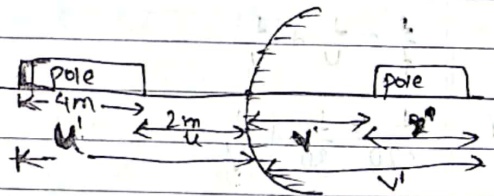
A pole 4m long is laid along the principal axis of a convex mirror of focal length 1 m. The end of the pole nearer the mirror is 2m, from it. Find the length of the image of the pole.
$$ f=-1m $$
$$ u=2m, v=? $$
NOW,
$$ \frac{1}{f}=\frac{1}{u}+\frac{1}{v} $$
$$ \frac{1}{-1}=\frac{1}{2}+\frac{1}{V} $$
$$ \frac{1}{V}=-1-\frac{1}{2}=\frac{-3}{2} $$
$$ V = -\frac{2}{3} $$
Again for far end (u = 6 m):
$$ \frac{1}{-1}=\frac{1}{6}+\frac{1}{v'} $$
$$ \frac{1}{v'}=-1-\frac{1}{6}=-\frac{7}{6} $$
$$ v'=-\frac{6}{7} $$
Length of image $$ = |v|-|v'| = \frac{2}{3}-\frac{6}{7} = \frac{4}{21} \approx 0.19 $$ m
thus, size of image = 0.19 m.
Q. [2060 Q.NO.7(6)]
An erect image, three times the size of the object is obtained with a Concave mirror of radius of curvature 36 cm. What is the position of the object.
Solving:
m = 3.0, $$ R = 36 \, \text{cm} \Rightarrow f = 18 \, \text{cm} $$, $$ u = ? $$
Here, $$ \frac{I}{O} = -3 $$
$$ \Rightarrow \frac{V}{u} = -3 $$
$$ [ \because \frac{I}{O} = \frac{V}{u} ] $$
$$ \Rightarrow v = -3u $$
NOW, $$ \frac{1}{f} = \frac{1}{u} + \frac{1}{V} $$ $$ \Rightarrow \frac{1}{18} = \frac{1}{u} + \frac{1}{-3u} $$ $$ \Rightarrow \frac{1}{18} = \frac{2}{3u} $$
$$ \Rightarrow u = 12 \, \text{cm} $$
Thus, Object is 12 cm far from the mirror.
Q. [2055 Q.NO.15(b)]
Calculate the focal length of a Concave mirror when an object placed at a distance of 40 cm. makes image equal to the size of the object.
Solving:
$$ u = 40 \, \text{cm}, \, I = O \Rightarrow [m = 1] \quad [\therefore m = \frac{I}{O}] $$
$$ v = ? $$
WE know: $$ m = \frac{V}{u} \Rightarrow 1 = \frac{V}{40} \Rightarrow v = 40 \, \text{cm} $$
Again, $$ \frac{1}{f} = \frac{1}{u} + \frac{1}{V} \Rightarrow \frac{1}{f} = \frac{1}{40} + \frac{1}{40} \Rightarrow \frac{1}{f} = \frac{2}{40} \Rightarrow \frac{1}{f} = \frac{1}{20} $$
$$ \Rightarrow [f = 20 \, \text{cm}] $$
Thus, focal length of the concave mirror is 20 cm.
Q. 2053 Q.NO.13
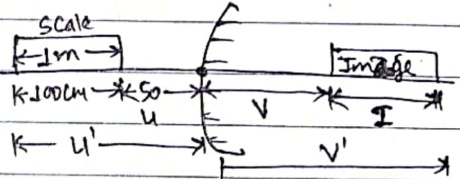
A metre scale is placed along the axis of a convex mirror of focal length 25cm, its nearer end being at a distance of 50cm, calculate the size of the image formed.
$$ f = 25 \, \text{cm} $$
$$ \frac{1}{f} = \frac{1}{u} + \frac{1}{v} $$
$$ \frac{1}{-25}=\frac{1}{50}+\frac{1}{V} $$
$$ \frac{1}{V}=-\frac{1}{25}-\frac{1}{50}=-\frac{3}{50} $$
$$ V=-\frac{50}{3} $$
For far end u = 150 cm:
$$ \frac{1}{-25}=\frac{1}{150}+\frac{1}{v'} $$
$$ \frac{1}{v'}=-\frac{1}{25}-\frac{1}{150}=-\frac{7}{150} $$
$$ v'=-\frac{150}{7} $$
$$ I=\frac{150}{7}-\frac{50}{3} = \frac{100}{21} $$
$$ I = 4.76\,(cm) $$
Thus, size of image is 4.76 cm.
Q. 2050 Q. No.15
A Convex mirror with a radius of Curvature 30 cm. Forms a real image 10 cm. from its pole. Explains how it is possible and find whether the image is erect or inverted.
$$ R=30cm $$ $$ \Rightarrow [f=15cm] $$
When the Converging rays of Light are incident, then image formed as real image.