Conduction
Conduction is the process of transfer of heat from one point to another. The point of a body carried out by means of collisions between rapidly vibrating atoms at hotter region and slowly vibrating atoms to at colder regions.
Thermal Conductivity
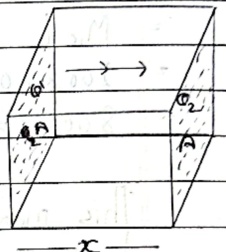
Let us consider a cube having side \(x\) and area of each face (A). Also let left end be at temperature \(T_{1}^{\circ}C\) and right end be at \(T_{2}^{\circ}C\) such that \(T_{1}>T_{2}\). So flow of heat takes place from left and end to right.
Experimentally, it has been found that the amount of heat(\(\phi\)) transfer between two faces are in time (t) is found to be;
Directly proportional to area of each face
i.e. \( \phi \propto A \) —①
Directly proportional to temperature between two faces
i.e. \( \varphi \propto (T_{1}-T_{2}) \) —②
Directly proportional to time for which heat flows, i.e. \( \varphi \propto t \) —③
Inversely proportional to the distance between two faces.
i.e. \( Q \propto \frac{1}{x} \) —④
Combining all equations, we get \( Q \propto A \frac{(T_{1} - T_{2})}{x} \)
or, \( Q = kA(T_{1}-T_{2})t \) ——⑤ where k is the proportional constant called thermal conductivity.
Also, \( \frac{Q}{t} = kA\frac{(T_{1} - T_{2})}{x} \).
If \( A = 1 \, m^2 \), \( T_1 - T_2 = 1^{\circ}C / 1k \) and \( x = 1 \, m \) then,
\( k = \frac{\phi}{t} \)
Thus
Thermal conductivity of material is numerically equal to the rate of flow of heat between two faces having area of each \( 1m^{2} \) Separated by distance 1m and maintained at temperature of \( 1^{\circ}C/1k \).
Mode of transfer of heat
1. Conduction
The mode of transfer of heat in which heat is transfer between two points without actual movement of particle is called conduction. Eg: Heat transfer in solid.
2. Convection
The mode of transfer of heat in which heat is transferred between two points by actual movement of particle is called convection. Eg: Heat transfer in liquid and gas.
3. Radiation
The mode of transfer of heat without presence of any medium in the form of infrared wave is called radiation.
Eg: Transfer of heat from sun to earth surface
Black Body
The substance which completely absorbs the heat radiation of all wave falling on it is known as perfect black body. Its absorption coefficient is unity. The sun emits radiation of all wave lengths. So, it may be regarded as black body even though it looks white. Black body absorbs 96% to 98% of incident radiation.
Ferry's Black Body
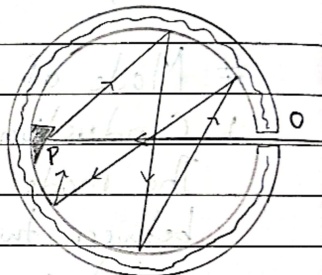
Ferry's black body is made for experimental verification. This is made with closed double walled hollow sphere having a tiny hole 'O' and Conical projection 'P' opposite to hole as shown in the figure below:
There is a projection 'P' which reflect the incident radiation passing through hole 'O' and reflections occur in inner wall and almost all radiation is absorbed into the wall.
When the black body is heated, absorbed radiation emerges from the hole 'O'.
Stefan's Boltzmann's Law
It states that "The heat radiation emitted per second per unit area by the perfectly black body is the directly proportional to the fourth power of its temperature."
If 'E' be the amount of heat radiation emitted by a perfectly black body per second per unit area and T be its temperature. Then according to Stefan's Boltzmann's Law;
\( E \propto T^{4} \)
or, \( E = \sigma T^{4} \)
where, \( \sigma \) is proportionality constant called Stefan-Boltzmann constant and its value is equal to \( 5.67 \times 10^{-8} Wm^{-2} K^{-4} \)
If 'e' be the emissivity of a body then Stefan's Boltzmann's law can be written as,
\( E = e\sigma T^{4} \)
Again,
If a body at temperature 'T₁' is enclosed by another body at temperature 'T₂' then Stefan's Boltzmann's law can be written as,
\( E = e. \sigma (T_{1}^{4} - T_{2}^{4}) \)
Numerical Problems
1. Radiant power of a spherical blackbody
A Spherical blackbody of radius 5 cm has its temper 127°C and its emissivity is 0.6. Calculate its radiant power. \( (\sigma = 5.67 \times 10^{-8} Wm^{-2} K^{-4}) \)
Solution:
Radius (R) = 5 cm = 5 × 10^{-2} m
Temperature (T) = 127°C = 400 K
Radiant Power (P) = ?
Emissivity (e) = 0.6
Stefan's Constant (\( \sigma \)) = 5.67 × 10^{-8} Wm^{-2} K^{-4}
Now, from Stefan's Law,
\( P = A e\sigma T^{4} \)
\( = 4\pi R^{2} e \sigma T^{4} \)
\( = 4 \times 3.14 \times (5 \times 10^{-2})^{2} \times 0.6 \times 5.67 \times 10^{-8} \times (400)^{4} \)
= 27.36 W
2. Power loss from a black body
Estimate the power loss through unit area from a per black body at \( 327^{\circ} \)C to the surrounding environment \( 27^{\circ} \)C. \( [\sigma = 5.67 \times 10^{-8} W m^{-2} k^{-4}] \)
Solution:
Temperature of black body (T) = 327°C = 600k
Area(A) = 1m²
Temperature of Surrounding (To) = 27°C = 300k
Stefan's Constant (\( \sigma \)) = 5.67 × 10^{-8} Wm^{-2} k^{-4}
Power loss per unit area (p) = ?
from Stefan's law,
\( P = \sigma A (T^{4} - T_{0}^{4}) \)
= 5.67 × 10^{-8} (600^{4} - 300^{4})
= 6889.05 W/m²
Hence, required power loss through unit area is 6889.0
3. Rate at which ice melts in a wooden box
Estimate the rate at which ice would melt in a wooden box 2.5 cm thick of inside measurement 100 cm × 60 cm × 40 cm assuming that the external temperature is 35°C and thermal conductivity of wood is 0.168 W·m⁻¹·K⁻¹.
Solution:
Thickness of wooden box (x) = 2.5 cm = 2.5 × 10^{-2} m
Internal temperature (\( \theta_{2} \)) = 0°C
Total surface area of the walls of the wooden box is,
\( A = 2(Lb + bh + Lh) \)
= 2 (100 × 60 + 60 × 40 + 40 × 100) cm²
= 24800 cm² = 2.48 m²
External temperature (\( \theta_{1} \)) = 35°C
Thermal conductivity of wood (k) = 0.168 Wm^{-1} K^{-1}
Here rate at which wooden box takes heat from surroundings = rate at which ice takes heat from box
or, \( \frac{kA(\theta_{1}-\theta_{2})}{x}=\frac{d}{dt}(mL) \)
or, \( L \frac{dm}{dt} = \frac{kA(\theta_{1}-\theta_{2})}{x} \)
or, \( \frac{dm}{dt} = \frac{kA(\theta_{1}-\theta_{2})}{xL} \)
\( =\frac{0.168 \times 2.48 (35 - 0)}{336000 \times 2.5 \times 10^{-2}} \)
\( =1.74 \times 10^{-3} kg/s \)
Hence, ice would melt at the rate of \( 1.74 \times 10^{-3} kg/sec \).
4. Ratio of energy radiated by a filament
What is the ratio of the energy per second radiated by the filament of a lamp at 2500 K to that radiated at 2000 K, assuming the filament is a black body radiator.
Solution:
Upper temperature of filament lamp (\( T_{1} \)) = 2500K
Lower temperature of filament lamp (\( T_{2} \)) = 2000K
Power radiated by lamp at 2500K = \( P_{1} \) = ?
Power radiated by lamp at 2000K = \( P_{2} \)
We know,
\( P_{1} = A \sigma T_{1}^{4} \) —①
\( P_{2} = A \sigma T_{2}^{4} \) —②
Dividing equation (1) by (2) we get;
\( \therefore \frac{P_{1}}{P_{2}} = \frac{A \sigma T_{1}^{4}}{A \sigma T_{2}^{4}} \)
\( = \left( \frac{T_{1}}{T_{2}} \right)^{4} \)
\( = \left( \frac{2500}{2000} \right)^{4} = 2.45 \)
Hence, the ratio of energy per second radiated is 2.45
5. Heat loss from a man's hand
Assuming that, the thermal insulation provided by a woolen glove is equivalent to a layer of quiescent air 3 mm thick, determine the heat loss per minute from a man's hand of Surface area \( 200 \, cm^2 \) on a winter day. When the atmospheric air temperature is \( -3^\circ C \). The skin temperature is to be taken as \( 35^\circ C \) and thermal conductivity of air as \( 24 \times 10^{-3} \, W \, m^{-1} \, K^{-1} \).
Solution:
Thickness of air \( x = 3 \, mm \)
Area of hand \( A = 200 \, cm^2 = 200 \times 10^{-4} \, m^2 \)
Temperature of atmospheric air \( \theta_2 = -3^\circ C \)
Time duration \( t = 1 \, min = 60 \, sec \)
Thermal conductivity of air \( k = 24 \times 10^{-3} \, W \, m^{-1} \, K^{-1} \)
Heat lost per minute = ?
We know the relation:
\( \frac{dQ}{dt} = \frac{kA(\theta_1 - \theta_2)}{x} \)
\( = \frac{24 \times 10^{-3} \times 200 \times 10^{-4} [35 - (-3)]}{3 \times 10^{-3}} \)
6.08 J/s
Now,
Heat lost per minute \( = \left( \frac{dQ}{dt} \right) \times 60 \)
\( = 6.08 \times 60 = 364.8 \, J \)
Hence, the heat lost per minute is 364.8 J.
6. Heat lost by a closed vessel
A closed vessel contains water at \( 75^{\circ}C \). The vessel has a surface area of \( 0.5 \, m^{2} \) and a uniform thickness of 4mm. If the outside temperature is \( 15^{\circ}C \), calculate the heat lost per minute by conduction. (Thermal conductivity of metal = \( 400 \, W \, m^{-1} \, K^{-1} \))
Solution:
Surface Area of vessel (A) = \( 0.5 \, m^{2} \)
Change in temperature (\( \Delta\theta \)) = \( 60^{\circ}C \)
Time taken (t) = 1 min = 60 sec.
Thermal conductivity of metal (k) = \( 400 \, W \, m^{-1} \, K^{-1} \)
Thickness of vessel (x) = 4mm = \( 4 \times 10^{-3} \, m \)
We know,
\( Q = \frac{kA(\Delta\theta)t}{x} \)
\( = \frac{400 \times 0.5 \times 60 \times 60}{4 \times 10^{-3}} \)
\( = 1.8 \times 10^{8} \) Joule
7. Rate of melting of ice along a bar
A bar 0.2 m in length and a cross-section area \( 2.5 \times 10^{-4} \) m\( ^{2} \) is ideally lagged. One end is maintained at 373 k while other end is maintained at 273 k by immersing in melting ice. Calculate the rate at which the ice melts owing to the flow of heat along the bar. [Thermal conductivity of the bar = 400 W m\( ^{-1} \) k\( ^{-1} \)], [Latent heat of fusion = \( 3.4 \times 10^{5} \) J kg\( ^{-1} \)]
Solution:
Length of bar \( x = 0.2 \, m \)
Cross section area of bar (A) = 2.5 × 10^{-4} m^{2}
Initial temp of bar end (\( \theta_{1} \)) = 273 K
Temp. of another bar end (\( \theta_{2} \)) = 373 K
Latent heat of fusion (L_f) = 3.4 × 10^{5} J kg^{-1}
Thermal conductivity of bar = 400 W m^{-1} K^{-1}
Rate of melting of ice (\( \frac{m}{t} \)) = ?
we know,
\( Q = \frac{kA(\theta_{2}-\theta_{1})t}{x} \)
\( = \frac{400 \times 2.5 \times 10^{-4} \times 100 \times t}{0.2} \)
=50t
We know, The heat required by ice to melt is given by:
\( Q = m L \)
\( 50t = m L \)
or, \( \frac{m}{t} = \frac{50}{L} \)
\( \therefore \frac{m}{t} = \frac{50}{3.4 \times 10^{5}} = 1.47 \times 10^{-4} kg/s \)
8. Temperature of lower surface of a pot
A pot with a steel bottom 8.5mm thick rests on a hot stove. The area of the bottom of the pot is 0.15m². The water inside the pot is at 100°C and 390 gm of water is evaporated every 3 minutes. Find the temperature of the lower surface of the pot which is in contact with the stove. \( [k = 50.2 \, W \cdot m^{-1} \cdot K^{-1}] \) \( [L_v = 2.26 \times 10^{6} \, J/kg] \)
Thickness of steel bottom (x) = 8.5 mm = 8.5 × 10^{-3} m
Area of bottom of pot (A) = 0.15 m^{2}
Temperature of lower portion of pot (\( \theta_{1} \)) = ?
Temperature of upper portion of pot (\( \theta_{2} \)) = 100°C
Mass of water evaporated (M) = 390 g = 0.39 kg
Time taken to get evaporated (t) = 3 min = 180 sec
Conductivity of steel (k) = 50.2 W m^{-1} K^{-1}
Latent heat of vaporization (L_v) = 2.26 × 10^{6} J/kg
we know, heat transferred by the pot is given by:
\( Q = \frac{kA(\theta_{1} - \theta_{2})t}{x} \)
Also, Heat required by water to get evaporated is given by;
\( Q = M L_{V} \)
Equating,
\( ML_{V}=\frac{kA(\theta_{1}-100)t}{x} \)
\( 0.39\times2.26\times10^{6}=\frac{50.2\times0.15(\theta_{1}-100)\times180}{8.5\times10^{-3}} \)
\( \therefore \theta_{1} = 105.5^{\circ}C \)
Hence, the lower temperature of pot is \( 105.5^{\circ}C \).
9. Energy radiated by the Sun
The Sun is a black body of surface temperature about 6000 K. If the Sun radius is \( 7 \times 10^{8} \) m, calculate the energy radiated per second.
Solution:
Given, Surface temperature (\( T \)) = 6000 k
Radius of Sun (\( R \)) = \( 7 \times 10^{8} \) m
Stefan's Constant (\( \sigma \)) = \( 5.67 \times 10^{-8} Wm^{-2} K^{-4} \)
Energy radiated (\( P \)) = ?
We know,
\( P = A \sigma T^{4} = 4\pi R^{2}\sigma T^{4} \)
\( = 4 \times \frac{22}{7} \times (7 \times 10^{8})^{2} \times 5.67 \times 10^{-8} \times (6000)^{4} \)
\( = 4.44 \times 10^{26} W \)
10. Temperature of the Sun from radiation rate
If each Sq.cm of Sun Surface radiates energy at the rate of \( 6.3 \times 10^{3} J/s \cdot cm^{-2} \) and the Stefan's constant is \( 5.7 \times 10^{-8} Wm^{-2} K^{-4} \). Calculate the temperature of the Sun.
Solution:
Given, Energy radiated (\( E \)) = \( 6.3 \times 10^{3} J s^{-1} cm^{-2} = 6.3 \times 10^{7} J/s m^{-2} \)
Stefan's Constant (\( \sigma \)) = 5.7 × 10^{-8} W m^{-2} k^{-4}
Temperature of Sun (T)?
We know,
\( E = \sigma T^{4} \)
\( 6.3 \times 10^{7} = 5.7 \times 10^{-8}T^{4} \)
\( T^{4} = 1.105 \times 10^{15} \)
\( T = 5765.5k \) or \( 5493^{\circ}C \)
11. Value of Stefan's Constant
Sphere of radius 2 cm with a black surface is cooled and then suspended in a large evacuated enclosure of the black walls of which are maintained at 27°C. If the rate of change of thermal energy of the sphere is 1.85 J/s when its temperature is −73°C. Calculate the value of Stefan's Constant.
Solution:
Radius of sphere (r) = 2cm = 2×10^{-2}m
Temperature of black walls (\( T_{1} \)) = 27°C = 300K
Temperature of sphere (\( T_{0} \)) = −73°C = 200K
Power (p) = 1.85 J s^{-1}
Stefan's Constant (\( \sigma \)) = ?
We know,
\( P = A \sigma (T_1^4 - T_0^4) \)
\( P = 4\pi r^2 \sigma (T_1^4 - T_0^4) \)
\( 1.85 = 4 \times \frac{22}{7} \times (2 \times 10^{-2})^2 \sigma \left[ (300)^4 - (200)^4 \right] \)
\( \therefore \sigma = 5.67 \times 10^{-8} \, Wm^{-2} \, K^{-4} \)
12. Working temperature of electric wire
The element of 1 kW electric wire has a surface area of \( 0.006 \, m^2 \). Estimate its working temperature (\( \sigma = 5.7 \times 10^{-8} \, Wm^{-2}K^{-4} \)).
Solution:
Power (p) = 1 kW = 1000 W
Area (A) = 0.006 m²
Stefan's Constant (\( \sigma \) = 5.7 × 10⁻⁸ W·m⁻²·K⁻⁴)
Working temperature (T) = ?
We know,
\( P = A \sigma T^{4} \)
or, \( 1000 = 0.006 \times 5.7 \times 10^{-8} \times T^{4} \)
or, T⁴ = 2.92 × 10¹²
∴ T = 1307.2 k
13. Temperature of colder body
The ratio of radiant energy radiated per unit surface by two bodies is 16:1. The temperature of hotter body is 1000 k. Calculate the temperature of other body.
Solution:
Area (A) = 1 m²
Temperature of hotter body (T₁) = 1000 k
Temperature of colder body (T₂) = ?
We know,
\( E_1 = A \sigma T_1^4 \)
Also, for colder body;
\( E_2 = A \sigma T_2^4 \)
By question:
\( \frac{16}{1} = \frac{\sigma (1000)^4}{\sigma T_2^4} \)
\( \therefore T_2 = 500 k \)
14. Cork and glass composite sheet
One face of sheet of cork 3mm thick is placed in contact with 1 face of sheet of glass 5mm thick, both sheets being 20 cm². The outer face of these square composites sheet are maintained at 100°C and 20°C, the glass being at higher temp. find;
i. The temperature of glass cork interface
ii. The rate at which heat is conducted across the sheet.
\( (K_c = 6.3 \times 10^{-2} Wm^{-1} K^{-1}, K_G = 7.2 \times 10^{-1} W m^{-1} K^{-1}) \)
Solution:
Thickness of Cork \( x_{c} = 3mm = 3 \times 10^{-3}m \)
Thickness of glass \( x_{g} = 5mm = 5 \times 10^{-3}m \)
Area of both sheets (A) = 20cm² = 2 × 10⁻³m²
Outer face temperature of glass \( \theta_{1} = 100°C = 373K \)
Outer face temperature of Cork \( \theta_{2} = 20°C = 293K \)
Temperature of interface \( \theta = ? \)
We know,
1. Rate of heat flow from glass = Rate of heat flow from Cork
or, \( \frac{K_{g} A}{x_{g}} (\theta_{1} - \theta) = \frac{K_{c} A}{x_{c}} (\theta - \theta_{2}) \)
or, \( \frac{7.2 \times 10^{-1}}{5 \times 10^{-3}} (373 - \theta) = \frac{6.3 \times 10^{-2}}{3 \times 10^{-3}} (\theta - 293) \)
\( \theta = 362.816K \) or \( 89.81^{\circ}C \)
Again,
Putting the value of \( \theta \) in equation above i.e.
\( \frac{Q}{t} = \frac{k_{g}A(\theta_{1}-\theta)}{x_{g}} \)
\( = \frac{7.2 \times 10^{-1} \times 2 \times 10^{-3} (373 - 362.81)}{5 \times 10^{-3}} \)
= 2.93 J/s
15. Thermal conductivity of a metal bar
One end of a 0.5m long metal bar is in steam and other in contact with ice. If \( 20 \times 10^{-3} kg \) of ice melts per minute. What is the thermal conductivity of metal. [cross-section area of bar = \( 5 \times 10^{-4} m^{2} \) and Latent heat of ice = 80 kcal/kg]
Solution:
Cross-sectional area of bar (A) = \( 5 \times 10^{-4} m^{2} \)
Mass of ice (M) = \( 20 \times 10^{-3} kg \)
Length of metal bar (x) = 0.5 m
Initial tempt. of steam (\( \theta_{2} \)) = 100°C
Initial tempt. of ice (\( \theta_{1} \)) = 0°C
Latent heat of ice = 80 kcal/kg = \( 80 \times 10^{3} \times 4.2 = 3.36 \times 10^{5} \) J/kg
Time taken (t) = 1 min = 60 sec.
We know,
\( Q = \frac{kA(\theta_{2} - \theta_{1})t}{x} \)
\( Q = \frac{k \times 5 \times 10^{-4} (100 - 0) \times 60}{0.5} = 6k \)
Now, Heat required by ice to melt is given by;
\( Q = ML \)
\( 6k = 20 \times 10^{-3} \times 3.36 \times 10^{5} \)
\( k = 1120 Wm^{-1}K^{-1} \)
16. Temperature at joint of aluminium and brass rod
11 A rod 1.3m long consist of a 0.8m length of aluminium joint end to end to a 0.5m length of brass. The free end of the aluminium section is maintained at 150°C and the free end of the brass piece is maintained at 20°C. No heat is lost through the side of the rod. At steady state. What is the temperature at the point where two metals are joint. [ \( k_{Al} = 205 Wm^{-1} k^{-1} \), \( k_{B} = 109 Wm^{-1} k^{-1} \)]
$$ 150^{\circ}C \leftarrow Al \quad Br \rightarrow 20^{\circ}C;\ \theta=? $$
Solution:
Length of Aluminium rod \( (x_{A}) = 0.8 m \)
Length of Brass rod \( (x_{B}) = 0.5 m \)
Temperature of aluminium end \( (\theta_{2}) = 150^{\circ}C \)
Temperature of Brass rod end \( (\theta_{1}) = 20^{\circ}C \)
Conductivity of Al \( (k_{A}) = 205 W m^{-1} k^{-1} \)
Conductivity of Brass \( (k_{B}) = 109 W m^{-1} k^{-1} \)
Let '\(\theta\)' be the temperature of the joint.
We know, At steady state
Rate of conductivity of Al = Rate of conductivity of Brass
i.e. \( \left(\frac{Q}{t}\right)_{A} = \left(\frac{Q}{t}\right)_{Br} \)
\( \frac{k_{A} A (\theta_{2}-\theta)}{x_{A}} = \frac{k_{B} A (\theta-\theta_{1})}{x_{B}} \)
\( \frac{205}{0.8} (150-\theta) = \frac{109}{0.5} (\theta-20) \)
\( \therefore \theta = 90.2^{\circ}C \)